
Enterprise Crowdsourcing: Leveraging Social Objects and Indirect Participation
Designing crowdsourcing community for the enterprise
This paper presents design principles and incentive models for enterprise crowdsourcing at IBM, focusing on a massive-scale translation task across 10 language pairs. The authors introduce the distinction between "direct" and "indirect" crowdsourcing to optimize participation, reaching a target of 1 million words per language pair within a year.
TL;DR
Building a crowdsourcing community within a corporation is fundamentally different from public platforms like Mechanical Turk. This paper by IBM Research details how they bypassed the need for cash incentives by identifying "Social Objects" (what employees care about) and creating an "Indirect Crowdsourcing" framework. This allowed them to collect millions of words for machine translation by tapping into the 90% of users who typically "lurk."
Background: The Firewall Challenge
Crowdsourcing is usually associated with the "Wild West" of the internet: micro-payments for micro-tasks. However, for a company like IBM, the crowd is limited to its 400,000 employees. You cannot scale the crowd indefinitely, and you cannot always give out cash for every internal contribution. The authors noticed that while public crowds are driven by extrinsic cash, enterprise crowds are often driven by Social Objects—values like global impact, personal development, or professional recognition.
Problem: The 1-9-90 Participation Inequality
In most online communities, participation follows a rigid hierarchy:
- 1% Creators: Actively generate content.
- 9% Refiners: Edit and comment.
- 90% Lurkers: Consume but do not contribute.
For a task like translating 10 million words, relying only on the 1% (the "Creators") is a recipe for failure.
Methodology: Direct vs. Indirect Crowdsourcing
The core innovation in this paper is the architectural split between two participation modes:
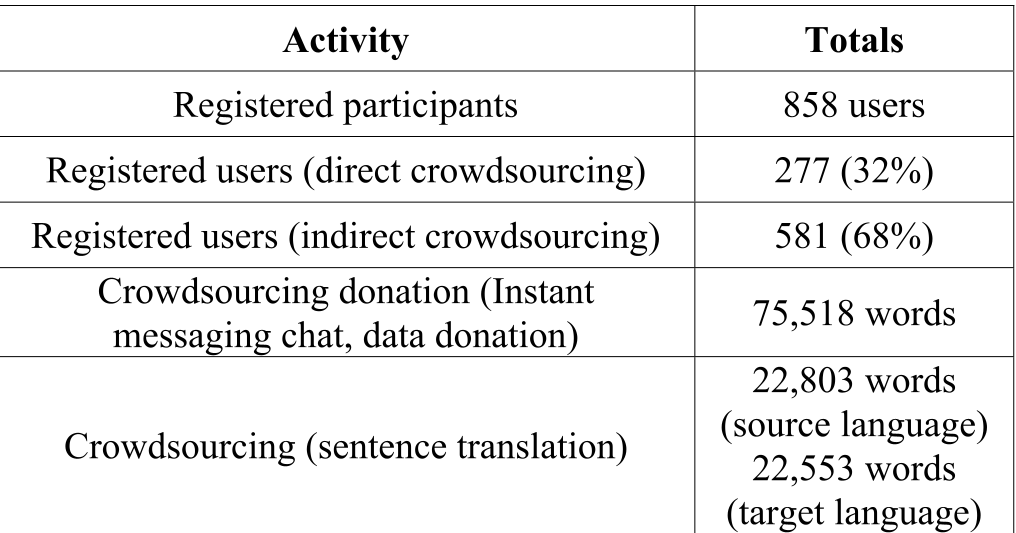
- Direct Crowdsourcing: Users log in specifically to translate sentences (High cognitive load).
- Indirect Crowdsourcing: Users perform their daily jobs using corporate tools (IM, document editors). If they use these tools to translate a chat or a file, the system asks permission to save a copy for the research database (Low cognitive load).

By embedding the "ask" into existing workflows, the authors successfully converted the "90% Lurkers" into active data donors.
Experiments: Testing Incentives
The authors tested three hypotheses to see what actually motivates employees:
- H1 (Build it and they will come): Only 9% were creators. The "portal-only" approach failed to break the 1-9-90 rule.
- H2 (Internal Hype/Caring about the Brand): Increased registered users to 858 in one week, with creators jumping to 32%. However, this participation dropped as soon as the internal marketing campaign ended.
- H3 (Extrinsic Rewards - Tangible Goods): Offering iPods, telescopes, and shirts stabilized the creator rate at 28% and yielded high-quality direct translations.
Key Results Comparison
| Metric | H1 (Portal Only) | H2 (Social/Brand Campaign) | H3 (Tangible Prizes) |
|---|---|---|---|
| Creator % | 9% | 32% | 28% |
| Words Translated | 4,000 (6 months) | 22,803 (1 week) | 26,326 (10 days) |
Critical Insights & Takeaways
The study proves that Social Objects are the "gripping surface" of a community. If the task doesn't resonate with an employee's values (like global issues or professional growth), they won't participate voluntarily.
Key Learnings:
- Efficiency of Indirection: Indirect crowdsourcing (background collection) outperformed direct efforts by orders of magnitude (2 million words vs. 4 thousand words).
- Beyond Cash: Tangible merchandise is a highly effective extrinsic motivator in a corporate setting, often more so than pure altruism or salary-linked bonuses.
- Sustainability: Marketing "hype" creates a temporary spike, but long-term participation requires a mix of "fun/interest" and "tangible rewards."
Conclusion
This work is a foundational roadmap for any organization looking to leverage its internal workforce for data labeling or knowledge creation. By focusing on Indirect Crowdsourcing, organizations can effectively bypass the participation bottleneck that kills most community-driven projects.
Article by Senior Academic Tech Editor