
Designing Fairly Fair Classifiers: Bridging Economics and Machine Learning
Designing Fairly Fair Classifiers Via Economic Fairness Notions
The paper introduces "Group Envy-Freeness" and "Group Equitability," two novel fairness relaxations derived from microeconomic resource allocation theories. These notions provide a unifying framework that generalizes classical binary fairness definitions (like Equalized Odds) to multiclass classification settings while incorporating individual utility functions.
TL;DR
Researchers from the University of Toronto have bridged a century-old gap between microeconomics and AI. By repurposing the economic concepts of Envy-Freeness and Equitability, they created a framework that treats fairness as a matter of "utility" (what individuals actually want) rather than just "parity" (mathematical equality). Their method generalizes classic fairness metrics to multiclass settings and provides a robust way to train classifiers that balance profit with social equity.
Background: The Crisis of Definitions
The ML community is currently drowning in fairness definitions—Statistical Parity, Equal Opportunity, Calibration, etc. The problem? Most are restricted to simple "Yes/No" decisions (like loan approvals) and are often mathematically incompatible.
More importantly, traditional metrics ignore utility. If a "fair" algorithm gives everyone an outcome they hate, is it actually fair? Economics has studied this via "Fair Resource Allocation" for decades. This paper asks: can we use these economic "gold standards" to fix ML?
The Core Insight: From Individuals to Groups
In economics, Envy-Freeness (EF) means no person prefers someone else’s bundle over their own. This is usually too strict for ML (e.g., in a loan setting, everyone "envies" the person who got the loan).
The authors propose a Group-level relaxation:
- Group Envy-Freeness: On average, individuals in Group A should not prefer the outcomes assigned to Group B more than their own.
- Group Equitability: The average utility (satisfaction) should be equal across all protected groups.
This shift is powerful because it allows for asymmetric preferences. In targeted advertising, a sports fan doesn't "envy" a tech geek's ads, even if the tech ads are "higher quality" by some objective metric.

Methodology: Can it Generalize?
A major contribution of this paper is the mathematical proof that these notions generalize. Using Rademacher Complexity and the Natarajan Dimension, the authors prove that if an algorithm is fair on a training set, it will remain fair on unseen populations.
They specifically focus on Linear One-vs-All Classifiers. They demonstrate that even with exponentially many groups to protect, we only need a polynomial amount of data to guarantee fairness.
Paradoxes and Tradeoffs
The paper doesn't sugarcoat the difficulty of fair AI. Through theoretical "worst-case" analysis, they find:
- The Price of Fairness: Imposing strict fairness can, in the worst case, lead to a massive spike in loss (error).
- The Danger of Laziness: Simply minimizing loss (ERM) without fairness constraints leads to "Highly Unfair" solutions where envy between groups is maximized.
Experimental Battleground: Targeted Advertising
The authors tested their framework against standard Empirical Risk Minimization (ERM).
Key Findings:
- ERM-GroupEF (Green in the charts below) managed to slash envy violations by 50% while maintaining much better "Loss" profiles than naive welfare-maximizing approaches.
- Scalability: Unlike prior individual-level envy-free models, the group-based model scales to large datasets, making it viable for real-world production systems.
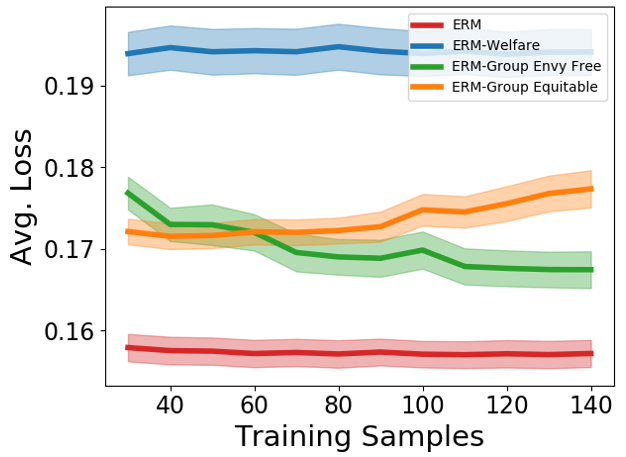 Figure: Comparison of Loss and Fairness across different models. Notice how ERM-GroupEF (Green) provides the best "middle ground."
Critical Insight & Conclusion
This paper is a vital "re-centering" of the fairness conversation. By proving that Equalized Odds and Statistical Parity are actually just special cases of Group Envy-Freeness, it provides a unified mathematical theory for the field.
Limitations: The model requires knowing (or estimating) user utility functions. If your utility model is wrong, your fairness guarantee is hollow.
Future Work: The next frontier is "Decoupled Classifiers"—training different models for different groups without introducing new forms of discrimination. As AI moves into more complex, multiclass domains (like generative AI and recommendation engines), these economic notions will likely become the standard for how we define a "just" algorithm.