
Beyond the Human: Designing for Multispecies Cohabitation in the Smart City
Designing for Cohabitation: Naturecultures, Hybrids, and Decentering the Human in Design
This paper introduces a posthumanist framework for Urban Informatics and Animal-Computer Interaction (ACI), proposing "Designing for Cohabitation." By leveraging the "Big Cat Behavioral Tracking Initiative" and "The Phenology Clock," it demonstrates how decentering the human can foster more equitable urban ecosystems in the Anthropocene.
TL;DR
As urbanization encroaches on wild habitats, the "smart city" can no longer be a playground for humans alone. This paper argues for a radical shift in HCI: decentering the human to design for "cohabitation." By analyzing how we track big cats and visualize ecological rhythms, the authors show that our future cities must be built for "Naturecultures"—where technology serves both the citizen and the urban leopard.
Motivation: The End of "Pristine Nature"
For decades, urban informatics treated the city as a purely social and technological entity. Nature was something "separate," located in a distant wilderness or a manicured park. However, we have entered the Anthropocene—an epoch where human activity has permanently altered Earth’s systems.
The authors argue that the dualism between "Nature" and "Culture" is dead. In a modern city like Mumbai, leopards live in the alleys; in Los Angeles, cougars cross highways. If our designs (like bright LED kiosks or high-speed roads) ignore these residents, we aren't just failing an ethical test—we are damaging the very ecosystems that support human life.
Methodology: The Posthuman Lens
The researchers propose three critical concepts to reshape how we think about design:
- Naturecultures: The idea that nature and culture are inseparable. A bus stop is not just a human utility; it is a bird's nest, a source of light pollution for moths, and a potential site for water collection.
- Hybrids: Humans and animals are "relational achievements." We co-evolve. The genetics and behaviors of urban animals are shaped by our cities, and our cultures are shaped by them.
- Decentering the Human: This doesn't mean ignoring humans, but rather viewing the city as an assemblage of multiple standpoints—where a leopard's "user journey" is as valid as a commuter's.
Case 1: The Quantified Cat
The paper examines the use of GPS collars to track apex predators. This "quantification" of animal behavior leads to tangible architectural interventions.
 Figure 1: A Wildlife Crossing in Alberta, Canada—a "hybrid" infrastructure designed for animal movement using natural elements.
Insight: By "thinking like a leopard," designers can create Wildlife Crossings. These are not just bridges; they are naturecultural artifacts that use soil and plants to "nudge" animals away from dangerous traffic, protecting both species.
Case 2: The Phenology Clock
If tracking is about space, the Phenology Clock is about time. Phenology is the study of cyclic natural phenomena (e.g., when flowers bloom or birds migrate).
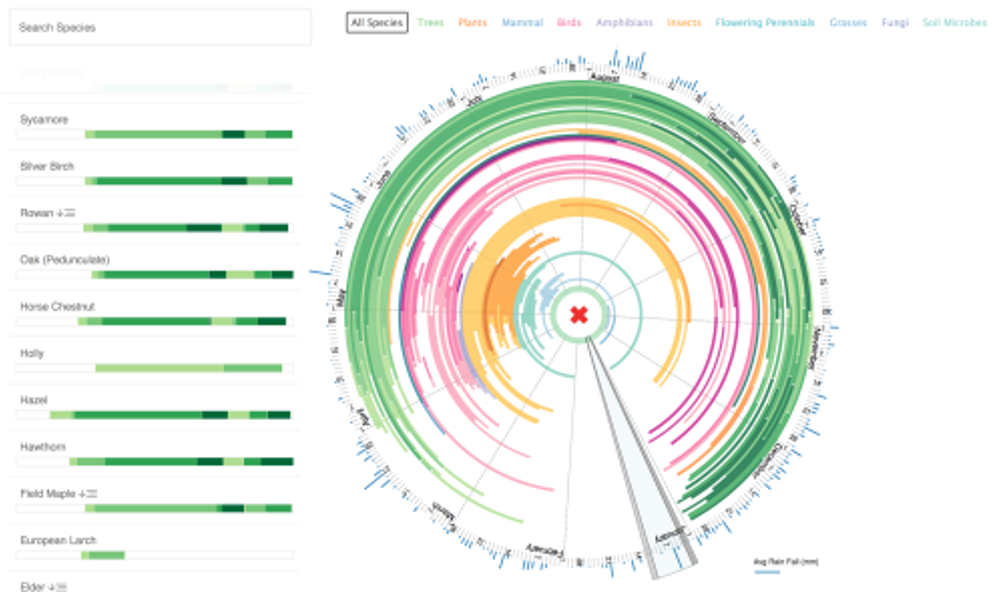 Figure 2: The London Phenological Clock—visualizing the "Earth’s calendar" through citizen science data.
Insight: This design challenges "Industrial Time." While humans live by the 9-to-5 clock, the city’s other inhabitants live by blooming cycles and soil temperatures. The Phenology Clock acts as a pedagogical tool, helping designers synchronize urban functions with ecological rhythms.
Experiments & Results: Shifting the Metric
The paper highlights that success in the Anthropocene isn't measured by "clicks" or "efficiency" alone, but by co-thriving metrics:
- Aversion of Accidents: Wildlife crossings significantly lower the frequency of vehicle-animal collisions.
- Citizen Engagement: Projects like the Nature’s Calendar use crowdsourcing (thousands of volunteers) to track biodiversity, proving that "Urban Informatics" can be a participative, multispecies effort.
- Data Resolution: Tracking reveals "idiosyncratic" behaviors—leopards in Mumbai adapt differently than cougars in Denver, requiring location-specific design rather than "one-size-fits-all" smart city solutions.
Critical Analysis & Conclusion
The "Takeaway"
The core contribution of this work is the realization that urban informatics must become biocentric. We need to move beyond "Animal-Computer Interaction" as a niche field for pets and recognize it as a fundamental requirement for sustainable urbanism.
Limitations & Future Work
While the paper provides a brilliant theoretical framework, the technical implementation remains challenging. How do we build sensors that don't disrupt animal "sense-making"? How do we resolve conflicts when animal and human interests are diametrically opposed (e.g., a leopard eating a herder's goat)?
The Future: We must design for "Collapse Informatics"—creating systems that are adaptive and resilient to the shifting patterns of a changing planet. The city of the future is not just "smart"; it is a shared sanctuary.
Editor's Note: This paper is a seminal call to action for HCI researchers to stop looking at screens and start looking at the "entanglements" of the living world around them.