
Designing for the Other ‘Hereafter’: normalising Forgetting in an Ageing World
Designing for the Other 'Hereaer': When Older Adults Remember about Forgeing
This paper explores how older adults perceive and manage "everyday forgetting" through a qualitative study of 18 independent-living seniors. It identifies a critical "internal tension" between the inevitability of memory lapses and their impact on self-identity, proposing design principles to normalize forgetting rather than just preventing it.
TL;DR
While the tech industry is obsessed with "never forgetting," this paper argues that for older adults, the experience of forgetting is an emotional minefield. By studying 18 seniors, the researchers found that acknowledging memory lapses creates a fundamental conflict with one's sense of self. The study suggests we should stop building just "reminders" and start designing "forgetting-friendly" environments that use humor, mundane objects, and mindfulness to reduce the stigma of aging.
The "Hereafter" Moment: Why Current Tech Fails Seniors
In the context of this paper, the "hereafter" isn't a religious reference—it's that common, frustrating experience of walking into a room and wondering: "What am I here after?"
Most Human-Computer Interaction (HCI) research views memory as a database problem: if a user forgets, just provide a notification. However, the authors argue this is "solving for the what" while ignoring the "why" and "how it feels." For an older adult, every alarm is a cold reminder of a declining faculty. This creates a stereotype threat where negative assumptions about failing cognition actually compromise the user's performance and self-worth.
Methodology: Peering into Everyday Lapses
The researchers combined diary studies with focus groups to capture what they call "Everyday Forgetting." They categorized lapses into:
- Prospective Memory: Forgetting future intentions (e.g., missed pills).
- Retrospective Memory: Forgetting the past (names, words like "asparagus").
- Attention Lapses: Mind-wandering (e.g., putting an ashtray in the sink instead of a coffee cup).
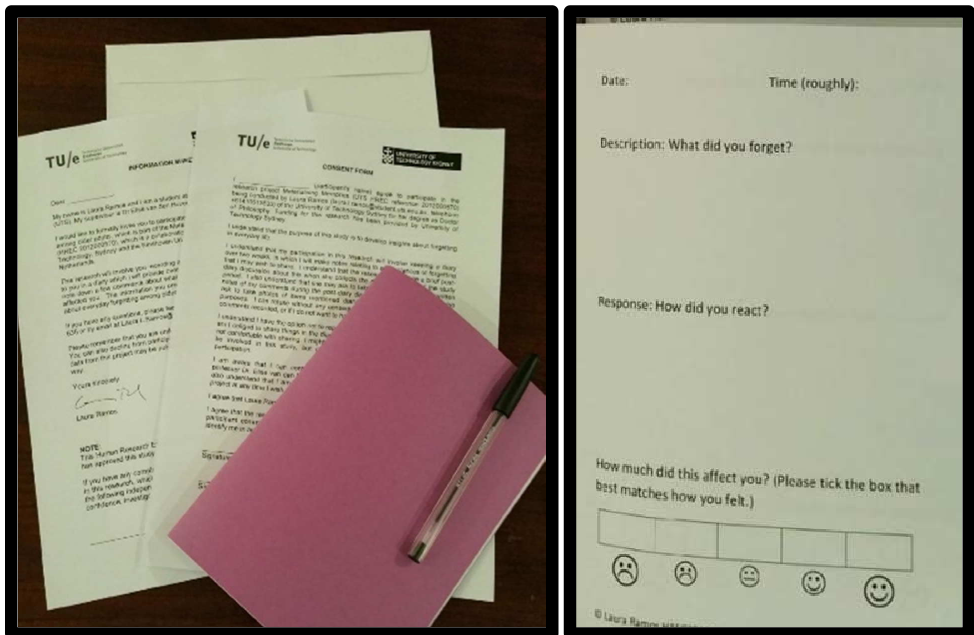 Above: The participant pack used to sensitize seniors to their own forgetting patterns.
The Psychological Conflict: Remembering about Forgetting
The most striking finding was the Internal Tension. Participants often used a Likert scale to rate forgetting as "neutral" (3/5), but their verbal descriptions were filled with "annoyance," "guilt," and "embarrassment."
The paper connects this to Autonoetic Consciousness—the idea that our memories support our self-belief. When a senior forgets a name, it doesn't just lose them a word; it threatens the "coherence of the self." To cope, many participants used humor or trivialized the events as "silly little things" to protect their identity.
From Reminders to Resentment-Free Design
The study observed that seniors are actually masters of mundane hacks. They don't use phone alarms; they use "special places."
- The China Dish: A specific bowl by the door for keys.
- Visual Prompts: Putting a canvas bag on a chair to remember tomorrow's errands.
 Above: Users prefer physical, low-tech interventions like "special places" over complex digital apps.
Strategic Recommendations for Academic and Tech Designers
- Exploit Mundane Materials: Instead of stand-alone apps, embed digital cues into everyday objects (the "special places" mentioned above).
- Acknowledge and Normalize: Systems should offer a "Forget It/OK" button for tasks, allowing users to consciously let go of overloaded schedules without guilt.
- Discrete Personalization: Memory aids must be "hidden" to avoid the social stigma of "needing help," respecting the user's vulnerability.
Conclusion
This work shifts the focus from memory as a computer function to memory as a human experience. As we age, forgetting is inevitable. The goal of design shouldn't be to create a "perfect" digital memory, but to make the inevitable "hereafter" moments a bit more liveable, humorous, and humane.