
Designing for Resilience: How Ergonomic Work Analysis Unmasks the hidden Complexity of Healthcare Triage
Designing for patient risk assessment in primary health care: a case study for ergonomic work analysis
The paper presents a qualitative case study in a primary healthcare facility in Brazil, utilizing Ergonomic Work Analysis (EWA) to evaluate patient risk assessment. It highlights the development of consistent real-work descriptions to inform the design of a Decision Support System (DSS) that reduces cognitive load and standardization gaps.
TL;DR
Health systems often treat "patient triage" as a simple algorithmic process, yet the reality is a high-stakes cognitive marathon. This study uses Ergonomic Work Analysis (EWA) to bridge the gap between prescribed protocols and the "messy" reality of clinical work, proposing a Decision Support System (DSS) designed to offload memory and stabilize risk assessment in a high-pressure Brazilian clinic.
The "Work-as-Imagined" vs. "Work-as-Done" Gap
The core tension in healthcare design is the assumption that if a professional is well-trained and follows a protocol, the system is safe. However, this paper argues that work is inherently underspecified.
In the studied Rio de Janeiro clinic, practitioners don't just follow the Manchester Triage Scale; they navigate a sea of tacit knowledge, socio-economic context, and environmental noise. When the system fails, managers often blame "lack of training," but the authors found the real culprit: a massive Cognitive Mental Workload that forces clinicians to rely on post-it notes and mental gymnastics to remember vital signs and patient histories.
Methodology: The EWA Spiral
The researchers didn't just hand out surveys. They stayed in the "risk assessment room" for 38 hours, using a four-phase iterative process:
- Framing: Identifying stakeholders and the "Support," "Focus," and "Accompaniment" groups.
- Global Analysis (EAMETA tool): Quantifying demands across space, furniture, tasks, and cognition.
- Operation Modeling: Creating detailed flowcharts of how triage actually happens (and how it varies).
- Validation: Negotiating findings with clinic managers to ensure recommendations are feasible.
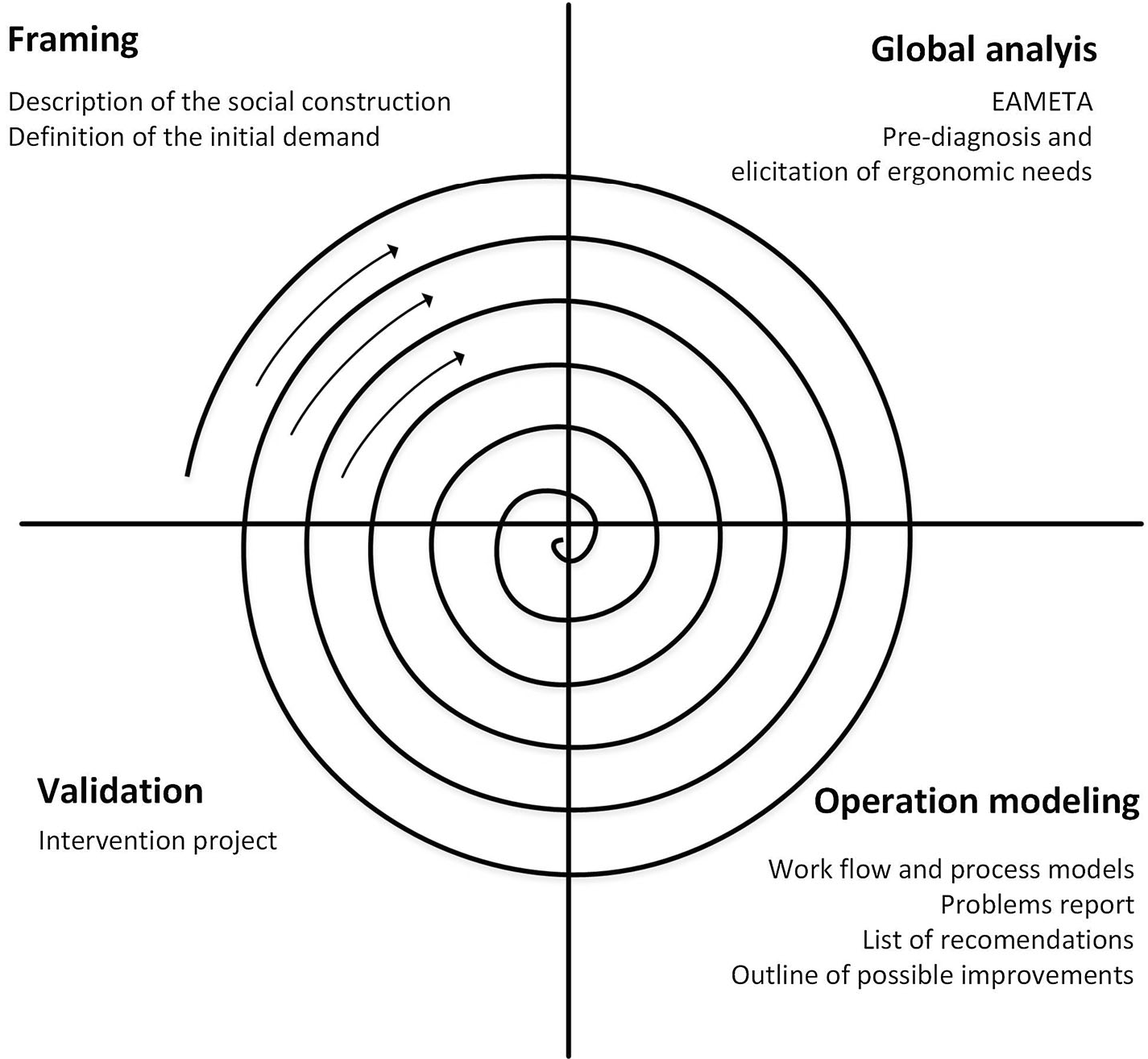 Figure: The iterative four-phase approach to Ergonomic Work Analysis.
The Friction Point: Cognitive Overload
The EAMETA results were striking. While physical environment and equipment received decent scores, Cognitive Demands (Attention, Memory, Decision-making) scored a bottom-tier 1.0.
Clinicians were found to be:
- Memory-Heavy: Tracking temperature, BP, and family history manually because the software didn't have the right fields.
- Constantly Interrupted: Dealing with walk-ins (representing up to 76.6% of visits) and other staff seeking information.
- Inconsistent: Two different teams assigned different risk colors to identical symptoms because one was "busier" than the other—a clear sign that environmental stress was warping clinical judgment.
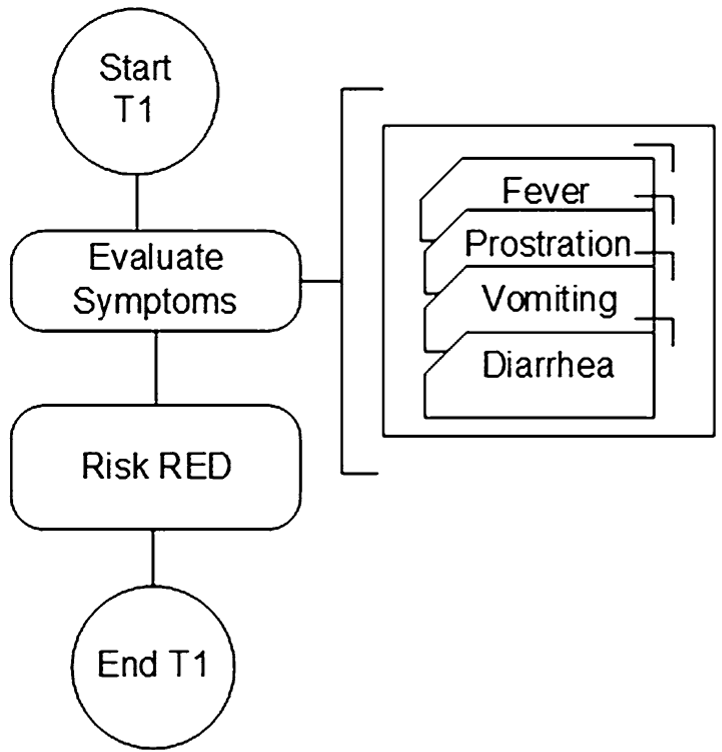 Figure: Comparative modeling showing how Team 1 and Team 2 arrive at different risk scores for similar symptom sets.
From Analysis to Design: The Support Tool
The paper concludes that simply "enforcing" protocols won't work. Instead, they recommend a Decision Support Tool with specific ecological features:
- Memory Offloading: Centralizing and storing variables so nurses don't have to keep them "in mind."
- Workflow Visualization: Making the protocol visible and interactive to guide less-experienced staff.
- Information Centralization: Converting verbal "tacit information" between teams into explicit, retrievable digital records.
Critical Insight: The Human-in-the-Loop
A vital takeaway from the validation phase was the practitioners' distrust of automation. They didn't want a computer to decide the risk; they wanted a tool to augment their perception. The authors advocate for an Ecological Interface Design, where the system provides multiple visualizations of data but leaves the final "red, yellow, or green" decision to the human expert.
Conclusion
This study serves as a masterclass in why "Human Factors" must precede software development in healthcare. By using EWA to map the hidden cognitive labor of nurses, the authors provide a blueprint for tools that actually support clinicians instead of becoming another "interruptive" obstacle in their day.