
SADD: Bridging Technology and Thanatology to Manage Our Digital Afterlife
Designing SADD: A Social Media Agent for the Detection of the Deceased
This paper introduces SADD (Social Media Agent for the Detection of the Deceased), an interdisciplinary computational framework designed to systematically identify social media accounts belonging to deceased users. Utilizing Python-based web crawling, text analysis, and sentiment evaluation on platforms like Twitter, SADD aims to facilitate digital memorialization and security.
TL;DR
As our lives increasingly migrate to the digital realm, we leave behind a growing wake of "ghost profiles." SADD (Social Media Agent for the Detection of the Deceased) is a pioneering technical framework designed to automatically identify accounts of users who have passed away. By merging web crawling, affective computing, and social network analysis, this tool helps preserve digital legacies, secure abandoned accounts from hackers, and provide closure for the bereaved.
Background: The Ghost in the Machine
In the coordinate system of modern research, SADD sits at the rare intersection of Human-Computer Interaction (HCI) and Thanatology (the study of death). While we meticulously prepare physical wills, our digital assets—photos, posts, and personal history—often float in a state of "digital limbo" upon our passing. The authors argue that current social media platforms are not "thanatosensitive"; they fail to account for the inevitable mortality of their users, leading to security risks and emotional distress for the living.
Problem & Motivation: Why Inactivity Isn't Enough
Existing platforms often struggle to distinguish between a user who has simply deleted an app and one who has died. This ambiguity leads to several pain points:
- Emotional Trauma: Automated algorithms might suggest "friending" or "celebrating a birthday" for someone who is deceased.
- Security Vulnerabilities: Unmonitored accounts are prime targets for hackers or "memorial trolls" who post inflammatory content.
- Lost History: Without proactive detection, valuable digital artifacts (intellectual property, family photos) may be deleted due to inactivity according to Terms of Service.
The authors' insight is that death leaves a "digital footprint" in the network—not through the user's own actions, but through the changed behavior of their connections and specific linguistic markers in public mentions.
Methodology: The SADD Framework
The SADD agent is built in Python, leveraging its robust libraries for social media API interaction and text processing.
The Core Architecture
The system operates through a multi-stage pipeline:
- Web Crawler: Mines public Twitter feeds for high-probability keywords (e.g., "#RIP", "in memory of").
- Text Analysis & Filtering: Uses "stop-word" removal to increase processing speed, focusing on meaningful semantic content.
- Grief Counselor & Sentiment Component: This is the "brain" of the agent. It analyzes the emotional tone of incoming posts toward a user. If the sentiment shifts toward collective mourning combined with a cessation of the user's original activity, the agent flags the account.
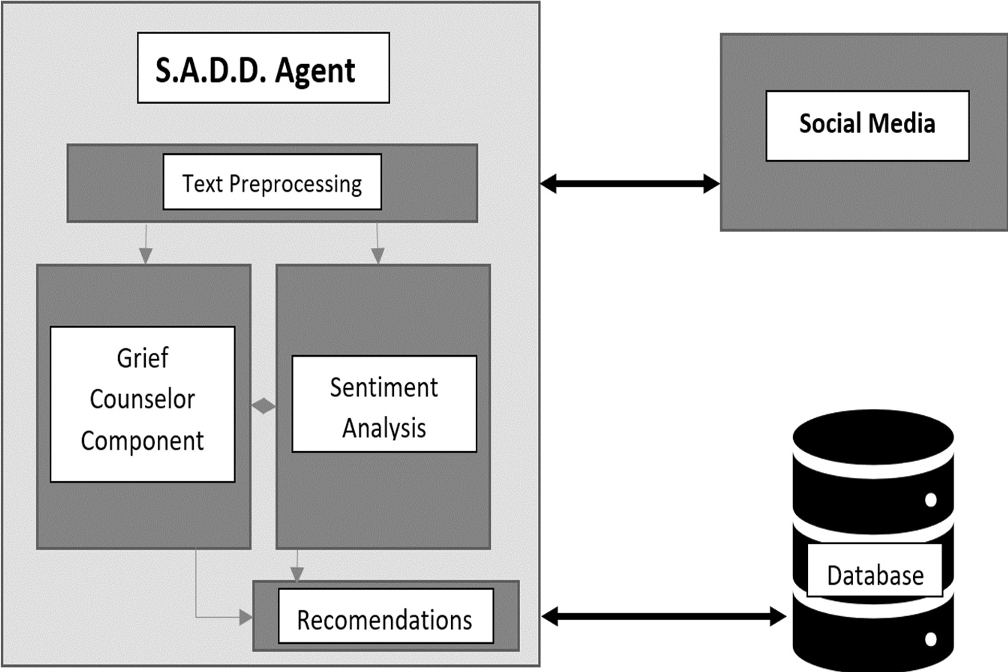 Figure 1: The SADD architecture featuring the Sentiment Analysis and Grief Counselor modules.
Experiments & User Perception
The researchers conducted a survey among technology students to gauge the "social pulse" on digital death.
Key Findings:
- Awareness vs. Action: While over 64% of participants were aware of deceased users' profiles, a staggering 92.9% had no documentation for their own digital final wishes.
- Privacy Tension: Results were split on whether families should be allowed to find "hidden" accounts. About 35% viewed it as helpful for legacy, while others saw it as a posthumous invasion of privacy.
- The "Memorial" Shift: Only 17.9% wanted their pages to remain active as-is, suggesting a preference for either deletion or formal memorialization.
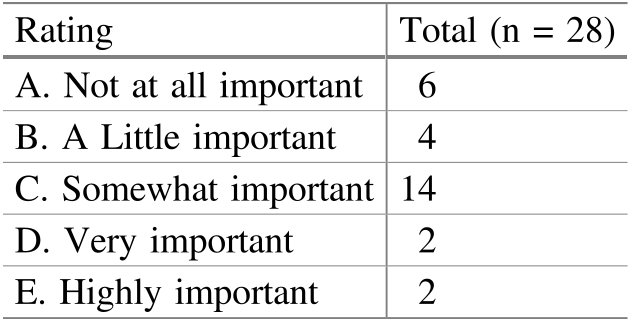 Table 2: Survey results indicating user perceptions of the importance of their digital content.
Critical Analysis & Conclusion
Takeaway: SADD represents a necessary evolution in social media management. It moves beyond simple "User/Admin" roles to include the "Bereaved" as a stakeholder in the digital ecosystem.
Limitations: The current prototype is highly susceptible to "Fake News" and celebrity hoaxes. If a thousand people tweet #RIP about a living celebrity, SADD might incorrectly flag the account. Furthermore, the reliance on public Twitter data limits its effectiveness on private platforms like Facebook or Instagram.
Future Outlook: The authors envision SADD evolving into a proactive intervention tool. By analyzing shifts in linguistic patterns, future versions might not only detect the deceased but also identify users experiencing suicidal ideation, potentially triggering life-saving interventions before the "memorial" phase is ever reached. This work places a cornerstone for a future where our digital presence is handled with as much dignity and planning as our physical one.