
DSTA: Optimizing Spatial Crowdsourcing via Destination-Aware Pathing
Destination-aware Task Assignment in Spatial Crowdsourcing
This paper introduces a Destination-Aware Task Assignment (DSTA) framework for Spatial Crowdsourcing, aimed at maximizing the total number of completed tasks. It models workers with fixed destinations and deadlines, matching them with location-sensitive tasks using a novel tree-decomposition-based exact search algorithm.
TL;DR
Spatial Crowdsourcing (SC) often assumes workers are stationary or just "around." This paper targets a more realistic scenario: workers moving toward a specific destination with a hard deadline. The authors propose a graph-decomposition approach that breaks down the massive worker-task assignment problem into independent sub-trees, solving it exactly with branch-and-bound pruning.
The Problem: The "Detour" Challenge
Most SC platforms (like Uber or TaskRabbit) think locally. However, a person driving from home to work might be willing to pick up a package or document two blocks off their path if they still arrive on time.
The technical difficulty is twofold:
- Sequence Dependency: For every worker, we must decide not just which tasks to do, but in what order.
- Global Intractability: Maximizing tasks for Worker A might steal an Essential Task from Worker B, making the global maximum lower. This creates a complex dependency web.
Methodology: Divide and Conquer via Tree-Decomposition
The core insight is that dependency is local. A worker in New York doesn't compete for tasks with a worker in Los Angeles. The authors formalize this using a Worker Dependency Graph (WDG).
1. Building the Hierarchy
If two workers can reach the same task, they are "dependent." By applying Tree-Decomposition, the authors transform the messy dependency graph into a structured tree of cliques. Each node in the tree represents a cluster of workers. If two nodes are in different branches, their workers are independent and can be optimized separately.
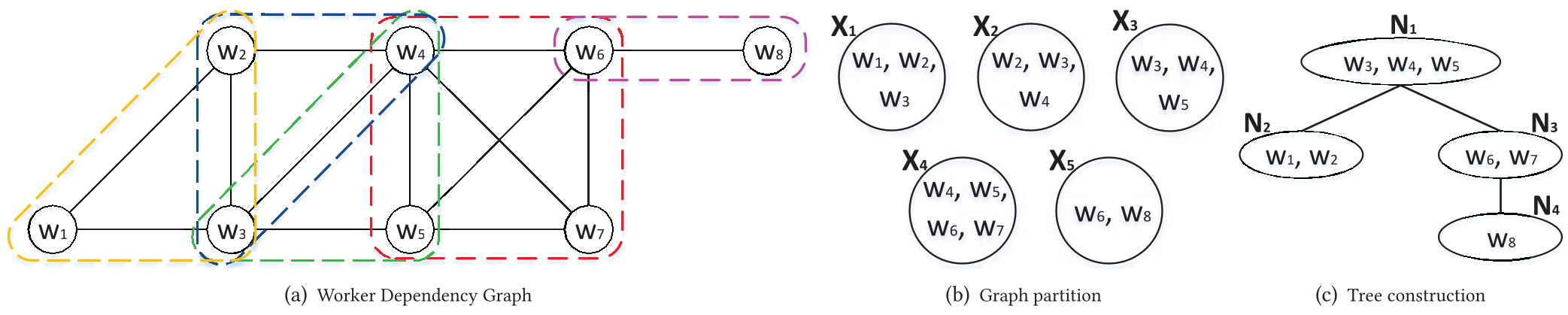 Figure: The process of turning a worker dependency graph into a balanced search tree.
2. The Search Engine (DFSearch)
To find the global optimum, the system performs a Depth-First Search. To avoid the "exponential explosion," they use two critical bounds:
- Upper Bound (UB): The theoretical maximum tasks a sub-tree could finish if there were no internal conflicts.
- Lower Bound (LB): The minimum tasks a sub-tree must finish to beat the current best global solution. If , the entire branch is pruned.
Experimental Analysis
Using real taxi trajectory data, the authors tested their algorithm against Greedy (GA) and Iterative Greedy (IGA) approaches.
Key Findings:
- Optimality: While greedy methods are fast, their performance degrades as task density increases. The proposed DSTA method always finds the 100% optimal solution.
- Scalability: By using a Balanced Tree-Construction (BTA), search depth is minimized. As shown in the results, BTA keeps CPU time low even when deadlines () are relaxed, while random tree structures () experience exponential time spikes.
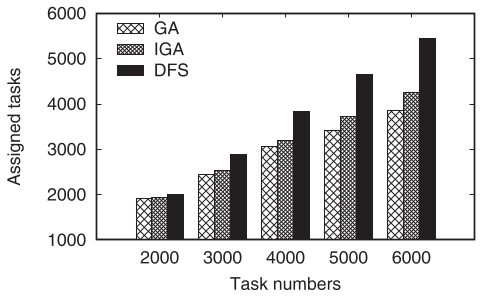 Figure: CPU time comparison showing the efficiency of optimized DFS and balanced tree structures.
Critical Insight & Conclusion
The brilliance of this work lies in recognizing that "global" problems in spatial contexts are often just collections of "local" problems connected by a few bridge nodes. By using Tree-Decomposition, the authors provide an exact solution to an NP-hard problem that actually runs in real-time.
Future Outlook: This framework is a perfect fit for the burgeoning "last-mile" delivery sector, where personal vehicles can be incentivized to act as a distributed logistics network without deviating significantly from their original intent.
Limitations
- The model assumes a "single-task assignment" (one task per worker), which might not suit high-throughput cargo scenarios.
- It relies on deterministic travel times, which doesn't account for real-world traffic volatility.