
Decoding the Tourist Mind: Why "Atmosphere" Trumps "History" in Destination Marketing
Destination Marketing and Users’ Appraisal: Looking for the reasons why tourists like a destination
This paper presents a qualitative method to analyze User-Generated Content (UGC) on TripAdvisor by treating forum posts as short argumentative texts. By reconstructing syllogisms from tourist feedback about Malta, the authors identify core "arguments" for visiting the destination and compare them against official marketing materials from Destination Management Organizations (DMO).
TL;DR
Why do people actually visit a destination? While Destination Management Organizations (DMOs) often bet on historical monuments, this study reveals that travelers are more persuaded by the "vibe"—local friendliness and authentic atmosphere. By applying Argumentation Theory to TripAdvisor posts, researchers bridged the gap between official marketing "supply" and traveler "demand."
The Problem: The Failure of Keyword Counting
In the age of Big Data, we often rely on automated tools to count word frequencies in reviews. However, knowing that a traveler mentioned "Malta" and "History" 50 times doesn't tell us why they chose it. Automated tools miss the deliberative function of communication—the logical process where a traveler weighs pros and cons to reach a decision. This paper argues that to truly understand the "Electronic Word-of-Mouth" (eWoM), we must look at reviews as logical arguments, not just a bag of words.
Methodology: The Syllogistic Approach
The authors treat short forum posts as Natural Syllogisms. In logic, a syllogism consists of a major premise, a minor premise, and a conclusion. In a travel context:
- Major Premise: A place with friendly locals is worth visiting.
- Minor Premise: Malta has very friendly locals.
- Conclusion: Malta is worth visiting.
Often, travelers leave the premises implicit. The researchers' job was to reconstruct these "invisible" steps to find the Middle Term—the specific attribute that bridges the destination to the "worth visiting" conclusion.
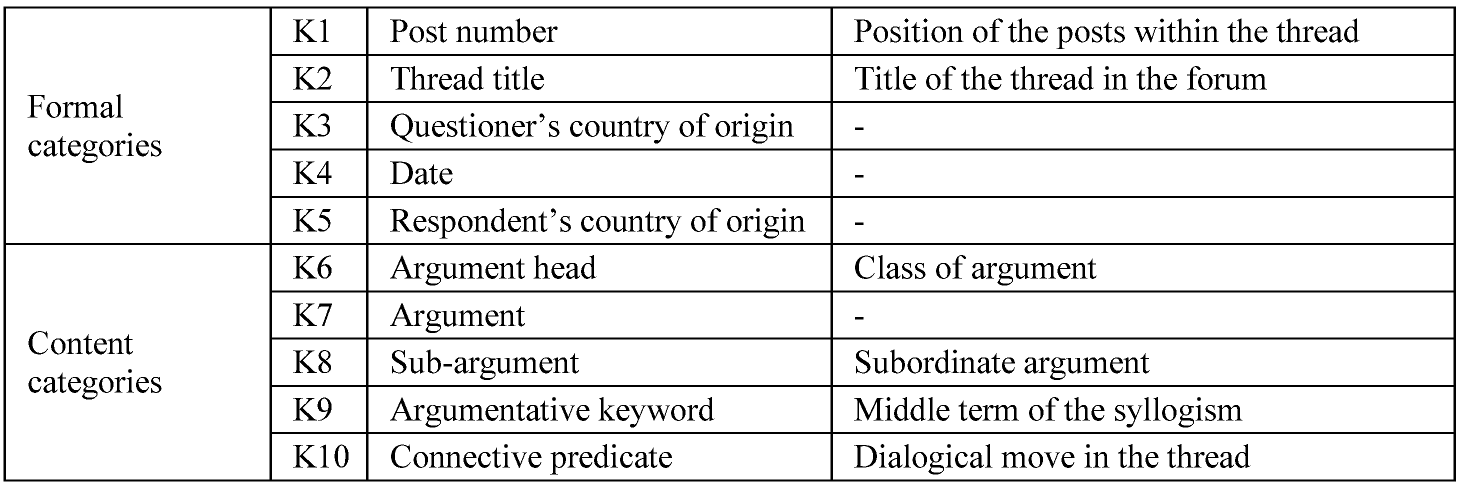 The codebook used to classify formal and content categories from the forum posts.
Key Insights: What We Say vs. What They Hear
The study analyzed a corpus of posts about the Republic of Malta and compared it to the official DMO brochure. The results highlighted a significant misalignment:
- The "History" Gap: The DMO brochure focuses heavily on Malta's 7,000-year history and megalithic temples. However, for American and British tourists, "History" only accounted for 10% of their arguments, while "Culture" (living traditions) and "Atmosphere" dominated.
- The Power of People: The most persuasive argument for visiting Malta, according to tourists, is the friendliness of the locals (22% of the Culture head). Yet, DMOs often treat this as a secondary footnote.
- Regional Divergence: European travelers (especially Italians) are "fun-directed," focusing on beaches and nightlife, whereas English speakers look for an "authentic, non-touristy" experience.
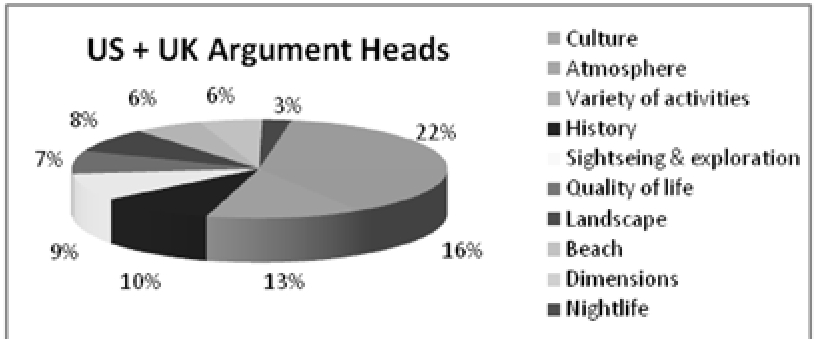 Distribution of Argument Heads for US/UK tourists on TripAdvisor.
Critical Analysis & Conclusion
Takeaway
The core contribution of this work is the shift from Sentiment Analysis (how do you feel?) to Argumentative Analysis (why should I choose this?). For marketers, this means moving away from "poetic language" and high-level descriptions toward emphasizing the specific "middle terms" that actual travelers use to convince their peers.
Limitations & Future Work
The main drawback of this method is that it is incredibly time-consuming. Reconstructing syllogisms manually is not scalable for millions of reviews. The authors suggest that future researchers could use the "middle terms" identified here as seeds for more sophisticated, semi-automated keyword searches. Furthermore, moving the focus from "Travel Fora" (quick tips) to "Travel Reviews" (longer narratives) might yield even richer argumentative data.
In the evolving landscape of AI, this paper provides a roadmap for Smarter Sentiment Analysis: one that doesn't just detect "happy" or "sad," but understands the logical architecture of a recommendation.