
Decoding Beauty: Can Machines Measure Artistic Harmony?
Can we detect harmony in artistic compositions? A machine learning approach
This paper explores the quantification of harmony in artistic compositions using a machine learning framework. By extracting a combination of hand-crafted structural features (e.g., balance, gravity, entropy) and deep-learned representations (Convolutional Autoencoders), the authors trained an SVM model that achieved 80% accuracy in distinguishing between harmonic and disharmonic grayscale images.
Executive Summary
TL;DR: Researchers from Maastricht University have successfully trained a machine learning model to distinguish "harmonic" from "disharmonic" art with 80% accuracy. By translating abstract concepts like visual "pull" and balance into mathematical features, the study demonstrates that the subjective human experience of art is not entirely random but follows underlying geometric logic.
Positioning: This work sits at the intersection of Psychological Aesthetics and Computer Vision, moving beyond simple object recognition toward the "computational understanding of abstract art."
The Challenge: Quantifying the Unquantifiable
Why is it so hard for an AI to tell if a painting "looks right"? Unlike detecting a "cat" or a "car," harmony is a global property. Previous attempts often relied on simple metrics like the Golden Ratio, but these fail to capture the complexity of human emotion and composition.
The authors identified two major hurdles:
- Feature Gap: Standard AI "eyes" (like SIFT or SURF) look for sharp edges and textures, not the "feeling" of balance.
- Subjectivity Bias: Humans are inconsistent. A rater might give an image a "4" one day and a "3" the next depending on their mood.
Methodology: Engineering the "Artistic Eye"
The researchers moved away from black-box deep learning and instead designed hand-crafted features that mirror how artists think about a canvas.
1. Structural Logic (Gravity & Balance)
The most innovative feature is Gravity. The authors treated every shape on the canvas as a physical mass, calculating the Newtonian force between them. A composition "pulls" itself together or apart, creating a measurable tension.
2. Spatial Distribution (Entropy & Two-Thirds)
They applied the Rule of Thirds—a classic photography technique—by analyzing the color distribution at four specific intersection points where human eyes naturally dwell.
3. Deep Learning Hybrid
To supplement these rules, a Convolutional Autoencoder was used to compress images into a 169-dimensional latent space, capturing patterns that humans might not even have names for.
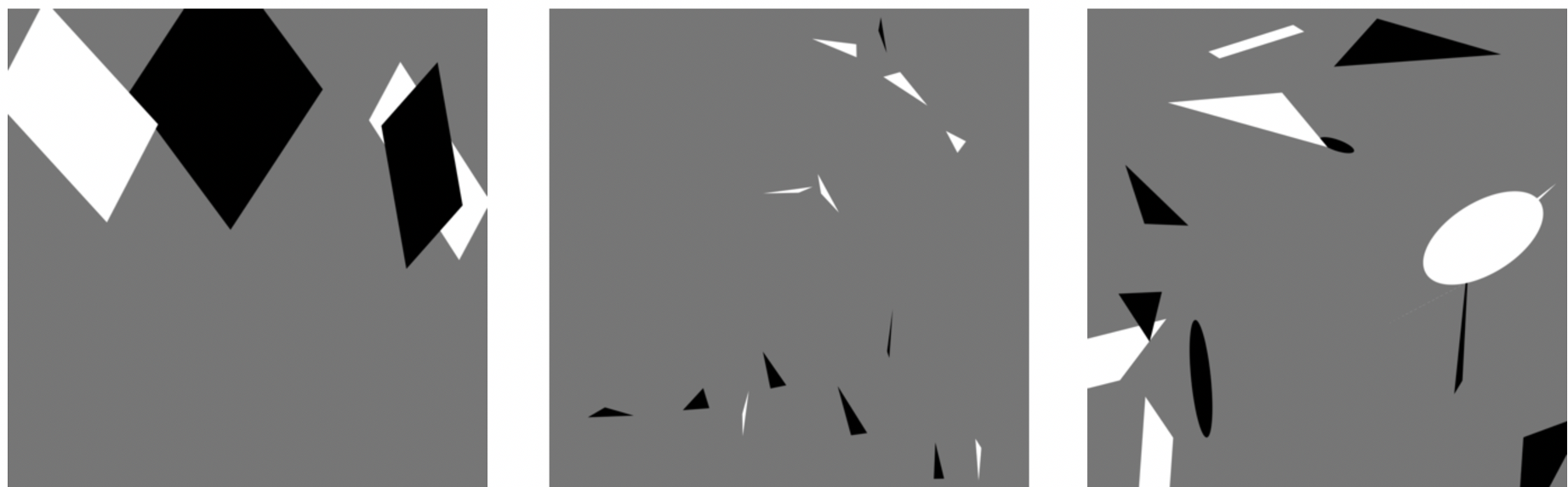 Figure 1: Examples of randomly generated compositions used to train the model.
Experiments and Results
The researchers used a dataset of 8,909 compositions. To fix the "Subjectivity Bias," they had participants re-rate images and used a statistical simulation to find a "converged" harmony score.
Key Findings:
- The Winner: The Support Vector Machine (SVM) consistently outperformed Neural Networks, likely because the feature set was already highly refined.
- The Failure of SURF: Standard computer vision features (SURF) actually hurt performance, proving that "harmony" is about the relationship between shapes, not the shapes themselves.
- Accuracy: The model hit a peak of 80% Accuracy when comparing very harmonic vs. very disharmonic images.
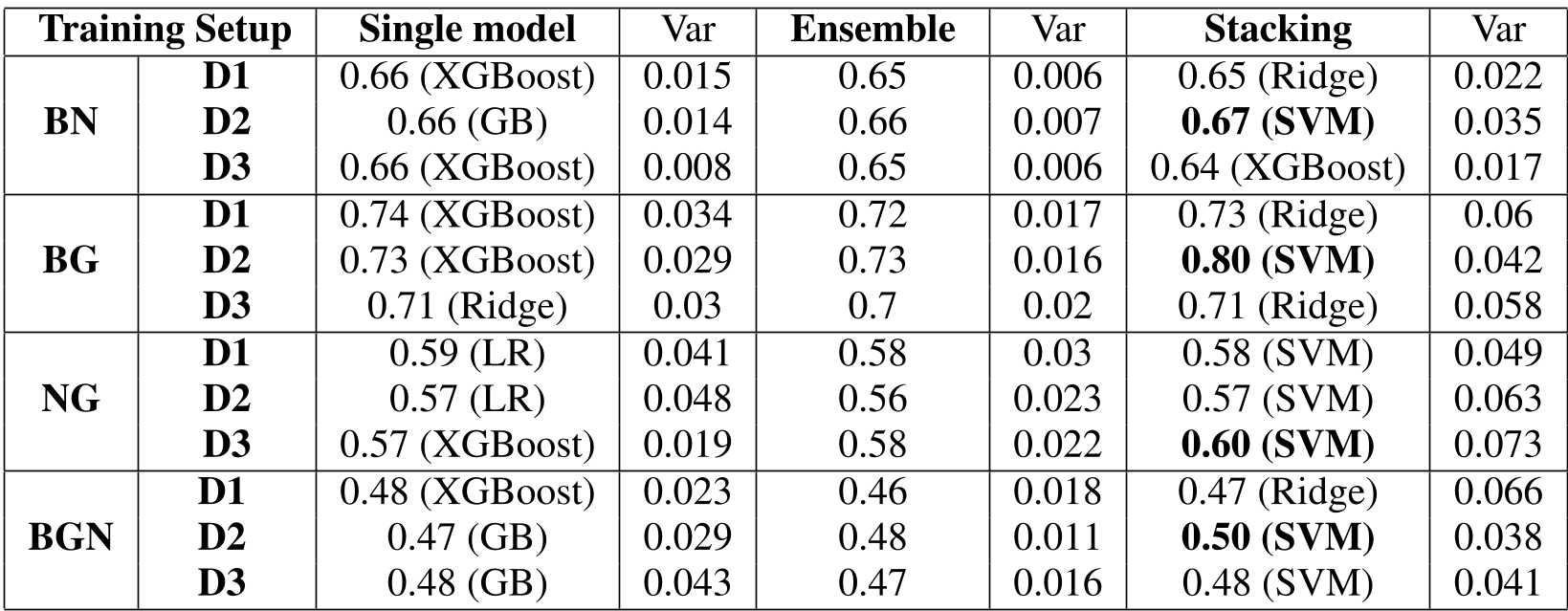 Table 1: Performance comparison across different models and feature sets.
Critical Insight & Future Outlook
This paper proves that Harmony is not magic—it's geometry. By using features like "Gravitational Force" on a canvas, we can build a bridge between the subjective world of the artist and the objective world of the mathematician.
Limitations: The study currently only uses grayscale, abstract shapes. The next frontier is Color Harmony and Semantics (how the meaning of an object, like a face, changes our perception of its placement).
Closing Thought: Imagine a future where your design software (like Canva or Photoshop) doesn't just align objects, but actively suggests a "more harmonic" placement based on the gravitational pull of your elements. This research is the first step toward that reality.