
Detect Them All: Strategic Monitor Placement to Curb Misinformation
1635_Misinformation in Online Social Networks Detect Them All with a Limited Budget.
This paper addresses the "Monitor Placement" problem for misinformation detection in Online Social Networks (OSNs). It introduces two main frameworks: a general detection model shown to be equivalent to Influence Maximization on a reverse graph, and a target-specific "-Monitor Placement" (-MP) problem designed to protect vulnerable nodes within a distance budget.
TL;DR
Online Social Networks (OSNs) are breeding grounds for misinformation. This paper tackles the "Monitor Placement" problem—deciding where to deploy limited detection resources to intercept false claims. The authors prove that optimally protecting a specific user is #P-hard and propose two robust algorithms, MMSC and MSMN, which use graph theory and Monte Carlo sampling to outperform standard centrality-based strategies on real-world datasets like Twitter and Epinion.
The Core Challenge: Distance and Budget
In the fight against "fake news," we face two brutal realities:
- Limited Budget: We cannot monitor every post by every user.
- The "Vulnerability" Gap: Once a user is influenced by misinformation, the psychological effect is hard to reverse. Detection must happen before the information reaches the target.
Existing solutions often treat the network uniformly. This paper argues for a target-centric approach, placing monitors near misinformation sources () to protect "central nodes" ()—users who are particularly susceptible or influential.
Methodology: From Math to Practice
1. The -Monitor Placement (-MP) Problem
The authors define -MP as finding the smallest set of monitors such that the probability of misinformation slipping through to a target is less than a threshold .
2. Overcoming #P-Hardness with Cut-sets
Because calculating exact connectivity in a probabilistic graph is computationally "heavy" (#P-hard), the authors introduce MMSC (Minimum Monitor Set Construction).
- The Insight: Use "cut-set2"—a set of edges whose removal separates and .
- The Heuristic: By identifying disjoint cut-sets based on graph distance, the algorithm estimates the "contribution" of each candidate monitor node to the overall flow of misinformation.
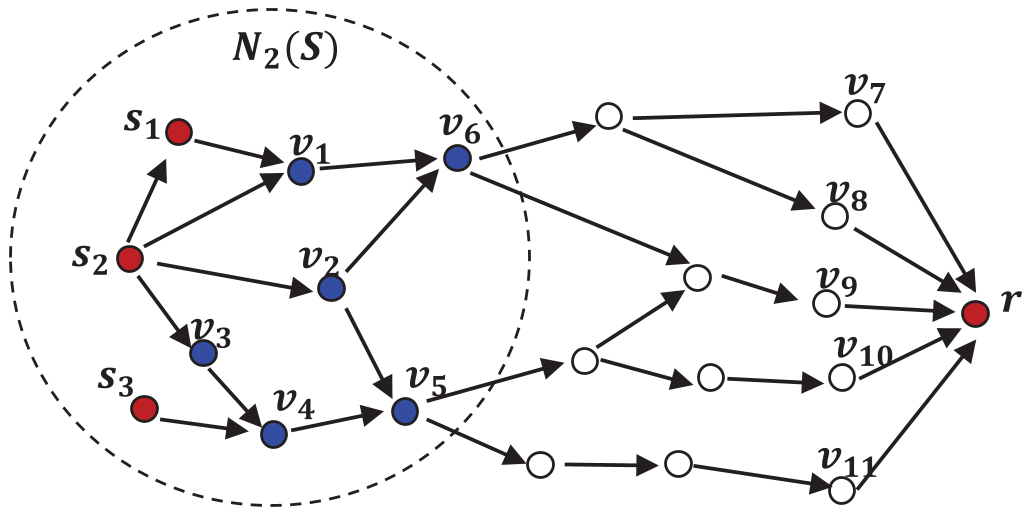 Figure 1: Illustration of placement options—monitoring near sources is often more efficient than monitoring neighbors of the target.
3. Scaling to Multiple Targets (MSMN)
When protecting a group of users, the MSMN (Monitor Set for Multiple Nodes) algorithm uses Monte Carlo sampling. It iteratively selects monitors that provide the maximum "normalized threat reduction" across all unsatisfied targets.
Experimental Proof
The researchers tested their methods on diverse social graphs:
- Twitter: High average degree (26.7), dense connections.
- Epinion/Slashdot: Lower density but complex trust structures.
Key Findings:
- Superior Efficiency: As the number of misinformation sources grows, the gap between MMSC and traditional "Degree Centrality" widens. MMSC keeps the monitor count low while the baseline explodes.
- The Power of : Placing monitors within 1 or 2 hops of the source (the -distance) allows for early intervention, proving more effective than monitoring the "high-profile" users themselves.
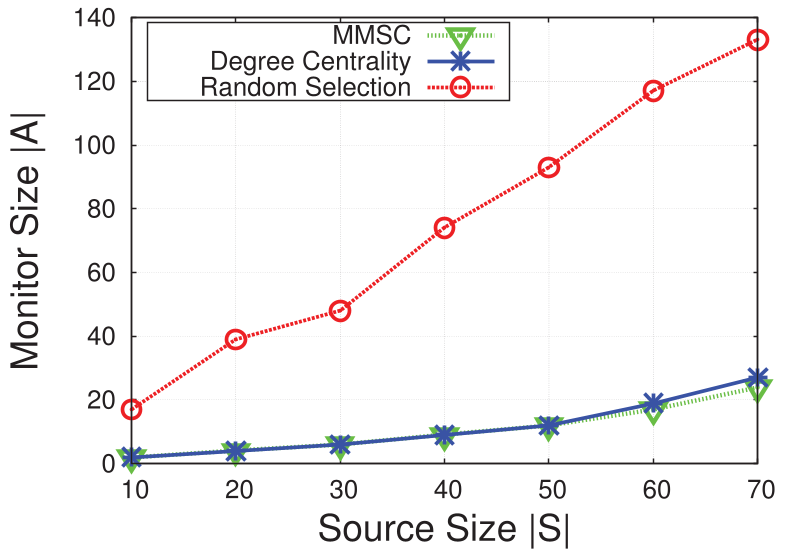 Figure 2: Performance comparison—MMSC requires significantly fewer monitors as the number of misinformation sources increases.
Critical Analysis & Future Outlook
Strengths: This work bridges the gap between theoretical Influence Maximization and practical network security. It provides a formal proof of complexity that justifies the use of heuristics like cut-sets and sampling.
Limitations:
- The model assumes a fixed Independent Cascade (IC) model. Real-world human behavior might follow "Linear Threshold" patterns where multiple exposures are needed for "infection."
- Edge weights (transmission probabilities) are currently assigned randomly/uniformly; real-world weights are far more dynamic and community-dependent.
Future Work: Integrating machine learning to predict edge weights based on content sentiment could make this monitor placement strategy even more surgical.
Conclusion
This paper shifts the paradigm from "detecting content" to "securing structural paths." By treating misinformation as a probabilistic flow problem, the MMSC and MSMN algorithms provide a blueprint for protecting digital communities with surgical precision and minimal cost.