
CLICT: Fusing Content and Triangles for Resilient Social Community Detection
Using link and content to detect social communities
The paper introduces CLICT, a community detection algorithm that integrates structural link data with textual vertex content. It leverages content similarity to expand the network and utilizes a Triangle Participation Ratio (TPR) refinement step to achieve SOTA performance on real-world social datasets like Flickr and Facebook.
TL;DR
Social networks are rarely just about "who follows whom." The actual communities are often defined by shared interests (content) and cohesive local structures (triangles). CLICT (Community detection using Link and Content Triangles) is a robust framework that expands noisy network graphs using content similarity and refines the results using the physical intuition that "friends of friends are likely in the same community."
The "Loud" Silence of Link Noise
Most community detection algorithms assume that an edge between two users is a strong signal of belonging. However, in the real world:
- Link Noise is rampant: Users follow others for trivial reasons, leading to "weak" edges.
- Missing Links: Two people with identical interests might not be connected yet.
- The Detectability Threshold: When communities are sparse, purely structural methods fail to find them.
CLICT addresses these by treating User Generated Content (UGC) (tags, profiles) not just as metadata, but as a scaffold to repair and refine the network structure.
Methodology: The Three Pillars of CLICT
The algorithm operates in a logical sequence that moves from broad fusion to precise refinement.
1. Network Expansion and Weighting
The authors don't just use the existing graph. They compute the content similarity (using Jaccard or Cosine) between all vertices and link each vertex to its top K most similar peers. This effectively "fills the gaps" in the graph. The edges are then weighted using a fusion of:
- Structural Affinity: Neighborhood Overlap (NO) or Salton Index (SI).
- Content Affinity: Jaccard or Cosine similarity of text vectors.
2. Initial Partitioning (Spectral Power)
Instead of a simple heuristic, CLICT employs k-way spectral clustering. By calculating the top eigenvectors of the Laplacian matrix, the network is projected into a k-dimensional Euclidean space where communities become distinct clusters manageable by K-means.
3. The Power of Triangles (Refinement)
The most unique contribution is the Refinement Phase. The authors argue that a "good" community is dense in triangles. They use the Triangle Participation Ratio (TPR)—the fraction of nodes in a community that are part of at least one triangle within that same community.
Note: The refinement process iteratively moves nodes between communities to maximize the global TPR score.
Experiments: What Works Best?
The study evaluated CLICT on Flickr (16k nodes, 716k edges) and Facebook ego-networks. Key findings include:
- Triangles Matter: Overlapping-community benchmarks showed that CLICT outperformed CODICIL, proving that structural refinement using TPR is essential.
- The Salton Index Advantage: In comparing structural metrics, the Salton Index (SI) generally yielded better community definitions than the standard Neighborhood Overlap.
- Jaccard > Cosine: For binary content vectors (like tags), Jaccard similarity was more effective at capturing the nuances of user interest than Cosine similarity.
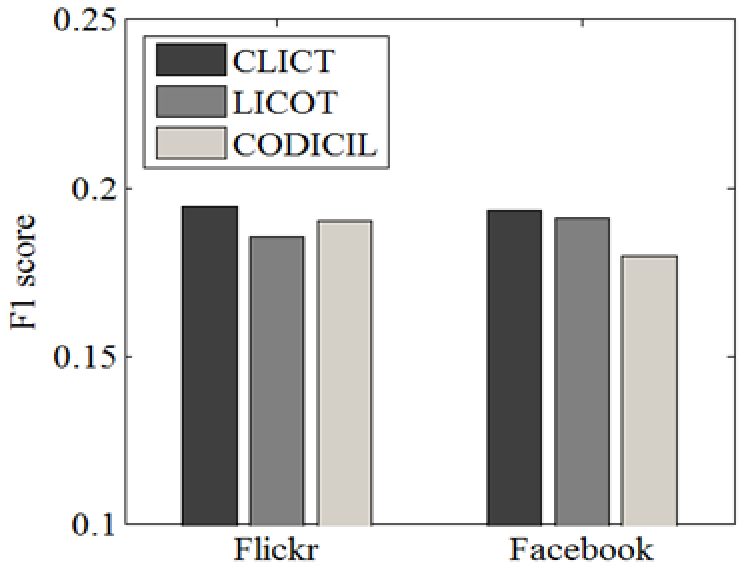 Figure 3: CLICT demonstrates a clear lead over LICOT (link only) and CODICIL (no triangle refinement).
Critical Insight & Future Outlook
While CLICT is powerful, its current bottleneck is the complexity for computing pairwise content similarity. For massive networks with millions of nodes, this requires dimensionality reduction or hashing techniques (like MinHash).
The Takeaway: The success of CLICT suggests that the "social" in social networks is best captured when we stop looking at edges as binary links and start looking at them as weighted probabilities reinforced by common language and local triangles.
Conclusion
CLICT provides a principled way to leverage the complementary nature of what we say (content) and who we know (links). By anchoring these in the geometric stability of triangles, it offers a path toward community detection that is significantly more resilient to the noise of modern social media.