
Defeating the Digital Hydra: A Deep Dive into Sybil Defense in Social Networks
Detecting and Defending against Sybil Attacks in Social Networks: An Overview
This paper provides a comprehensive overview of Sybil attack defense mechanisms in decentralized social networks, specifically focusing on graph-theoretic approaches like SybilGuard and SybilLimit. It evaluates how structural properties such as "fast-mixing" honest regions and "attack edges" can be leveraged to isolate malicious multi-identity entities.
TL;DR
In the decentralized wilderness of modern social networks, "Sybil attacks"—where one person masquerades as a crowd—threaten everything from content ranking to democratic voting. This paper surveys the evolution of defense mechanisms, from the early days of SybilGuard to advanced community detection in SybilDefender, providing a roadmap for securing distributed systems without a central gatekeeper.
Context: This is a foundational survey that categorizes the "arms race" between attackers seeking to inflate their influence and researchers using graph theory to prune fake identities.
The Problem: The Cost of Redundancy
In distributed systems, redundancy is a feature for reliability but a bug for security. If a system allows anyone to join, a malicious actor (the "Sybil") can generate thousands of identities.
The paper identifies a critical challenge: How do you distinguish a legitimate community from a synthetic one when you don't have a "Real ID" system? Prior work relied heavily on the "fast-mixing" property—the idea that random walks in an honest network quickly reach a uniform state, whereas they get "trapped" in Sybil regions because the connection (the attack edge) is thin.
Methodology: Graph Theory as a Shield
The authors break down the most influential defense architectures based on social network topology:
1. Random Walk Protocols (SybilGuard & SybilLimit)
These methods use the "Fast-Mixing" assumption. If a Verifier (honest) and a Suspect (potential Sybil) both perform random walks, their paths are highly likely to intersect if both are in the honest region.
- The Intuition: Sybil regions are "cliques" connected to the rest of the world by only a few "attack edges." Random walks starting inside a Sybil region find it hard to "escape" into the honest region.
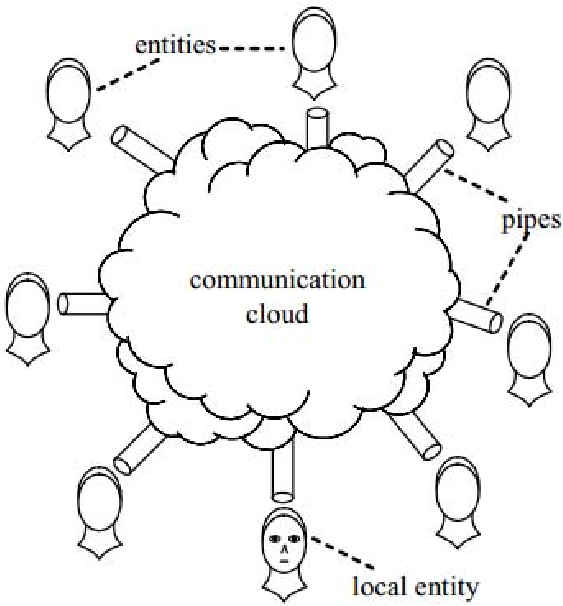 Figure 1: The classic Douceur model of Sybil entities vs. Honest entities.
2. Credit and Flow-based Systems (SumUp)
Instead of just walking through the graph, SumUp views the trust relation as a "pipe" with limited capacity.
- The Intuition: If a node tries to cast 10,000 votes through a single trust connection, the "pipe" bottlenecks at the attack edge. Use max-flow/min-cut algorithms to automatically throttle malicious influence.
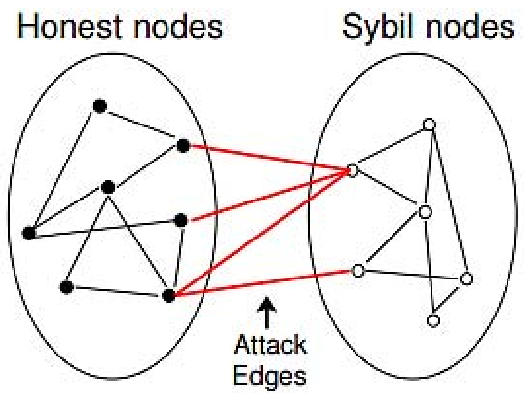 Figure 2: The structural bottleneck (Attack Edges) between Honest and Sybil regions.
Experiments & Real-World Efficacy
The paper compares several heavy-hitters using real-world datasets from Orkut and Facebook (3M+ nodes):
- SybilLimit: Proved that each attack edge accepts at most Sybil nodes. In a million-node network with 15 attack edges, it accepted 95% of honest nodes.
- SybilDefender: Demonstrated that in Facebook's topology (avg. degree 18.32), it could identify the majority of Sybil communities even when the attacker managed to create several nodes per attack edge.
- SumUp: On the "Digg" social network, at least 50% of suspicious articles flagged were confirmed Sybil attacks, proving that flow-based limits work for content ranking.
Critical Insight: The "Identity" Fallacy
One of the most profound takeaways from this overview is the questioning of what constitutes an "attack."
The authors point out a terminological nuance: Having multiple identities (e.g., one for work, one for family) is a human right and a functional necessity. A "Sybil Attack" only occurs when these identities are merged to perform malicious actions. Therefore, future defense schemes shouldn't just look at who the node is (topology), but what the node does (behavior/clickstream).
Conclusion & Future Outlook
While graph-based defenses are mathematically elegant, they suffer from two major flaws:
- Topology Awareness: Many require a full view of the graph, which is hard in decentralized settings.
- Mixing Assumptions: Real social networks aren't always "fast-mixing."
The Takeaway: The next generation of defense will likely be hybrid. We need to combine the structural rigor of random walks with the "messy" data of user content and behavior to catch the Sybils that have managed to embed themselves deeply into our social fabric.