
Beyond Global Metrics: Decoding Anomalous Node Evolution via Link Prediction
Detecting and Assessing Anomalous Evolutionary Behaviors of Nodes in Evolving Social Networks
This paper introduces the LPD (Link Prediction Detection) and MPA (Matrix Perturbation Assessment) methods to detect and quantify Anomalous Evolutionary Behaviors of Nodes (AEBN) in evolving social networks. By shifting focus from macroscopic network performance to microscopic node-level evolutionary mechanisms, it achieves state-of-the-art anomaly identification across multiple real-world datasets.
Executive Summary
TL;DR: Most social network anomaly detection looks at the "forest" (the whole graph), but this paper focuses on the "trees" (individual nodes). By using Link Prediction Detection (LPD) to monitor shifts in how nodes form connections and Matrix Perturbation Assessment (MPA) to measure the fallout, the authors provide a surgical tool for identifying truly suspicious behavior in evolving networks.
Positioning: This work is a pivotal shift from feature-based monitoring to mechanism-based detection. It moves beyond simply asking "Is this node changing?" to "Is the logic behind this node's growth changing?"
The "F" vs "D" Problem: Why Features Fail
In traditional social network analysis, we might flag a node if it suddenly gains 50 friends. However, as the authors illustrate with their "User F vs User D" example, a sudden spike in edges might be normal for a power user (User D) but highly suspicious for an occasional user (User F).
The problem with prior work (like EBM or feature-tracking) is that it relies on static structural features (degree, clustering coefficient). These features catch the result of a behavior but ignore the mechanism. This paper argues that every node follows a stable evolutionary mechanism—like Triadic Closure (befriending friends of friends) or Preferential Attachment (befriending the famous). An anomaly is a deviation from these personal "rules of growth."
Methodology: The Core Mechanics
1. The Behavior Vector (LPD)
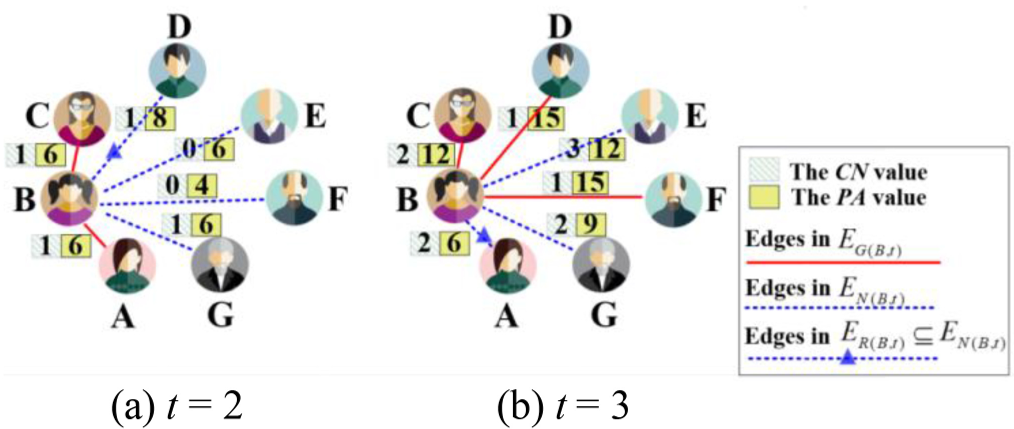
To "fit" a node's evolutionary mechanism, the authors use link prediction algorithms as sensors. If a node's new connections are highly predictable by a "Common Neighbors" algorithm, the node is likely following triadic closure.
The Behavior Vector combines:
- Edge Generation Index (egi): How well-fit is the creation of new edges?
- Edge Removal Index (eri): How well-fit is the deletion of old edges?
2. Quantifying Impact (MPA)
Once an anomaly is detected, how much does it matter? The authors treat anomalous behavior as a perturbation on the network's adjacency matrix. By using first-order approximation (keeping eigenvectors fixed while varying eigenvalues), they calculate a Perturbation Index (PI). A high PI indicates that the node's behavior is fundamentally altering the skeletal structure (spectral properties) of the social network.
Experimental Insights
The authors tested LPD and MPA across eight diverse datasets, including Wikipedia edits and Enron emails.
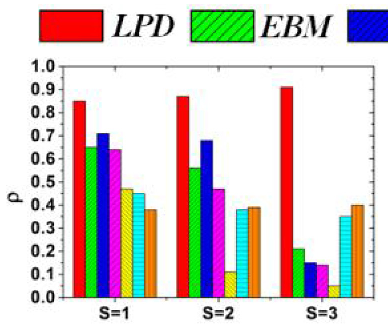
- Higher Sensitivity: LPD achieved the highest detection accuracy (ρ) across the board. Because it looks at the direction of the behavior vector rather than just the magnitude of change, it ignores "normal" growth while catching "anomalous" shifts.
- Mechanism Synergy: The study found that using a diverse set of link prediction algorithms (CN, PA, Adamic-Adar, etc.) in the behavior vector significantly boosts performance compared to using just one.
Deep Insight & Conclusion
The genius of this paper lies in its realization that Social Physics is better than Social Geometry. Instead of measuring the "shape" of a node (geometry), we should measure the "forces" driving it (physics).
Takeaway: If you are building a system to detect bot behavior or account takeovers in social platforms, don't just look for high activity. Look for a shift in the logic of activity. If an account that usually grows through local community interaction (Triadic Closure) suddenly starts connecting to distant, high-degree hubs (Preferential Attachment), you’ve found an AEBN.
Limitations: The method is computationally intensive, as it requires running multiple link prediction models per node. For massive networks, community pre-partitioning is a necessary prerequisite to make the matrix perturbation analysis tractable.
Future Outlook: Integrating these mechanism-based vectors into Graph Neural Networks (GNNs) could lead to the next generation of self-supervised anomaly detection.