
Human, Bot, or Cyborg? Decoding the Automation Spectrum on Twitter
Detecting Automation of Twitter Accounts: Are You a Human, Bot, or Cyborg?
This paper introduces a tri-class classification framework (Human, Bot, Cyborg) for Twitter accounts by analyzing a large-scale dataset of 500,000 users. It proposes a multi-component system utilizing behavior entropy, spam patterns, and account metadata, achieving a 96% overall classification accuracy.
TL;DR
Twitter is no longer just a playground for humans. This seminal paper moves beyond the simplistic "Human vs. Bot" binary to uncover the Cyborg: the hybrid accounts that dominate our feeds. By analyzing 500,000 accounts and 40 million tweets, the researchers developed a robust classification system combining behavioral entropy, Bayesian spam detection, and account metadata to achieve a staggering 96% accuracy in identifying the true nature of social media actors.
The Problem: The Rise of the Social Cyborg
Prior research often treated social media automation as a black-and-white issue. However, the reality is a spectrum. We have legal news bots, malicious spammers, and most importantly, Cyborgs—human-assisted bots or bot-assisted humans (like a journalist using RSS feeds but occasionally replying to comments).
The challenge lies in the "grey zone": Cyborgs exhibit high-level intelligence (human) but follow regular schedules (bot). Traditional spam filters miss them, and simple frequency checks are easily fooled by "incubation" periods where bots stay silent.
Methodology: The Four Pillars of Detection
The authors propose a system that looks at more than just what is being said, focusing heavily on how and when it is said.
1. The Entropy Component (The Smoking Gun)
The core intuition is that humans are "complex." Our timing is inherently irregular. Machines, conversely, are driven by timers. The authors use Corrected Conditional Entropy (CCE) to measure the complexity of inter-tweet delays.
- Low Entropy: Suggests periodic, regular behavior (Bot/Cyborg).
- High Entropy: Suggests the chaotic, unpredictable nature of real human activity.
2. Spam Detection & Account Properties
Automated accounts almost always have a goal: redirection. This leads to two measurable "red flags":
- URL Ratio: Bots often have a URL ratio approaching 1.0 (nearly every tweet is a link).
- Device Makeup: Real humans mostly use the Web or Official Mobile Apps. Bots rely on APIs or third-party integrators (like
twitterfeed).
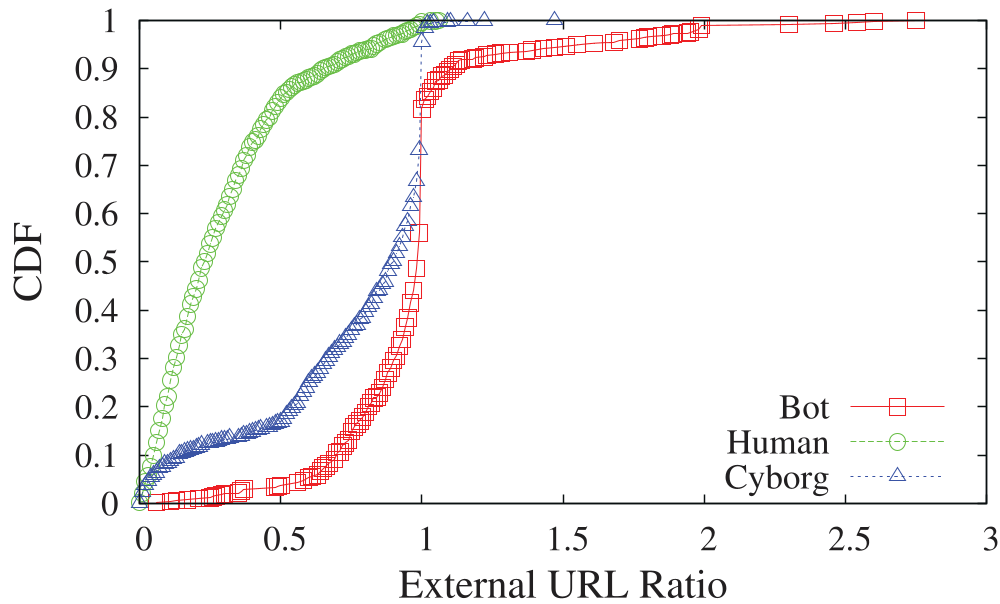 Figure 1: The high-level architecture of the classification system, showing the integration of Entropy, Spam, and Property components.
Experimental Insights: Who Rules Twitter?
The study applied the classifier to over half a million users, revealing a surprising population breakdown:
- Humans: ~53%
- Cyborgs: ~36%
- Bots: ~11%
This means nearly half of the active presence on Twitter involves some level of automation.
Key Discriminators
Which feature is the most effective?
- Entropy (82.8%): The regularity of timing remains the hardest trait for a machine to fake convincingly over long periods.
- URL Ratio (74.9%): The commercial intent of automation usually forces the use of external links.
- Account Reputation: Bots tend to follow thousands but have few followers, leading to a reputation score near 0.
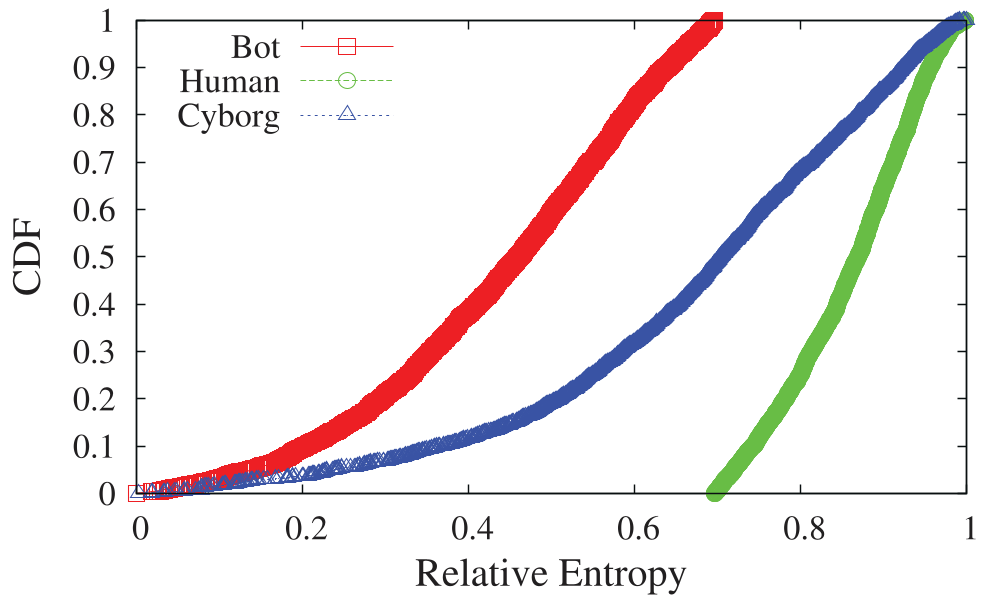 Figure 2: CDF of relative entropy across the three classes. Notice how Bots (low entropy) are clearly separated from Humans (high entropy).
Critical Analysis: Is the System Future-Proof?
The authors acknowledge that sophisticated bots can attempt evasion:
- Mimicry: Bots can intentionally add "jitter" to their timing to increase entropy values.
- Dilution: Mixing spam with "ham" (benign text like quotes/adages) to fool Bayesian filters.
However, the Device Makeup feature remains a high barrier to entry. As long as Twitter distinguishes between API-based posts and manual Web-based posts, the "Intent to Automate" remains visible.
Conclusion: A New Standard for Social Auditing
This research moved the needle by proving that the "Cyborg" is a distinct social class. For platform designers and researchers, the takeaway is clear: don't just look for spambots—look for the subtle overlaps where automation and human interaction meet. The 5:4:1 ratio suggests that our digital public square is far more mechanical than we perceive.