
Detecting Automation on Twitter: Are You a Human, Bot, or Cyborg?
Detecting Automation of Twitter Accounts: Are You a Human, Bot, or Cyborg?
This paper introduces a robust classification system to distinguish among Humans, Bots, and Cyborgs (human-assisted bots or bot-assisted humans) on Twitter. By analyzing over 500,000 accounts and 40 million tweets, the authors developed a Random Forest-based framework that integrates behavioral entropy with account metadata and content analysis to achieve 96% classification accuracy.
TL;DR
This seminal work by Zi Chu et al. moves social media forensics beyond the simple "Bot vs. Human" binary. By introducing the category of Cyborgs—accounts that interweave manual and automated behavior—the authors provide a nuanced classification system. Using behavioral entropy, device metadata, and content analysis, they achieved a SOTA classification accuracy of 96% on a massive dataset of 500k users.
Problem & Motivation: The "Cyborg" Gray Area
Most researchers in 2011-2012 viewed the Twitter landscape through a black-and-white lens: legitimate users versus malicious spambots. However, the authors noticed a massive middle ground.
- The Pain Point: Humans often use RSS feeds to post updates (automated), while some bots are human-assisted to bypass CAPTCHAs.
- The Insight: Pure bots are repetitive and regular; humans are complex and irregular. The key to identifying the "Cyborg" is detecting the coexistence of these two signals.
Methodology: The Four Pillars of Detection
The authors propose a system that doesn't just look at what was said, but how and from where it was sent.
1. Entropy: The Measure of Complexity
Automation typically relies on timers (periodic behavior). The authors use Corrected Conditional Entropy (CCE) to measure the complexity of inter-tweet delays.
- High Entropy: Human-like, unpredictable spikes in activity.
- Low Entropy: Bot-like, regular intervals (e.g., every 30 minutes).
2. The Device Makeup
This is one of the paper's most clever observations. They categorized 3,648 distinct devices into "Manual" (Web/Mobile) and "Automated" (API/RSS widgets).
- Humans: >50% Web usage.
- Bots: ~42% via unregistered APIs.
- Cyborgs: A distinct mix of both.
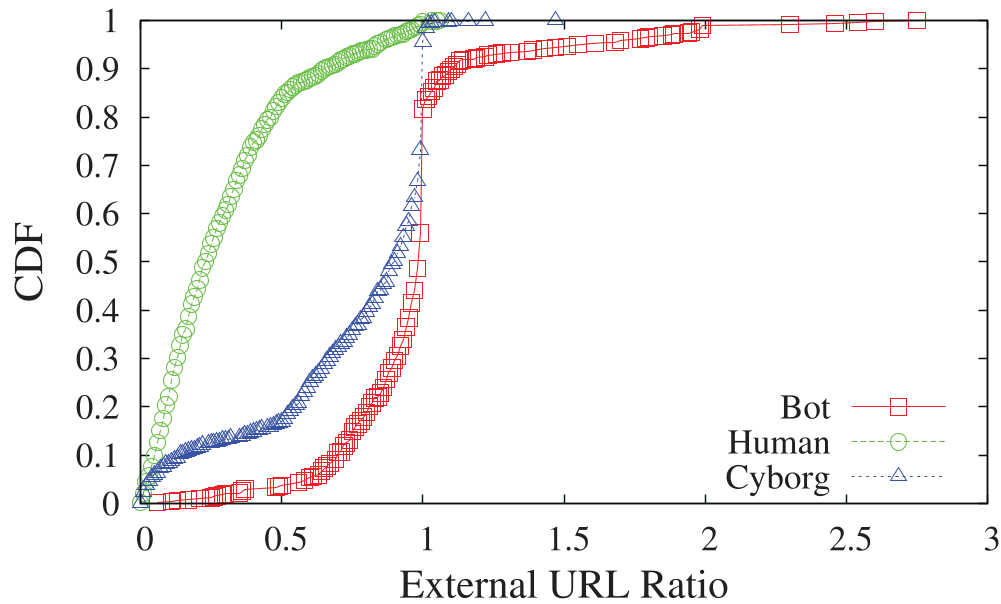 Figure 1: The high-level design of the Twitter classification system showing the integration of Entropy, Spam, and Account Property components.
Experiments & Results: Mapping the Twittersphere
The authors didn't just test their model; they used it to census the entire network.
Performance Comparison
The Random Forest classifier proved highly resilient. Even when humans and bots showed similar follower counts (a metric bots often manipulate), the Entropy of their timing usually gave them away.
| Feature | Individual Accuracy (%) |
|---|---|
| Entropy | 82.8% |
| URL Ratio | 74.9% |
| Device Makeup | 71.0% |
| Bayesian Spam Check | 69.5% |
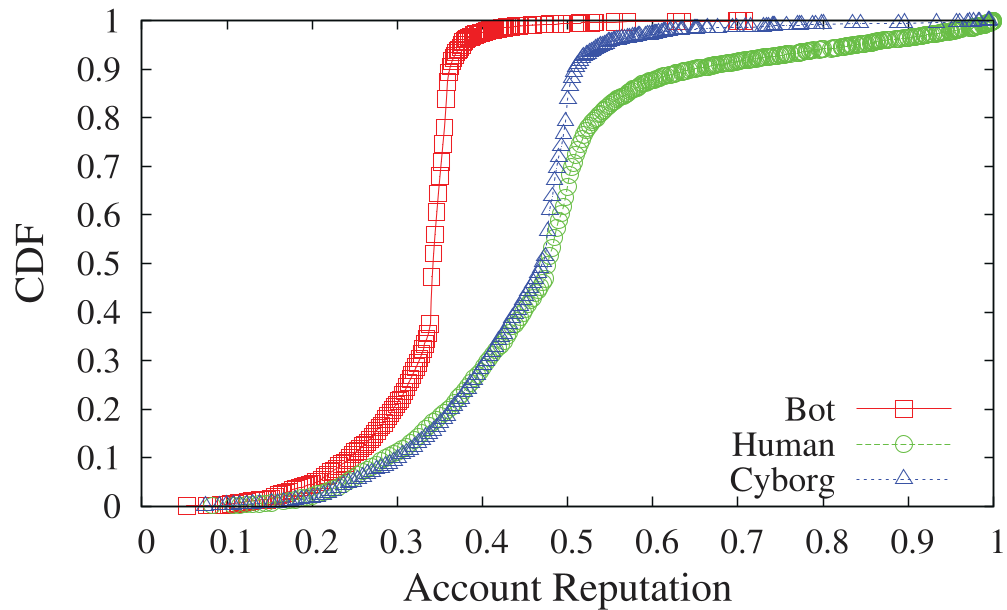 Figure 2: CDF of tweet counts showing the high activity levels of Cyborgs compared to pure Humans or Bots.
Key Findings:
- Cyborg Domination: 36.2% of the sampled accounts were Cyborgs. This suggested that automation was already a standard part of the "Human" social experience.
- The 5:4:1 Ratio: The Twitter population was estimated at ~53% Human, ~36% Cyborg, and ~11% Bot.
Critical Analysis & Conclusion
This paper's enduring value lies in its transition from "Spam Detection" to "Behavioral Forensic Science."
Strengths
- Entropy over Frequency: Simply counting tweets is easy to fake. Faking the complexity of human timing (burstiness followed by organic silence) is much harder for a script.
- Device Provenance: By looking at the "Source" field (e.g., "via Twitter for iPhone" vs "via API"), the model captures the physical reality of the interaction.
Limitations & Future Work
The authors admit that a sophisticated bot could "mimic" human entropy by injecting random delays. Today, in the age of ChatGPT, the Spam Detection component (the weak link at 69.5%) would likely be obsolete, as AI-generated text no longer follows the predictable "Orthogonal Sparse Bigram" patterns of 2012.
Final Takeaway: As social platforms evolve, the "Human" signal is increasingly mediated by machines. This paper provided the first rigorous framework for identifying where the human ends and the machine begins.