
Bridging the Data Gap: Using Synthetic CO2 Dynamics for Smarter Building Occupancy Detection
Detecting Building Occupancy with Synthetic Environmental Data
This paper introduces a simulation-aided transfer learning framework for building occupancy detection using CO2 environmental data. By pretraining Deep Learning models on synthetic data generated from physical simulations and fine-tuning on limited real-world data, the authors achieve SOTA-level accuracy with significantly reduced manual labeling effort.
TL;DR
Building occupancy detection is essential for energy efficiency, yet it suffers from a massive data labeling bottleneck. This paper proposes a simulation-aided transfer learning approach that uses physical indoor climate simulations to pretrain models. The result? A 50% reduction in the real-world data needed to achieve high-accuracy occupancy detection, alongside a significant boost in model robustness.
Background: The Privacy-Preserving Proxy
Why use CO2 sensors for occupancy? Unlike cameras, environmental sensors are non-intrusive and preserve privacy. However, training a model to "read" occupancy from CO2 is difficult because every room has a different "personality"—factors like window leakage (infiltration), HVAC settings, and sensor placement create unique data signatures. Traditionally, this meant you had to manually record occupancy for weeks in every single room to train a model, which is practically impossible for large-scale commercial buildings.
The Core Insight: Physics as a Pretrainer
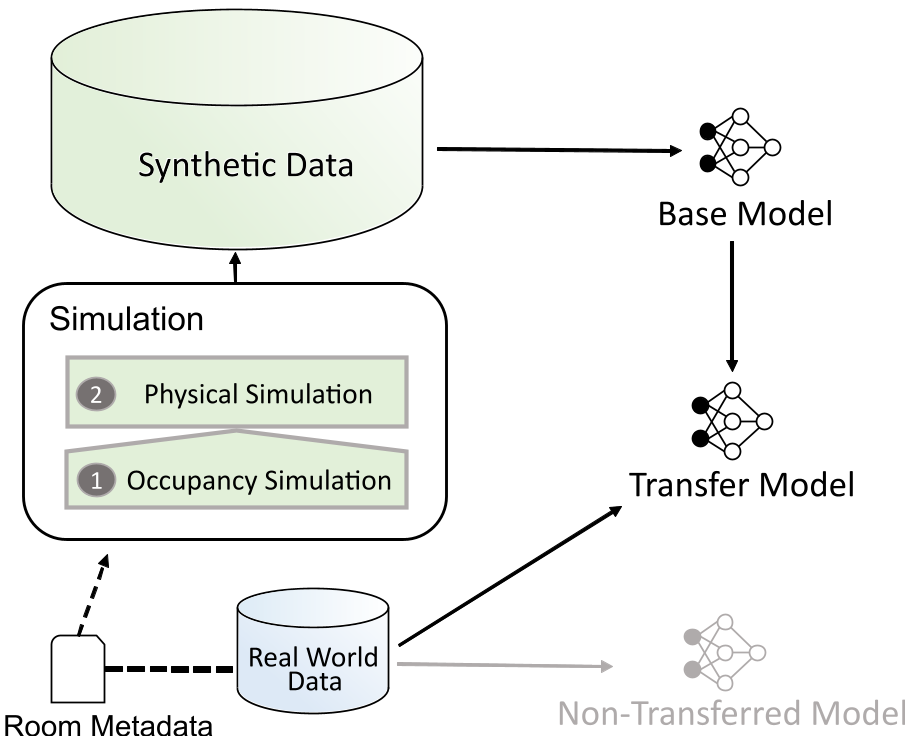
The authors realized that while rooms differ, the fundamental physics of gas dynamics remains constant. Instead of starting with a "blank slate" model, they use two stages of simulation:
- Occupancy Simulation: Generating realistic synthetic patterns of people entering and leaving.
- Physical Simulation: Converting those patterns into CO2 concentration curves using established physical equations.
By exposing the model to 400 days of this synthetic data, the model learns the "language" of CO2—the typical lags, peaks, and decay patterns—before it ever sees a single real-world data point.
Methodology: From Synthetic to Real
The workflow follows a classic transfer learning paradigm:
- Base Model: A Deep Neural Network (CDBLSTM-like architecture) is trained on simulated data.
- Transfer Step: The pretrained weights are used to initialize a room-specific model.
- Fine-tuning: A tiny slice of real-world data (1 to 4 days) is used to adapt the model to the specific infiltration rates and sensor quirks of the target room.
The authors explored two strategies: Upfront specific simulation (tailored to the room's dimensions) and Reusable general base models (trained on multiple random room characteristics).
Experimental Results: Efficiency and Robustness
In a real two-person office test, the results were striking. The transfer-learning model achieved an Accuracy of 0.875 with just 1 day of real training data, outperforming a standard model trained on double the amount of data (0.874 with 2 days).
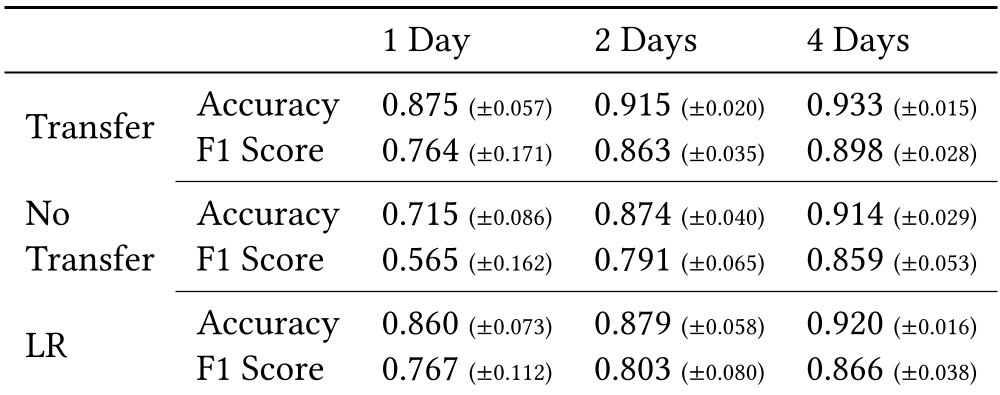
Key takeaways from the data:
- Data Efficiency: You only need half the ground truth data.
- Stability: The standard deviation (variance in performance) dropped by up to 50%, meaning the model is much more reliable across different time periods.
- SOTA Benchmarking: Even with sparse data, the model outperformed baseline Logistic Regression (LR) in F1 scores significantly when training data was limited.
Critical Insight & Future Outlook
The genius of this work lies in its Inductive Bias. By using physics to generate synthetic data, the researchers are essentially "baking" the laws of nature into the neural network architecture.
Limitations: The current simulation assumes constant infiltration rates and human CO2 generation. In reality, these are dynamic (e.g., people being active vs. sedentary). Future Direction: Integrating real-time weather data and exploring time-series data augmentation (like GANs) could further close the gap between synthetic "clean" data and real-world "noisy" data.
This work marks a significant step toward plug-and-play building automation, where occupancy models can be deployed quickly without the nightmare of manual data collection.