
Decoding Depression: Why Your Smartphone Knows Your Mind Better Than You Do
Detecting change in depressive symptoms from daily wellbeing questions, personality, and activity
This study investigates detecting changes in depressive symptoms (BDI scores) using smartphone-based passive sensing and daily self-reports. The authors employ Linear Regression with Forward Selection (BIC) and Lasso regularization to identify that sleep irregularity, physical activity, and "Openness" personality traits are primary predictors of mental health shifts.
TL;DR
Researchers from UC Berkeley and UCSF have demonstrated that passive smartphone data—specifically how much you move and how irregularly you sleep—is a far better predictor of worsening depressive symptoms than your own daily mood logs. By analyzing 44 students over a semester, the study found that personality traits like "Openness" and coarse sleep metrics extracted from simple accelerometer data can catch the early signs of a mental health decline that active surveys often miss.
The "Daily Survey" Paradox
For years, the gold standard in mobile health (mHealth) has been Ecological Momentary Assessment (EMA)—those "How are you feeling right now?" notifications that pop up on your screen. However, this study exposes a critical flaw: daily self-reports of "happiness" or "energy" often fail to correlate with long-term shifts in clinical depression, measured by the Beck Depression Inventory (BDI).
The motivation for this research stems from the fact that users hate filling out surveys. Dropout rates are high, and "absolute" depression levels are notoriously hard to guess from a phone. Instead, the authors asked: Can we sense "change" rather than "state," and can we do it without bothering the user?
Methodology: The Power of Passive Sensing
The authors didn't use fancy wearable rings; they used the raw 3-axis accelerometer found in every Android phone.
1. Feature Engineering
They extracted several key features:
- "Sleep" Proxy: Defined as the longest duration the phone was set down during 1 AM – 7 AM.
- Daytime Stillness: How often the phone (and presumably the user) remained stationary during the day.
- Personality: The "Big 5" traits, collected once at the start.
2. Modeling with Interpretability
Rather than using "black-box" neural networks, the team used Forward Selection (BIC) and Lasso Regression. This choice was surgical: they wanted to see exactly which features carried the most weight.
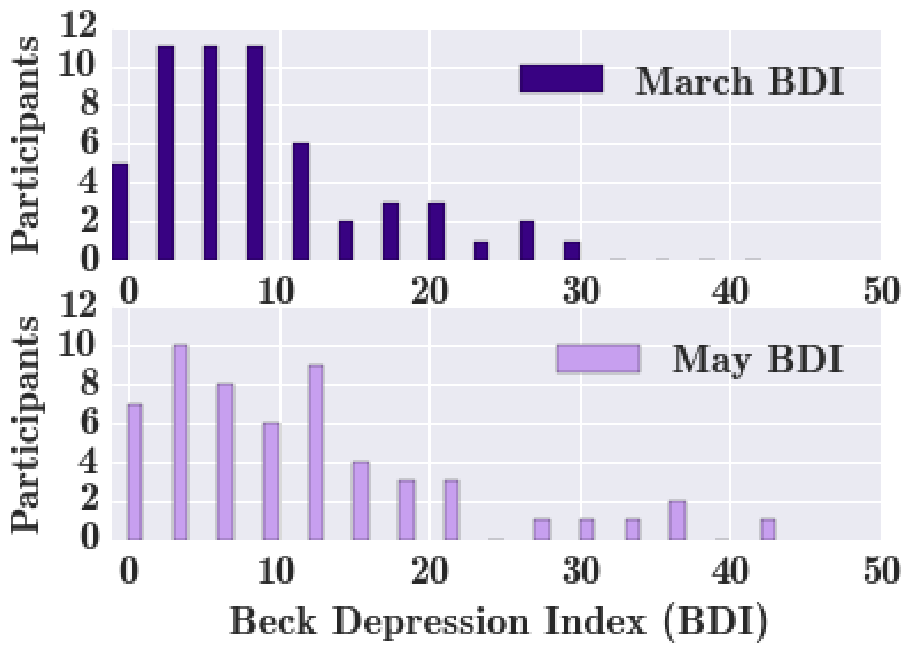 Figure 1: The drift toward higher BDI scores (increased depression) in students as final exams approached.
Results: Sleep and Personality are King
The findings were striking. While daily wellbeing reports were largely ignored by the predictive models, three factors stood out:
- Sleep Irregularity: The standard deviation of sleep duration and "slope" (change over time) were the strongest indicators of a rise in depressive symptoms.
- Personality Bias: "Openness" was the only feature that remained significant across every single model iteration, even when outliers were removed. This suggests that certain personality types may express or experience academic stress in more detectable ways.
- Coarse Data is Enough: You don’t need medical-grade sensors. Even "noisy" accelerometer data collected for 3 seconds every 5 minutes was sufficient to reach an of 0.785.
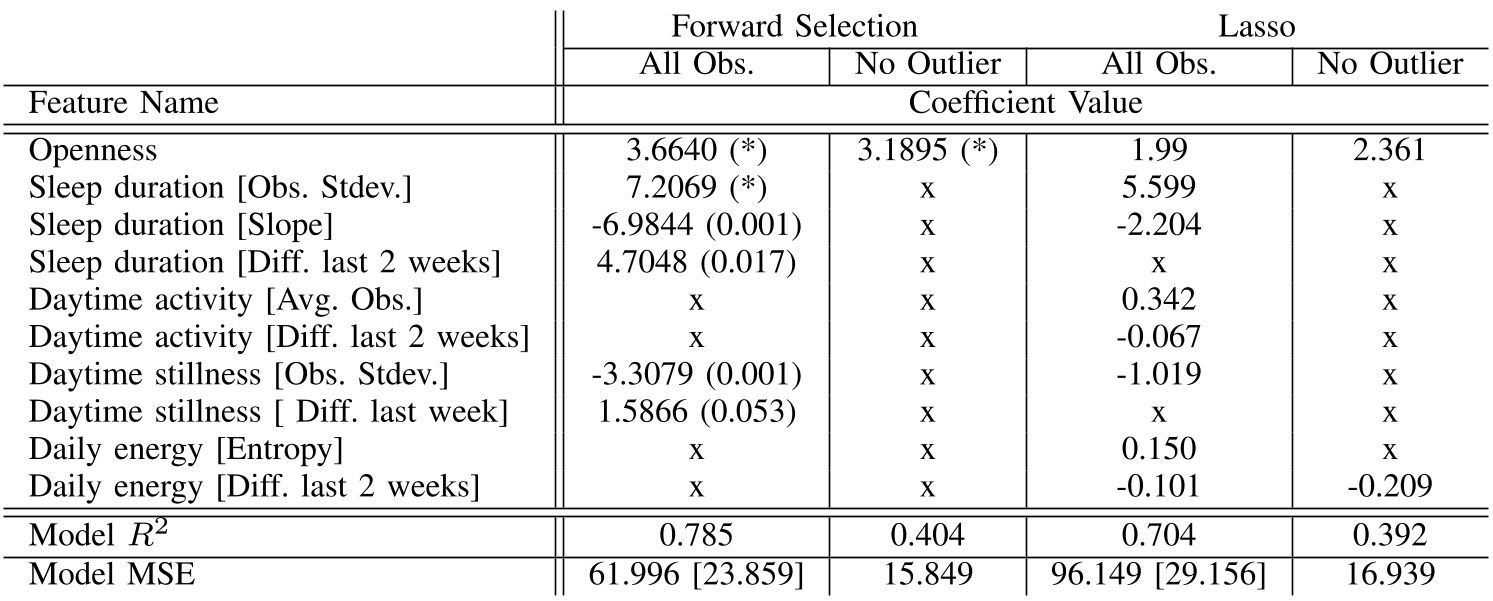 Table 1: Comparison of coefficients showing the dominance of sleep and openness features.
Depth Insight: The "Outlier" Lesson
The researchers encountered a participant who experienced an extreme BDI increase (+50 points). While most studies might hide such data, this paper explicitly shows how a single "distressed" individual can skew a small-population model.
The takeaway for the industry is clear: Mental health AI needs massive, diverse datasets. "Artisanal" datasets of 40-100 people are vulnerable to overfitting, making the discovery of robust features like "Openness" even more valuable as they represent the few truly "stable" signals in a sea of noise.
Critical Analysis & Future Outlook
Contribution: This work validates that passive sensing isn't just a "nice-to-have"—it is fundamentally more objective than user self-reporting for longitudinal tracking.
Limitations: The study's reliance on a student population limits generalizability to clinical populations. Additionally, the reliance on a single sensor (accelerometer) ignores the rich context provided by GPS (social isolation) or app usage (procrastination).
Conclusion: If we want to build smartphones that act as "mental health thermostats," we must stop asking users how they feel and start looking at how they change their behavior. The future of psychiatric assessment is invisible, passive, and deeply personalized.