
Detecting the Pulse of Social Media: A Unified Content-Timing Approach
Detecting changes in content and posting time distributions in social media
The paper introduces a unified generative model for social media change point detection by integrating categorical content distributions with exponential posting-time intervals. It proposes an efficient recursive greedy search and local refinement algorithm to identify abrupt shifts in user behavior, achieving state-of-the-art accuracy in tracking evolving opinions and burst patterns.
TL;DR
This study presents a robust framework for identifying critical turning points in social media streams. Unlike traditional methods that only look at how often people post (burst detection) or what they post (sentiment analysis), this model combines both into a single generative framework. By using a Likelihood Ratio-based optimization, it can pinpoint exactly when a brand's reputation shifts or when a seasonal trend kicks in.
Background Positioning
In the landscape of social media analytics, most researchers live in two silos: Influence Maximization (who spreads info) and Sentiment Analysis (what is being said). This paper bridges the gap by focusing on Temporal Dynamics. Published in ASONAM '13, it addresses the "Event Detection" niche by treating content and timing as a joint signal, a precursor to modern real-time monitoring systems.
Problem & Motivation: The Blind Spots of Current Detection
Why do we need a new method? Imagine a product review page where the number of reviews per day stays exactly the same, but the average rating drops from 5 stars to 2 stars.
- Burst Detection would fail here because the frequency is constant.
- Anomaly Detection (like Outlier detection) might flag a single bad review but wouldn't recognize a structural "regime shift" in the community's opinion.
The authors' insight is that changes in content and timing are often synchronized (e.g., a "burst" of posts usually carries a specific sentiment), but even when they aren't, a unified likelihood model can capture the total information gain from a potential change point.
Methodology: The Generative Engine
The model assumes that at any given time , the probability of a post occurring with content after an interval is:
- Content Model: An -categorical distribution representing scores (1–7 stars).
- Timing Model: An exponential distribution representing the arrival rate of posts.
The Optimization Algorithm
Finding the best change points is a combinatorial nightmare. The authors solve this with a two-stage approach:
- Greedy Search (A1): Progressively splits the timeline into segments to maximize the Likelihood Ratio.
- Local Search (A2): Refines the boundaries found in A1 to ensure they aren't stuck in local optima.
 Figure 1: The conceptual framework where observed content (stars) and timing (intervals) are processed to identify structural shifts.
Experiments & Results: Evidence of Synergy
The authors tested their method against specialized models (Content-only vs. Timing-only).
Synthetic Validation
The results were striking: the error rate for the joint model was significantly lower than the sum of the errors of the individual models. This "more than additive" effect proves that temporal and content data provide mutual regularizers for each other.
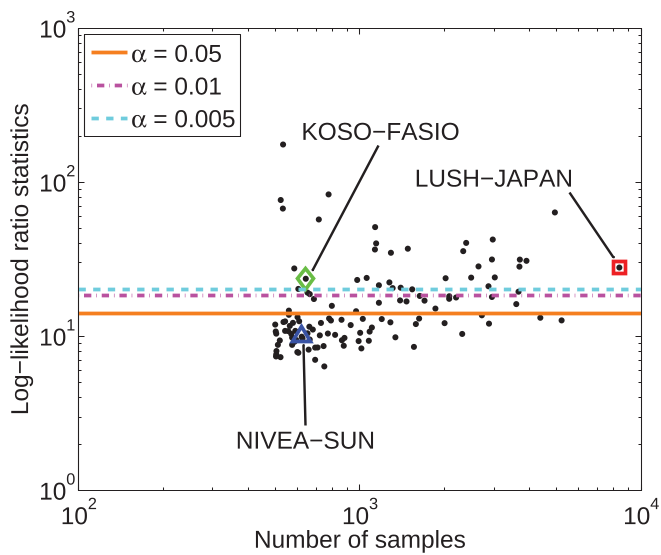 Figure 2: Relative estimation error across different numbers of change points (J). The LR (Likelihood Ratio) method consistently outperforms individual modality counterparts.
Real-World Case Study: @cosme
Applying the model to a Japanese cosmetics site revealed three distinct types of events:
- Reputation Decay: For "LUSH-JAPAN," the model found a shift where high scores decreased while posting frequency remained relatively stable.
- Malicious Activity: For "KOSE-FASIO," the model detected a burst of low-rated reviews from a single account, essentially identifying "review bombing."
- Seasonality: For "NIVEA-SUN," the model captured the summer surge in sunscreen reviews, noticing that more users lead to more critical/diverse feedback compared to the "hardcore fan" base in off-seasons.
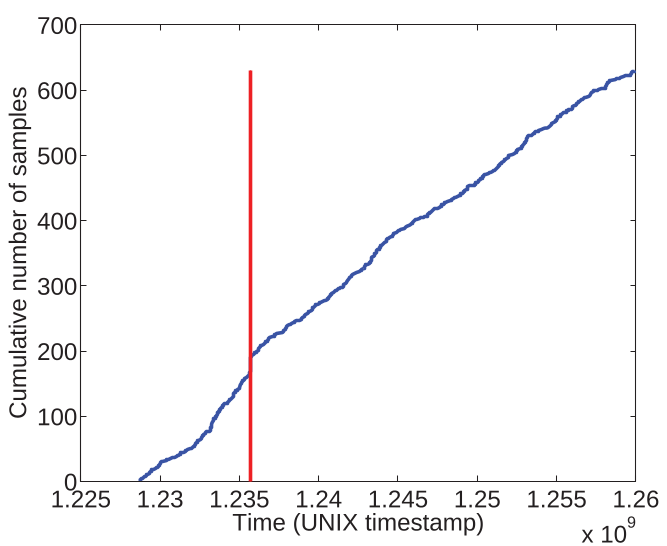 Figure 3: Deep dive into LUSH-JAPAN, showing the drift in score distributions over three detected periods.
Critical Analysis & Conclusion
Takeaway
The paper confirms that social media is more than just "how much loud noise" exists; it's about the character of the noise. By framing change detection as a statistical model selection problem, the authors provide a rigorous way to separate organic growth from artificial bursts or fundamental market shifts.
Limitations
While efficient (), the model assumes step functions for parameter changes. In the real world, opinions often shift gradually (linear or sigmoidal) rather than abruptly. Furthermore, the model relies on the independence of content and timing given the segment parameters, which might not hold during complex viral events.
Future Outlook
This approach is highly extensible. One could replace the categorical distribution with Word Embeddings (like BERT/RoBERTa latent spaces) or the exponential distribution with more complex Hawkes Processes to model self-exciting tweet chains.