
Detecting the "Hot Span": Unmasking External Shocks in Social Network Diffusion
Detecting changes in information diffusion paerns over social networks
This paper introduces an efficient framework for detecting "hot spans"—periods of anomalous activity caused by external factors—within information diffusion processes on social networks. It proposes a general iterative search algorithm applicable to both the Asynchronous Independent Cascade (AsIC) and Value-weighted Voter (VwV) models, achieving state-of-the-art efficiency by utilizing likelihood derivatives to identify change points.
Executive Summary
TL;DR: This research tackles the problem of identifying when and how much a social network's behavior changes due to external events. By treating these events as "hot spans" where diffusion parameters spike, the authors develop a derivative-based search algorithm that identifies these windows 100x faster than traditional brute-force methods while maintaining higher accuracy across both "push" (active spreading) and "pull" (opinion forming) models.
Academic Positioning: This work bridges the gap between stationary probabilistic modeling and real-world non-stationary dynamics. It moves beyond simple "burst detection" (like Kleinberg’s HMM approach) by explicitly modeling the underlying graph-based diffusion mechanism.
The Motivation: Why Stationary Models Fail
Most information diffusion models, such as the Independent Cascade (IC) or Voter models, assume that the probability of a "rumor" spreading or an "opinion" being adopted remains constant over time. In reality, external shocks—a political scandal, a product launch, or a natural disaster—temporarily alter the "reflectivity" of the network.
The authors identify a critical gap: Detecting these changes retrospectively from limited data. Current methods either ignore the network structure or are too slow, as they try to fit new parameters for every possible start and end time of a potential "hot span."
Methodology: The Geometry of Likelihood
The core innovation lies in the General Iterative Search Algorithm. Instead of the "Naive" approach—which picks a time window, optimizes parameters, checks likelihood, and repeats—the authors look at the gradient of the likelihood function.
The Intuition
If we assume no change and fit a parameter to the whole dataset, the derivative of the total log-likelihood is zero. However, in segments where the actual parameter was higher (the hot span), the local derivative will be positive; where it was lower (normal span), it will be negative.
- Global Fit: Estimate parameters for the entire duration .
- Gradient Search: Compute the modification vector , which sums the partial derivatives over a candidate window .
- Boundary Identification: The window that maximizes is the most likely "hot span."
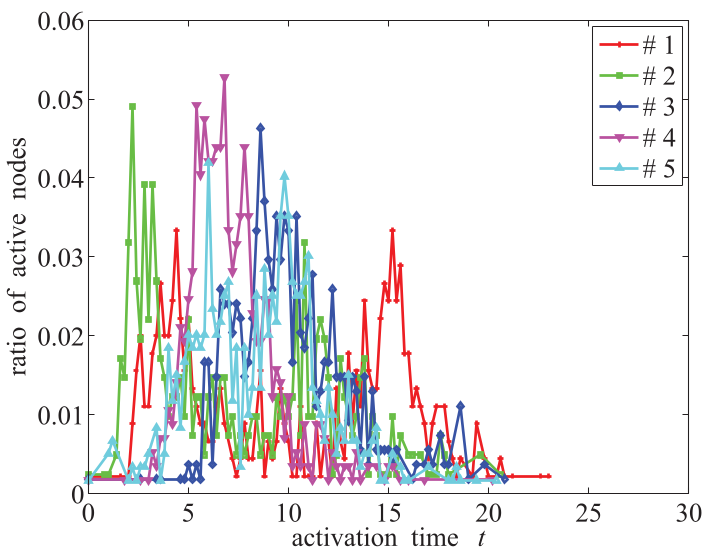 Figure 1: Comparison of information diffusion with and without a hot span. Note how the "bursty" activity in (b) hints at parameter shifts.
Two Flavors of Diffusion: AsIC and VwV
To prove the method's versatility, the authors tested it on two distinct behaviors:
- Asynchronous Independent Cascade (AsIC): A "Push" style model where an active node tries to infect neighbors. The parameter of interest is Diffusion Probability.
- Value-weighted Voter (VwV): A "Pull" style model where a node adopts the majority opinion of its neighbors based on their "weight." The parameter of interest is Opinion Value.
Experimental Evidence: Speed vs. Accuracy
The researchers utilized four real-world datasets: Blogroll, Coauthorship, Enron (email), and Wikipedia.
Key Findings:
- Accuracy: The proposed method consistently outperformed the naive method (which used a restricted set of candidate points) by a factor of 3 to 10 in terms of absolute time error.
- Efficiency: Because it avoids the "inner loop" of parameter optimization, the algorithm is several orders of magnitude faster.
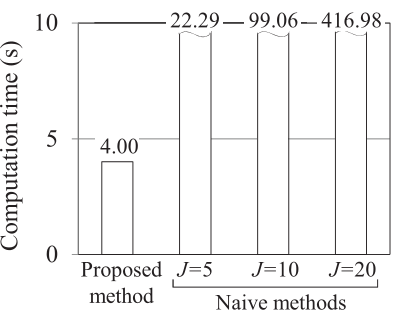 Figure 2: Statistical error and computation time comparison. The proposed method (red/filled) stays low on error while being drastically faster than naive candidates (J=5, 10, 20).
Critical Analysis & Future Directions
The beauty of this work is its mathematical parsimony. By using the first-order derivative, the authors transformed a combinatorial search problem into a signal processing task on the likelihood manifold.
Limitations:
- The model assumes a "rect-linear" change (a sudden step up and step down). While the authors briefly show a recursive partition approach for multiple spans (see Appendix), real-world shocks often have a "decay" pattern (exponential or power-law) which the current model might only approximate.
- It assumes the network structure itself is stationary, which might not hold during long-term social shifts.
Future Work: Applying this to spatio-temporal detection—where only a portion of the graph (a specific community) goes "hot"—is the logical next step for detecting localized social unrest or targeted marketing success.
Conclusion
This paper provides a robust toolkit for social scientists and data engineers to "hear" the external signal through the "noise" of network diffusion. By shifting focus from "what is happening" to "how the rules of interaction are changing," it offers a sophisticated lens for modern social media monitoring.