
Social Spam Exposed: How 57,000 Compromised Accounts Hijacked Facebook Walls
Detecting and characterizing social spam campaigns
This paper introduces an automated system to detect and characterize coordinated spam campaigns on Facebook by analyzing 187 million "wall" messages. It utilizes textual similarity fingerprints and URL destination clustering to uncover large-scale malicious activities, marking a pioneering effort in quantifying social network spam.
TL;DR
This seminal study by Gao et al. provides the first large-scale quantification of spam campaigns on Facebook. By analyzing 187 million wall posts, researchers developed a clustering algorithm that identifies coordinated attacks based on URL and text similarity. The shocking revelation? Social spam isn't just "fake bots"—it's a fleet of nearly 97% compromised legitimate accounts spreading phishing and malware under the guise of friendship.
Background: The Trust Paradox
In 2010, Facebook surpassed Google as the most visited site. Its core value was "trust"—you are more likely to click a link from a friend than a random email. This trust, however, created a "high-return" environment for attackers. While email spam was a solved problem for many, social spam was an emerging frontier characterized by obfuscated URLs (e.g., www dot hack dot com) and customized messaging.
Methodology: Connecting the Dots
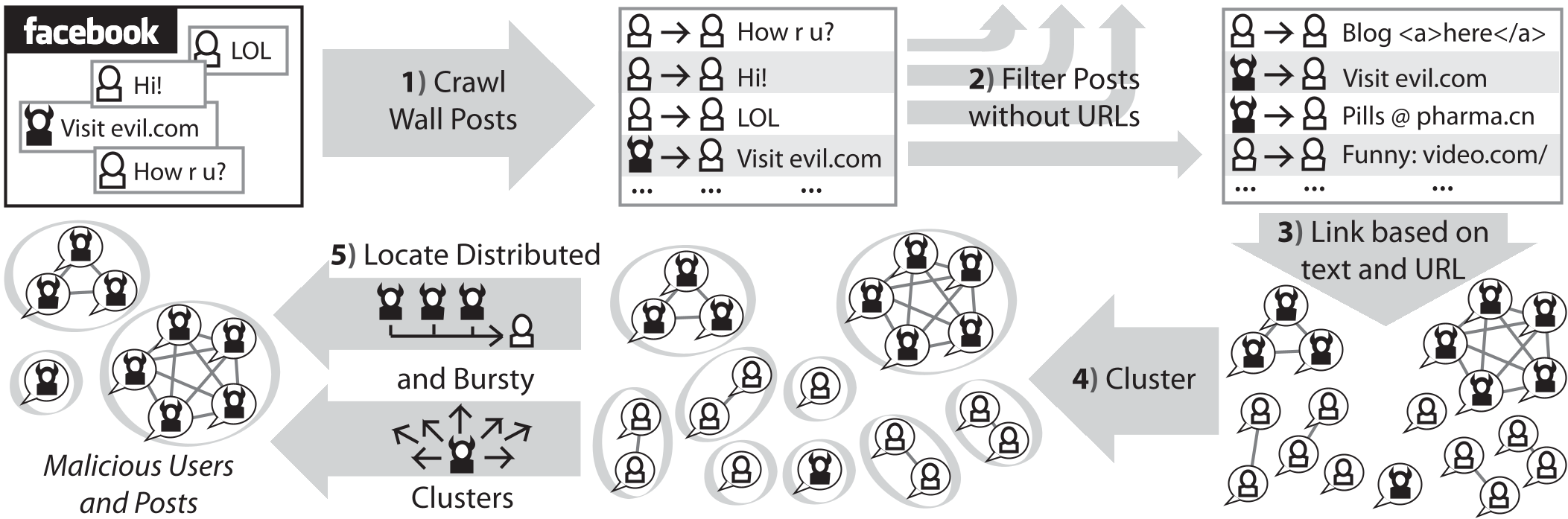
The researchers' core insight was that while individual spam messages might look different, they share a common DNA: the destination and the template.
1. The Similarity Graph
The system builds a graph where each wall post is a node. Edges are drawn based on:
- URL Matching: Even if a URL is hidden in plain text or behind a redirect chain, the system follows it to its final destination.
- Textual Fingerprinting: Using MD5 hashes of 10-byte substrings, the system creates a "probabilistic fingerprint." If 19 out of 20 fingerprints match between two posts, they are clustered together.
2. Identifying the "Bursty" and "Distributed"
A massive cluster isn't necessarily spam (it could be a viral concert link). To separate the wheat from the chaff, the system looks for:
- Distribution: Does the content come from many different User IDs?
- Burstiness: Are the messages posted in rapid succession? (Threshold used: median interval < 1.5 hours).
Key Findings: Phishing via Your Friends
The results from the 297 identified campaigns paint a grim picture of OSN security:
- Phishing Dominance: Over 70% of malicious wall posts directed users to phishing sites, often mimicking the Facebook login page to steal credentials.
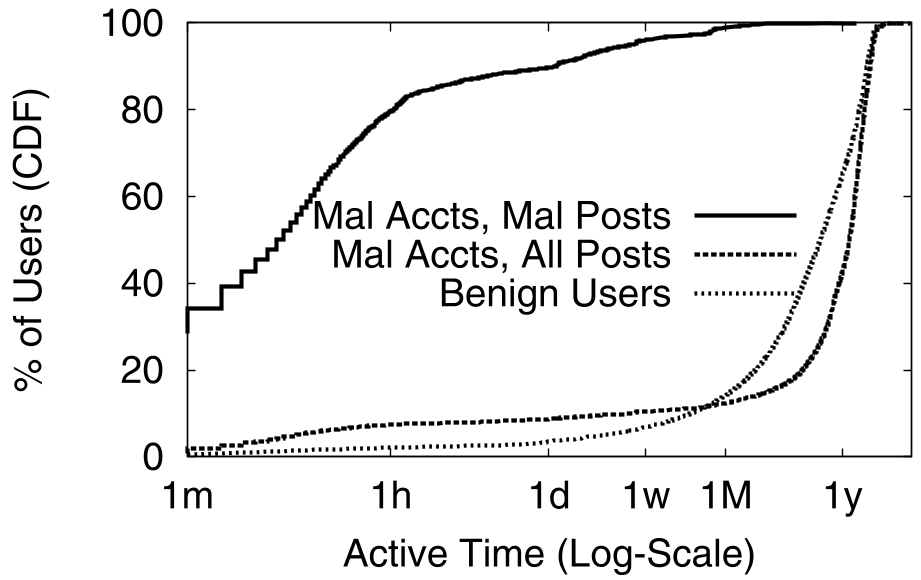
- The "Compromised" Truth: By analyzing application usage and social interaction, researchers concluded that 97% of accounts were compromised, not fake. Attackers hijack a real person’s account to exploit their existing social ties.
- Diurnal Patterns: Spammers are "night owls" by necessity. Malicious activity peaks at 3:00 AM local time, likely to avoid immediate detection by the account owner.
Campaign Diversity
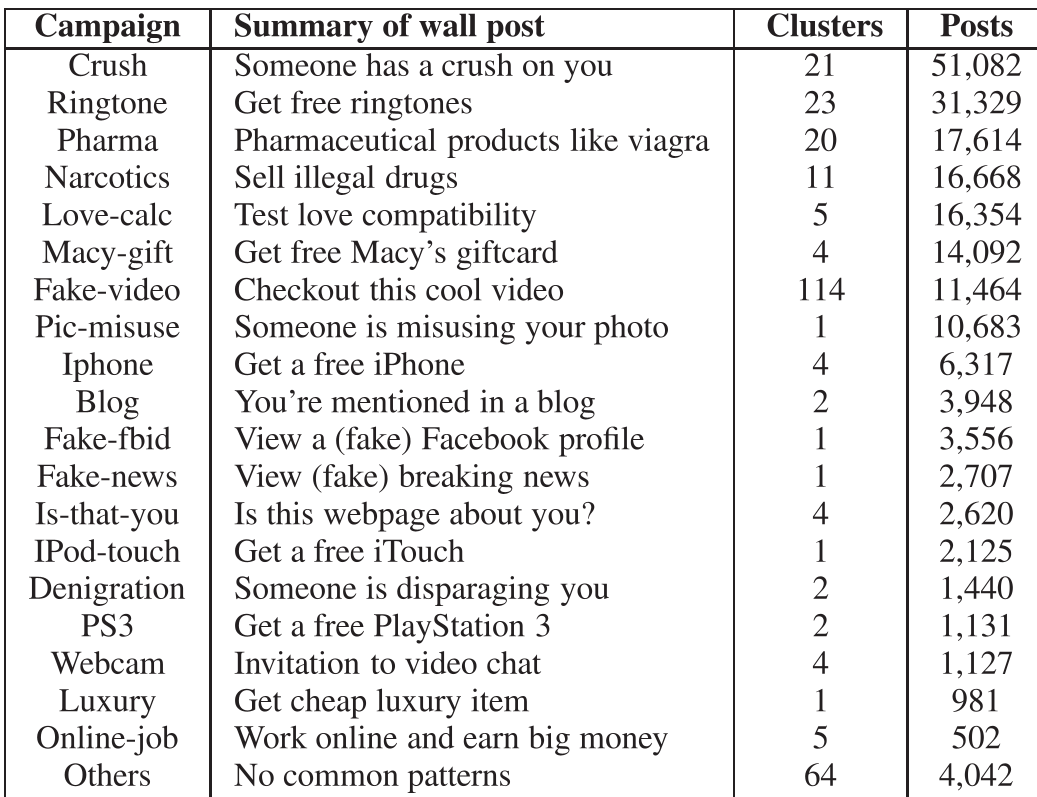
The authors identified 19 unique campaign types. The "Crush" campaign (e.g., "Someone has a secret crush on you!") was the most prolific, leveraging human curiosity to drive clicks.
Critical Insight & Conclusion
The genius of this work lies in shifting the focus from content to coordination. By looking for "campaign-like" behavior across the entire network graph, the researchers bypassed the arms race of message obfuscation.
The Takeaway: For developers of social platforms, the biggest threat isn't the Sybil (fake) account—it's the "Zombie" account (a legitimate friend's account under remote control). Security systems must prioritize cross-account correlation over single-account rate limiting.
Limitations: As this study is post-mortem (2010), it doesn't account for modern AI-generated spam that can vary text templates even more drastically. However, the fundamental logic of "distributed and bursty" traffic remains a cornerstone of OSN security today.