
DSBM: A Bayesian Leap in Tracking Evolving Social Communities
Detecting communities and their evolutions in dynamic social networks—a Bayesian approach
This paper introduces the Dynamic Stochastic Block Model (DSBM), a probabilistic generative framework designed to detect community structures and their temporal evolutions in dynamic social networks. By employing a Bayesian treatment rather than point estimation, the model updates community memberships through transition matrices and predicts links via Bernoulli distributions, achieving SOTA performance in accuracy and robustness to noise.
TL;DR
Social networks are not static; they breathe and evolve. This paper presents the Dynamic Stochastic Block Model (DSBM), a rigorous Bayesian framework that doesn't just look at community "snapshots"—it models the actual transition of individuals across groups over time. By moving from simple point estimation to a full Bayesian posterior analysis, the authors achieve a new level of robustness against noise and a deeper understanding of network dynamics.
The Evolution Gap in Network Analysis
Most community detection algorithms treat time as a series of still frames. They find groups in Time , find them again in Time , and then try to "glue" them together using heuristics. This approach has two fatal flaws:
- Instability: Small noise at one timestamp can radically flip the community structure, leading to "false" evolutions.
- Lack of Motivation: They answer what changed, but not how the underlying probability of moving between groups evolved.
The authors identify that point estimation (like standard EM algorithms) is too brittle for sparse, noisy real-world data. They propose a generative approach where the network's state today is a direct probabilistic consequence of its state yesterday.
Methodology: The Generative Intuition
The DSBM operates on a dual-logic system:
- The Transition Logic (The "How It Changes"): Every node has a probability of staying in its current group or migrating to a new one, governed by a transition matrix .
- The Emission Logic (The "How It Looks"): Once memberships are set, the links (edges) between nodes are drawn based on their community blocks (within-group ties vs. between-group ties).
The Model Architecture
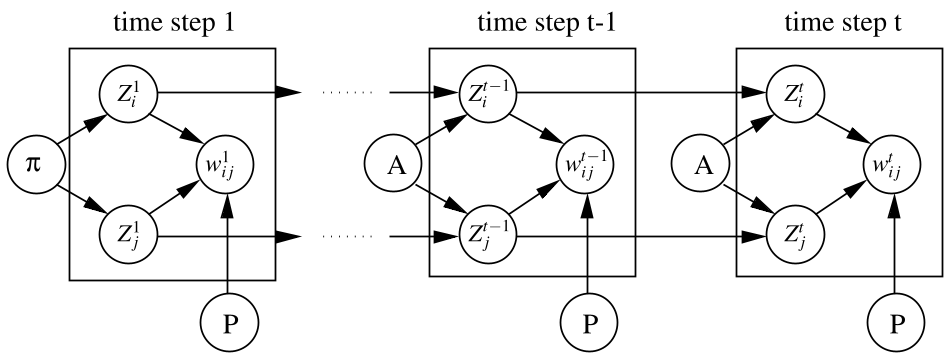
The beauty of the Bayesian treatment here is the use of Conjugate Priors. Instead of guessing a single value for membership, the model calculates the entire posterior distribution. This allows the model to be "uncertain" when data is sparse (like a blog with only one link) and "confident" when patterns are strong.
Efficiency at Scale: Sparse Gibbs Sampling
A common critique of Bayesian methods is their computational cost. The authors bypass this by developing a Gibbs Sampling algorithm optimized for sparse matrices.
- Linear Complexity: The time complexity is , where is nodes and is edges.
- Incremental Updates: Since only one node's membership changes at a time during sampling, the global statistics are updated incrementally rather than recalculated from scratch.
Experimental Evidence
The model was tested against state-of-the-art baselines like FacetNet and Evolutionary Spectral Clustering.
Accuracy and Noise Robustness
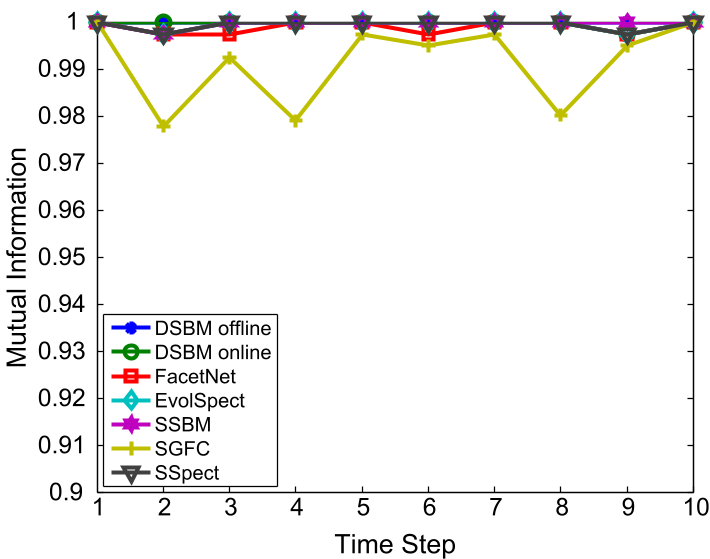
On synthetic datasets where "ground truth" was known, DSBM consistently maintained high Normalized Mutual Information (NMI) even as noise levels (the ratio of inter-community to intra-community links) increased.
Real-World Insight: DBLP Co-authorship
In a 10-year study of DBLP data, the model successfully tracked the migration of researchers. For instance, it captured the shift of prominent scholars from "Database" communities to "Data Mining" and "AI" communities, reflecting the broader industry trend of the early 2000s—all without ever "seeing" the paper titles or conference names.
Critical Analysis
Why it works
The transition matrix acts as a temporal regularizer. It prevents the model from over-fitting to temporary noise in a single snapshot by requiring that changes in community membership must be statistically significant over the long term.
Limitations
- Fixed K: The model assumes the number of communities is known and fixed. In real-world scenarios, communities often split or merge, changing dynamically.
- Hyperparameter Sensitivity: While robust to and , the parameters and (governing link density) require careful validation using modularity as a proxy.
Conclusion
The DSBM is a landmark in dynamic network analysis. It transitions the field from "observing changes" to "modeling the process of change." For practitioners, the message is clear: when dealing with temporal data, the transition is as informative as the state.
Technical Editor's Note: This paper remains a foundational reference for anyone building recommendation systems or social listening tools that need to account for the "shifting sands" of user interests over time.