
Unmasking the Water Army: A Hybrid Approach to Crowdsourcing Spam Detection in CQA
Detecting Crowdsourcing Spammers in Community Question Answering Websites
This paper presents a supervised machine learning approach to identify crowdsourcing spammers in Community Question Answering (CQA) platforms. By linking the ZBJ crowdsourcing market with Baidu Zhidao, the authors propose a hybrid detection model utilizing 131 features across profile, social network, content, and linguistic dimensions, achieving an AUC of 0.995.
TL;DR
Community Question Answering (CQA) sites like Baidu Zhidao are being overrun by "Internet Water Armies"—paid workers hired via crowdsourcing platforms like ZBJ to spread spam or manipulate opinions. This paper introduces a high-precision detection framework that combines behavioral profile analysis with semantic linguistic modeling. By tracking the "survival rate" of answers and the "copying" habits of workers, the authors achieved a near-perfect AUC of 0.995.
Problem & Motivation: The Rise of "Crowdturfing"
Unlike traditional bot-driven spam, crowdsourcing spammers are real humans. They are hired for tiny rewards (1) to perform tasks that are easy for humans but hard for algorithms to detect.
The authors identify a critical gap: while prior research focused on Twitter or Weibo, CQA platforms present a unique challenge because the social links between users are weak and transient. Spammers operate in pairs (one asking, one answering), making it difficult to rely solely on graph-based social network analysis.
Methodology: The Hybrid Feature Engine
The core of this research lies in its multi-dimensional feature set. The authors extracted 131 features, categorized into five groups:
- Profile Features (PF): Including a new metric called the Survival Answer Rate. Since spam is often reported or deleted by admins, a low ratio of "accessible" answers to "total" answers is a massive red flag.
- Social Network Features (GF): Measuring Authority and Centrality. Spammers tend to have significantly lower authority scores compared to legitimate contributors.
- Content Similarity (CF): Using Latent Semantic Indexing (LSI) to detect if a worker is recycling answers across different tasks to maximize profit.
- Linguistic Features (LF): Utilizing the Textmind system to analyze 102 psycholinguistic dimensions, discovering that spammers use significantly more numerals and Latin words (URLs/Brand names) than normal users.
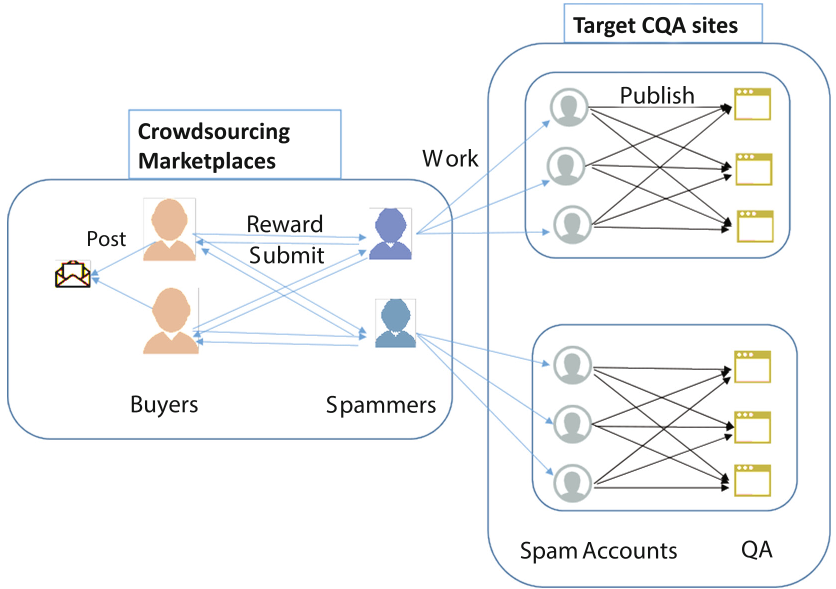 Figure 1: The workflow linking crowdsourcing markets (ZBJ) to CQA targets (Zhidao).
Experiments & Results: Precision is Key
The authors tested their features using Naive Bayes, SMO, and Random Forest. Recognizing that the dataset was imbalanced (fewer normal users than spammers), they applied SMOTE (Synthetic Minority Over-sampling Technique).
The Power of "Survival" and "Copying"
The Feature Selection process revealed that the most significant indicator of a spammer is the "Mean number of answers copied per excellent answer." This reflects the business reality: buyers want their paid answers to be marked as "Best Answer," but workers are too lazy to write original content for every task.
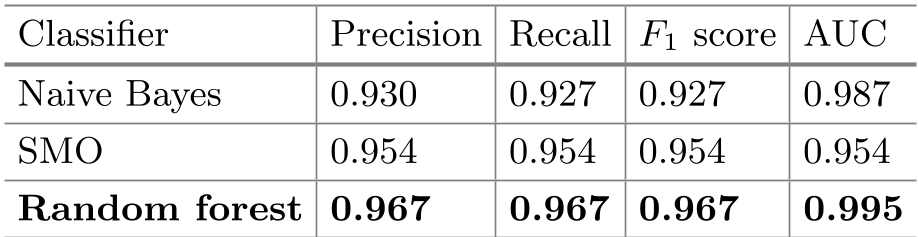 Table 5: Results showing Random Forest's dominance after SMOTE application.
Compared to the 2015 baseline by Xu et al., which relied heavily on profile and basic social features, this hybrid approach improved the AUC from roughly 0.94 to 0.99, proving that linguistic and content similarity features are the missing pieces of the puzzle.
Critical Analysis & Conclusion
Takeaway
The success of this method emphasizes that contextual history matters. We cannot judge a user simply by their current post; we must look at the "mortality rate" of their previous posts (Survival Rate) and their tendency to repeat patterns seen elsewhere in the network.
Limitations & Future Work
The study was conducted in 2016. In the current era of Generative AI, spammers can now use LLMs to generate unique, high-quality, and "human-like" text for every post, potentially neutralizing the "Content Similarity" and "Linguistic" features used here. Future research must look into AI-generated text detection to keep the "Water Army" at bay.
Overall, this work remains a foundational case study in cross-platform adversarial analysis, showing that the best way to catch a spammer is to look at where the job was posted in the first place.