
Friends or Foes: Unmasking Dishonest Recommenders in Social Networks
Friends or Foes: Detecting Dishonest Recommenders in Online Social Networks
The paper introduces a distributed detection framework to identify "shill attackers"—dishonest users who provide misleading product recommendations in Online Social Networks (OSNs). It proposes two randomized algorithms (Alg. A1 and A2) targeting baseline and intelligent attackers, achieving near-zero false positive rates within a small number of purchase rounds.
TL;DR
In the age of viral marketing, your "friends" might be paid shills. This paper by Li and Lui presents a mathematically rigorous, fully distributed framework to detect dishonest recommenders in Online Social Networks (OSNs). By analyzing the mismatch between social recommendations and the actual quality of purchased products over time, their algorithms can isolate malicious actors with high precision (near-zero false positives) in as few as 15 purchase cycles.
Problem & Motivation: The "Shill" in the Machine
Viral marketing relies on the word-of-mouth effect. While effective for business, it is highly susceptible to Shill Attacks. Attackers can:
- Promote: Give high ratings to low-quality products.
- Bad-mouth: Discredit high-quality competitors.
The core challenge is the Inductive Bias of Social Trust. If an honest friend recommends a bad product because they were misled by others (the "Majority Rule"), they appear dishonest. How do we distinguish a malicious attacker from a friend who is simply wrong?
Methodology: The Logic of Elimination
The authors propose a "Detector" model. Every time a user (the detector) makes a purchase, they gain "Ground Truth" about a product's quality. They then compare this truth against previous recommendations received from their neighbors.
1. The Shrinking Suspicious Set
The detector maintains a Suspicious Set .
- Initial State: Everyone is a suspect.
- Observation: If a neighbor provides a correct recommendation (matching the ground truth), they are cleared and removed from the set.
- Retention: If they provide a wrong or no recommendation, they stay in the set.
2. Handling the Intelligent Attacker
Sophisticated attackers don't just lie; they lie probabilistically () to mimic honest behavior and avoid detection. To counter this, the authors introduce Alg. A2: Randomized Detection. Instead of clearing someone the moment they are right, the algorithm uses a randomized probability to decide whether to trust that "correct" recommendation, making it statistically impossible for an attacker to remain hidden in the long run.
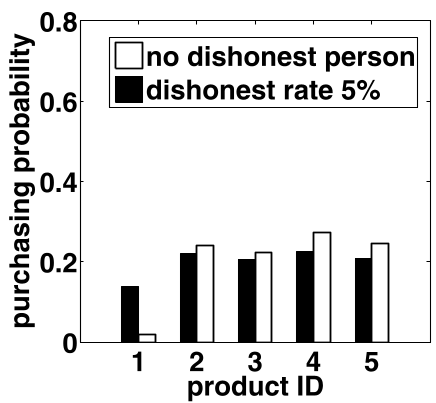 Fig 1: Impact of shill attacks on market share (Malicious Competition vs. Malicious Cheating).
Experiments & Results
The authors validated their model using a synthetic OSN with 8,000 nodes and 70,000 edges, following a power-law degree distribution (GLP model).
- Attack Impact: The presence of just 5% dishonest users can distort the market distribution of a low-quality product to the point of making it appear competitive with high-quality goods.
- Detection Efficiency: As shown below, the False Positive rate () drops exponentially.
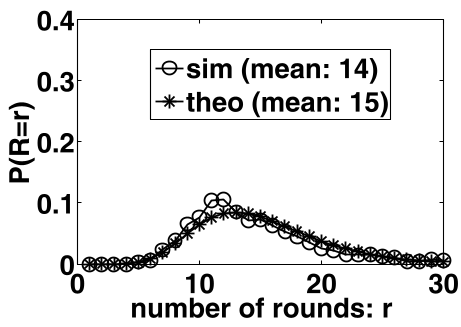 Fig 2: Convergence of False Positive and False Negative probabilities over detection rounds.
For the baseline attack, is effectively 0—meaning no attacker escapes. For intelligent attacks, the detector might need a few more rounds or a lower "shrinkage probability," but the trend towards total detection remains inevitable.
Critical Analysis & Takeaways
This work is foundational because it moves away from Centralized Reputation Systems (like eBay or Amazon's global ratings) and focuses on Local, Distributed Trust.
Key Insights:
- Why it works: The "Ground Truth" from a purchase is the ultimate verifier. While attackers can manipulate opinions, they cannot manipulate the quality of the product once it's in the detector's hands.
- Limitations: The model assumes "regular" purchase intervals and substitutable products. In the real world, diverse product categories and varying purchase frequencies might slow down the "shrinkage" of the suspicious set.
- The Future: This logic could be integrated into browser extensions or OSN plugins, providing users with a "trust score" for their friends' shopping advice without needing a central authority to police speech.
By treating recommendation security as a stochastic process, Li and Lui provide a robust roadmap for securing the economic integrity of our social interactions.