
Decoding Emergence: Using Semi-Boolean Algebra to Map Hidden Social Complexities
Detecting Emergence in Social Networks
This paper introduces a mathematical framework based on Semi-Boolean Algebra to predict and detect emergent behaviors in interconnected social networks. By modeling networks as a "System of Systems," the authors identify candidate emergent properties as fusion elements in a derived "op-logic" structure.
TL;DR
The collective behavior of interconnected social networks is significantly more complex than the sum of their individual parts. This paper proposes a rigorous mathematical framework using Semi-Boolean Algebra to detect "Emergent Behavior"—unforeseen actions arising from the interaction of experts, startups, or even illicit cells. By mapping these interactions into a specific inference structure called op-logic, the researchers provide a roadmap for identifying hidden patterns that traditional "aggregate" analysis misses.
Background: Why "Aggregate" is Not "Emergence"
In the study of complex systems, there is a vital distinction between aggregate and emergent behavior.
- Aggregate behavior is predictable: if you add more nodes to a network, the volume of traffic grows linearly.
- Emergent behavior is "greater-than-the-sum." It is what happens when a visionary and a financier come together to create a startup, or when diverse radical groups form a terrorist cell.
The primary technical challenge is the lack of a "God's eye view." In the real world, we only see slices of a network (e.g., one department, one specialized investigation). This paper attempts to bridge these slices without needing a single, global view.
The Core Insight: Semi-Boolean Algebra
Traditional Boolean algebra assumes that for every set of elements, there is a global "logical opposite" (complementation). In sprawling, decentralized social networks, this isn't true. Instead, the authors turn to Semi-Boolean Algebra (specifically Subtraction Algebra).
How it Works:
- Operations as Perspectives: Each investigation or "sub-network" is treated as a maximal element (an operation).
- Relative Complementation (oc): Within one sub-network, we can find "logic opposites." For example, in a smuggling ring, if you aren't investigating the leader (C), you are investigating the transporters (A and B).
- Operational Perspective (op): If two groups from different sub-networks share a common "logical opposite," they are considered "operationally perspective." This links disparate networks together.
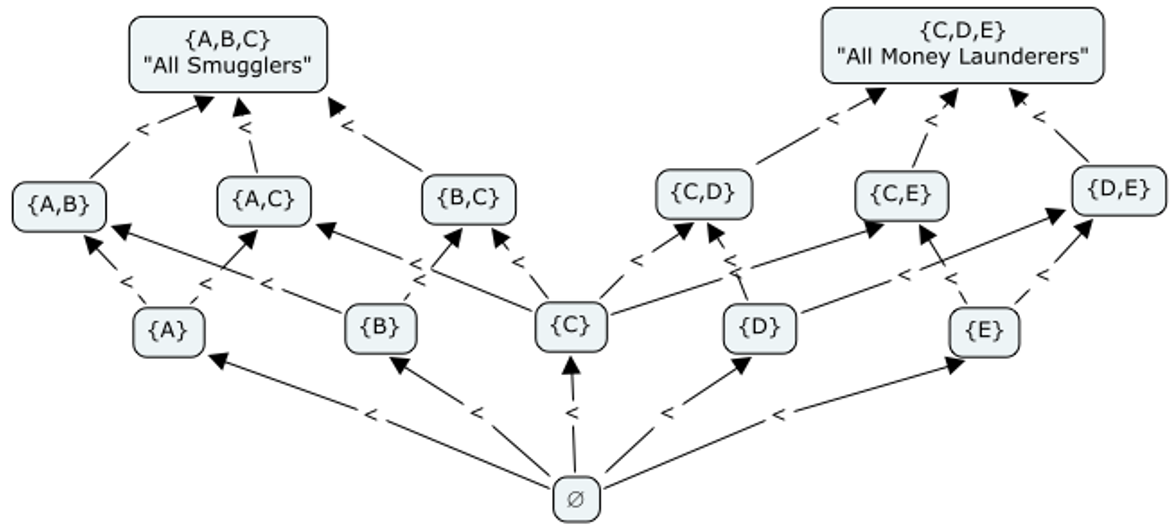 Figure 1: The lattice diagram shows how "All Smugglers" and "All Money Launderers" share element 'C', creating a merged structure that is non-Boolean.
Methodology: From Posets to op-logic
The authors define candidate emergent behaviors as nodes in an inference structure (op-logic) that contain members from different sub-networks.
If a node in this logical structure merges elements from the "Smugglers" set and the "Money Launderers" set, that node represents an emergent behavior. The researchers call these "interesting" equivalence classes. As seen in Figure 2, the behavior "Avoiding C" is an emergent property inferred from the atomic behaviors of individuals in both networks.
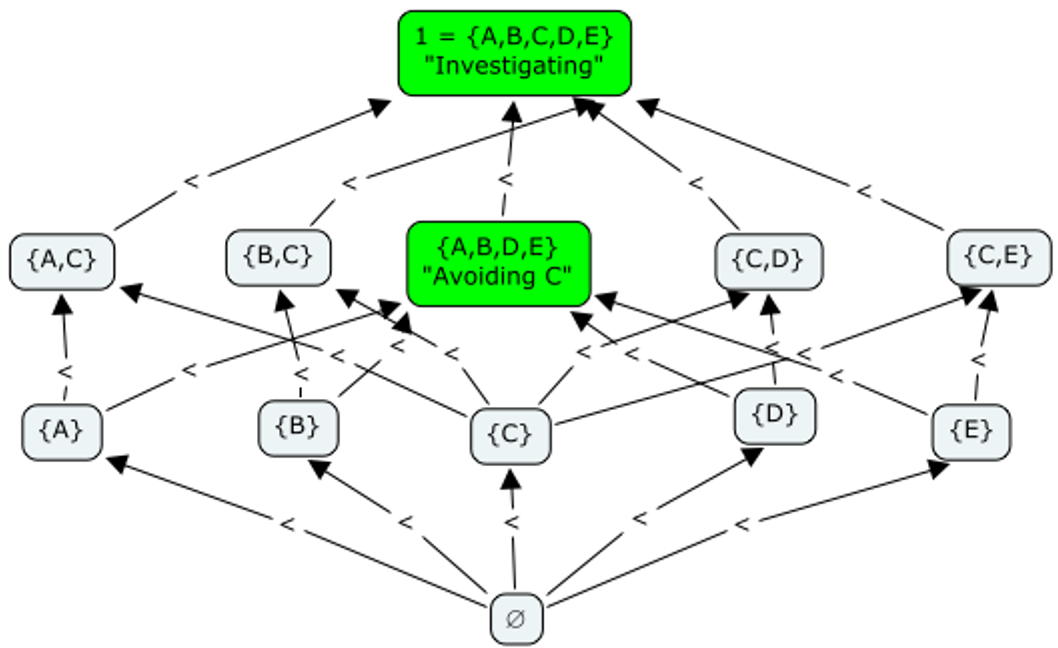 Figure 2: The green nodes signify where emergence occurs—where different network behaviors fuse into a new logical state.
SOTA Comparison & Results
Unlike prior heuristic-based approaches that rely on simple connectivity (e.g., "who knows who"), this method uses Order Axioms.
- Inference Utility: Even if we only detect a single person (A) in the smuggling network, we can use the op-logic to infer the larger emergent behavior ("Avoiding C") that involves people from the money laundering network (D, E).
- Robustness: The method handles "weak emergence" (unexpected results) by providing a formal quotient structure that maintains logical consistency even across fragmented data.
Critical Analysis & Future Outlook
While the paper provides a powerful qualitative tool for detection, it faces limitations in quantification. The authors acknowledge that characterizing "real-world situations" that produce these regularity conditions is still an open research goal.
Future Directions:
- Latent Variables: Integrating Structural Equation Modeling (SEM) into the Semi-Boolean framework to find "unobservable" parameters that drive emergence.
- Dynamic Complexity: Applying this to real-time social streams where the "M" (Manual condition) for lattice stability might change as the network evolves.
This work serves as a foundational bridge between abstract lattice theory and practical social network analysis, moving us closer to predicting radical shifts in group dynamics before they reach a tipping point.