
Beyond Sentiment: Decoding the "Why" Behind Emotions with CRF
Detecting Emotion Stimuli in Emotion-Bearing Sentences
This paper introduces the task of Emotion Stimulus Detection in English text using an information extraction approach. The authors leverage FrameNet to automatically construct a labeled dataset and deploy a Conditional Random Field (CRF) learner that integrates linguistic features to identify text spans responsible for evoking emotions.
TL;DR
While AI has become adept at recognizing that a user is angry or sad, understanding why remains a significant challenge. This paper presents a pioneering effort to detect "Emotion Stimuli" in English text. By repurposing FrameNet data and applying a Conditional Random Field (CRF) model enriched with syntactic features, the authors move the needle from simple sentiment classification to deep causal extraction.
Context & Motivation: The Missing Link in Affective Computing
Most sentiment analysis tools are "black boxes" of emotion—they label a sentence as "Happy" but ignore the event that triggered it. In the sentence, "Labour MPs unleashed their anger at the Liberal Democrats for promising to back the Government," the emotion is anger, but the stimulus is the Liberal Democrats.
Previous work in this niche was largely confined to Chinese datasets or over-simplified clause-level spotting. The authors argue that English requires a finer granularity because the stimulus often resides within complex phrases or specific syntactic roles that generic causality models miss.
Methodology: Engineering the Causal Detector
The research transforms the problem into an Information Extraction (IE) task. The core of their approach rests on two pillars:
1. Data Construction via FrameNet
The authors bypassed the "no data" problem by mining FrameNet, a rich linguistic resource. They mapped 173 Lexical Units (LUs) to Ekman’s core emotions (Happiness, Sadness, etc.). This resulted in a supervised dataset where both the emotion and the specific "Stimulus" span were meticulously labeled.
2. The Sequential Learning Model (CRF)
Instead of simple classification, they treated the sentence as a sequence of tokens. They utilized Conditional Random Fields (CRFs), which are superior for this task because they consider the conditional probability of a label sequence based on the entire observation.
Key Features Injected into the CRF:
- Corpus-Based Features: Token patterns and neighboring window words (context).
- Events: Utilizing the Evita tool to identify verbal and nominal events (e.g., "the crash", "has died").
- Syntax (Chunks & Clauses): Using OpenNLP to identify SBAR (subordinate clauses) and noun/verb chunks to prevent the model from cutting off spans mid-phrase.
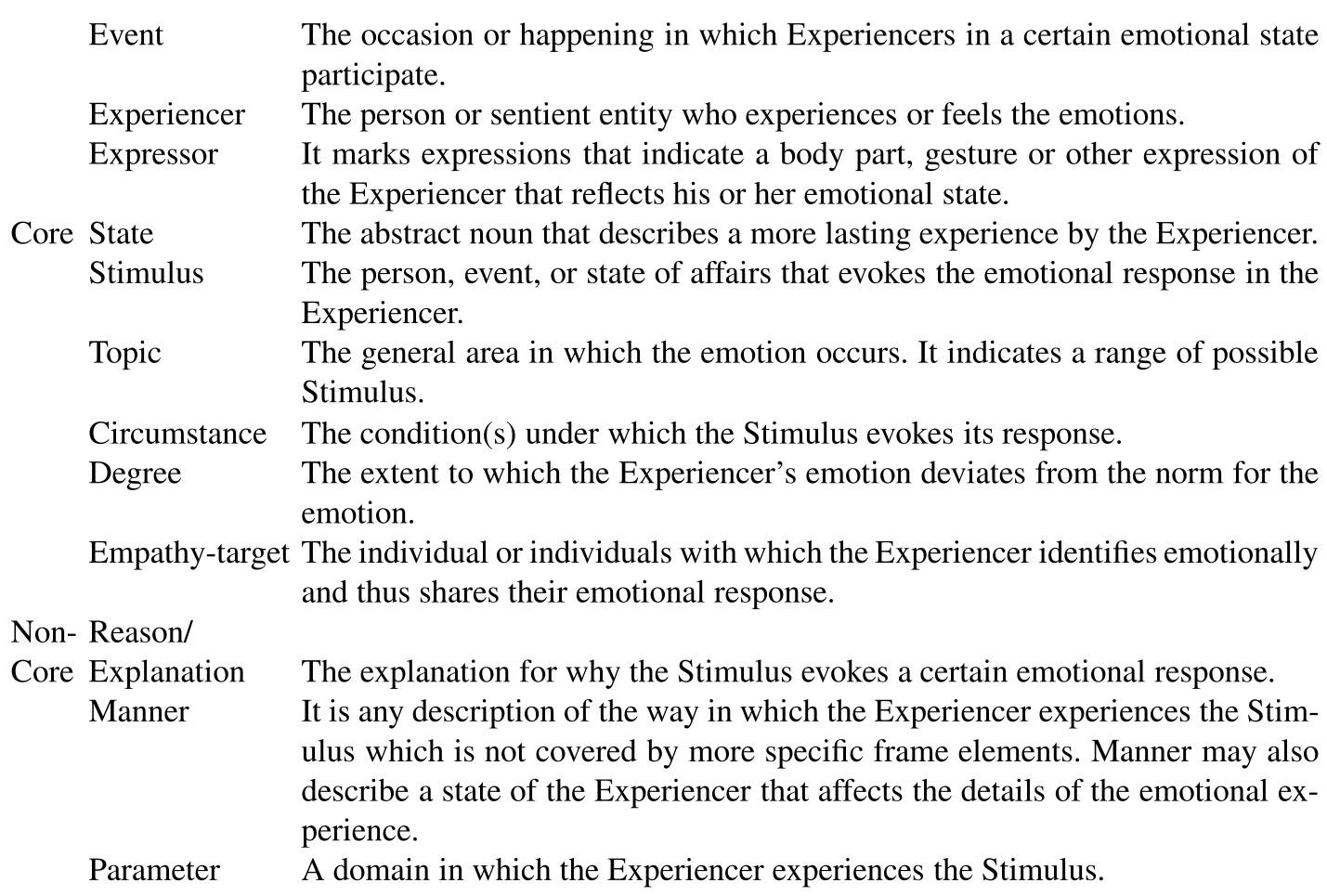 Table 1: The FrameNet hierarchy used to define 'Core' vs 'Non-Core' emotion elements.
Experiments: What Makes a Stimulus?
The authors tested several baselines, including random verb selection and Bag-of-Words. The results clearly showed that syntax is king.
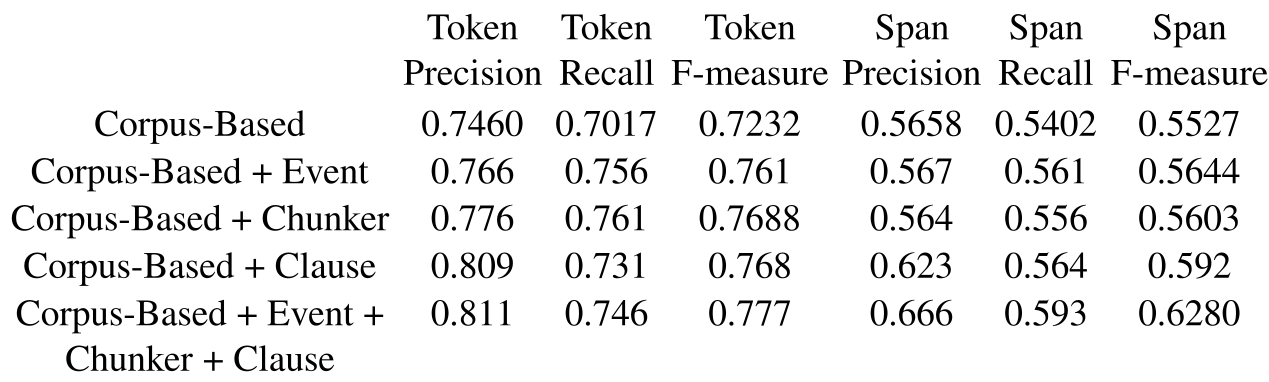 Table 6: The incremental value of adding syntactic features to the CRF model.
Key Findings:
- The "Clause" Insight: Adding clause-level features provided the biggest jump in Span Precision (from 0.56 to 0.62). This confirms that emotion stimuli are often self-contained propositional units.
- Event Sensitivity: Recognizing that a word is an "event" (like a death or a meeting) provides the model with the semantic "trigger" for the emotion.
Critical Analysis & Future Outlook
The model's primary weakness remains the detection of the end of a stimulus span. The authors noted that the model often gets distracted by prepositions like "at" or "with," sometimes capturing trailing irrelevant information.
Why this matters for the industry: This research lays the groundwork for more empathetic AI. Imagine a customer support bot that doesn't just see a "frustrated" user, but explicitly extracts the reason (e.g., "the late delivery") and addresses that specific stimulus.
In the future, moving toward Joint Extraction—detecting the emotion and the stimulus simultaneously—could allow the two tasks to reinforce each other, further bridging the gap between machine perception and human understanding.
Summary Takeaway
By moving from "what" to "why," this paper provides a robust framework for Emotion Stimulus Detection in English, proving that a combination of CRF learners and deep syntactic features outperforms standard NLP baselines.