
Sensing Geographic Communities: Bridging Physical Mobility and Social Ties
Detecting Geographic Community in Mobile Social Network
This paper introduces the concept of "Geographic Community" for mobile social networks, a novel measurement that bridges spatial proximity and social structures. The authors propose an improved Symmetric Nonnegative Matrix Factorization (SNMF) method to detect these communities by processing a spatial proximity matrix derived from GPS/location trajectories.
TL;DR
This research proposes the Geographic Community, a new metric that shifts the focus of social network analysis from "who you talk to" to "where you share space." By applying Symmetric Nonnegative Matrix Factorization (SNMF) to spatial proximity data, the authors demonstrate a method to detect communities that can predict future social evolutions and optimize wireless network performance.
Background: Beyond the Digital Handshake
In the realm of mobile social networks, communities have traditionally been defined by interaction frequency—calls, texts, and shared interests. However, an essential dimension is often overlooked: Spatial Proximity. Humans are creatures of habit, driven by periodic movements (work/home) and social invitations. This paper argues that individual mobility doesn't just reflect social ties; it shapes them.
The Core Challenge
Existing community detection algorithms like Newman’s method are effective for static social graphs but are less suited for high-dimensional, noisy mobility data. The problem is twofold:
- Measurement: How do we mathematically quantify the similarity between two people's physical trajectories?
- Detection: How do we extract meaningful clusters from a dense matrix where everyone has some level of geographic overlap with everyone else?
Methodology: The SNMF Approach
1. Defining Spatial Cosine Similarity
The authors define spatial proximity using the Spatial Cosine Similarity (). Essentially, it treats a user's visitation history across various locations (Cell Towers) as a vector. The similarity between two users is the cosine of the angle between these vectors:
2. Community Sensing via SNMF
Once the spatial proximity matrix is constructed, the authors treat it as an undirected weighted network. They use Symmetric Nonnegative Matrix Factorization to solve the following optimization problem:
The resulting matrix provides a "membership probability," allowing for the detection of overlapping communities where individuals might belong to multiple geographic groups.
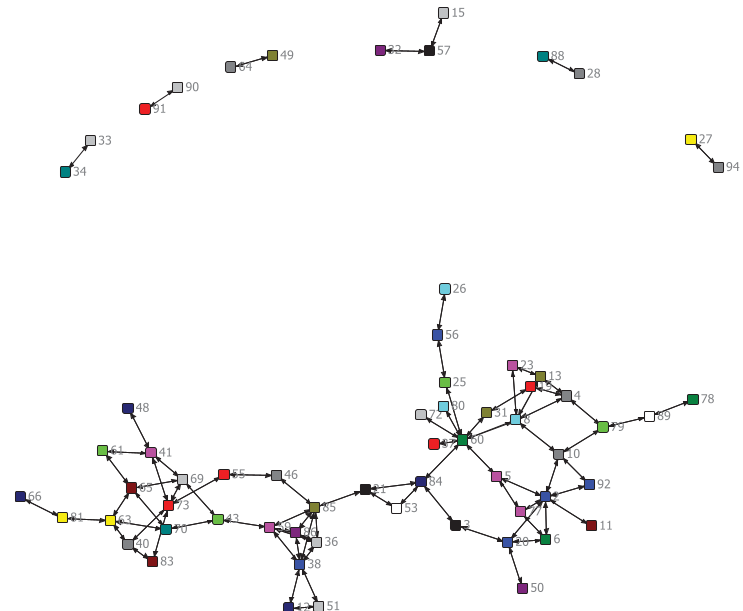 Fig 1: The approximate overlay network based on spatial proximity, showing the dense connections before clustering.
Experimental Insights
Using the MIT Reality Mining dataset, the study compared social communities (friendship based on calls) with geographic communities.
Key Findings:
- Visibility: Unlike social graphs which often have clear clusters, geographic overlays are dense (Fig. 1). Standard binarization loses too much data; hence the need for weighted SNMF.
- Mapping: In Fig. 4, the SNMF convergence reveals how 94 different nodes map into two primary geographic clusters. The "gray level" represents the probability of belonging to a specific community.
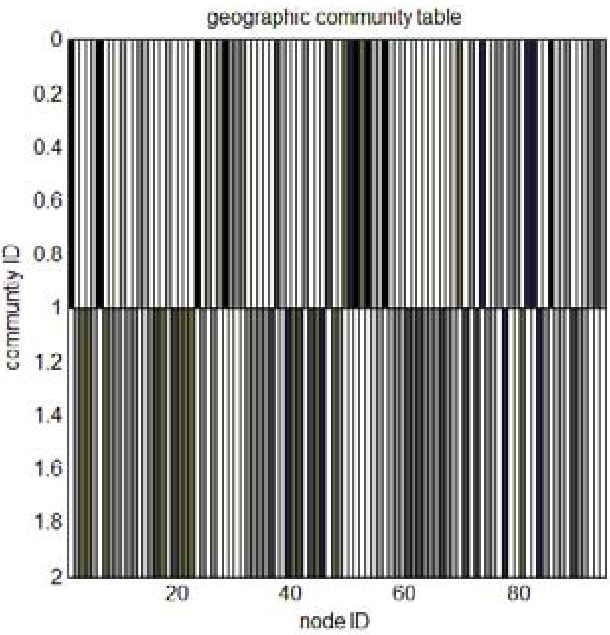 Fig 2: The membership probability matrix X, showing the distribution of the 94 nodes across two detected geographic communities.
Critical Analysis & Future Outlook
While the paper successfully formalizes the "Geographic Community," several challenges remain:
- Ambiguity: Spatial proximity is "noisy." Being at the same mall doesn't mean you are in the same social community.
- Predictive Power: The authors suggest geographic proximity predicts future social links, but more longitudinal studies are needed to quantify this "lead time."
Future Directions
- Evolution Prediction: Using geographic patterns to forecast when a new social group is about to form.
- MANET Optimization: Using these communities to design "social-aware" routing protocols, where data is passed to individuals who physically move between geographic communities (data mules).
Conclusion
This work provides a necessary bridge between geography and sociology. By treating space as a first-class citizen in social network analysis, we move closer to models that can truly anticipate the dynamic nature of human interaction.