
Unveiling the Invisible: Detecting Hidden Friendships via Privacy Exceptions
Detecting Hidden Friendship in Online Social Networks
This paper introduces a methodology to detect "hidden friendships" in Online Social Networks (OSNs) by analyzing exceptions in ring-based privacy settings. By calculating an adaptive trust threshold based on shared profile items, the author reveals latent social ties that are not formally declared as "friendships" but exhibit high levels of mutual trust.
TL;DR
In the world of Online Social Networks (OSNs), a "friend" isn't always a friend, and a stranger isn't always a stranger. This paper reveals how privacy settings—specifically the exceptions we make—act as a "trust leak" that allows investigators to map hidden social networks. Even if users never click "Add Friend," their fine-tuned data-sharing permissions give away their closest allies.
Background: The Limits of the Explicit Graph
Most Social Network Analysis (SNA) treats friendship as a binary edge: either it exists, or it doesn't. However, this fails to capture the nuance of Trust. In security and intelligence, this is a critical flaw. Criminals might deliberately avoid formal links to stay under the radar of algorithms that look for high-centrality nodes. If we only look at the explicit friendship graph, we are blind to the most dangerous, hidden connections.
The Core Insight: Privacy Exceptions as Trust Signals
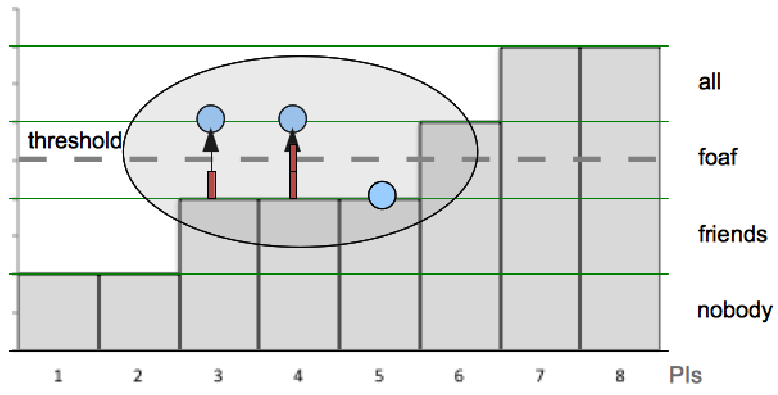
The author moves from a static graph to an exception-based trust model. Most OSNs use a "Ring-based" disclosure system:
- R0: Nobody
- R1: Friends
- R2: Friends-of-friends (FoF)
- R3: Everyone
The breakthrough here is focusing on Exceptions. If User A allows User B (who is technically only an FoF) to see private items usually reserved for "Friends Only," User A has explicitly signaled a high degree of trust in User B. These are the "hidden links."
Methodology: From Simple Counts to Adaptive Thresholds
Simply counting shared items isn't enough. If a user shares their "Music Interests" with everyone by exception, it doesn't mean they trust everyone. It just means that specific piece of data isn't considered sensitive.
To solve this, the paper introduces an Adaptive Threshold (SL'). The weight () of a disclosure is devalued if it is "inflationary."
- High Selectivity = High Weight: If you share your phone number with only one person outside your friends, that link is heavily weighted.
- Ubiquity = Low Weight: If you share your profile photo with 90% of your non-friends, it ceases to be a meaningful indicator of hidden friendship.
Case Study: Jumping the Ring
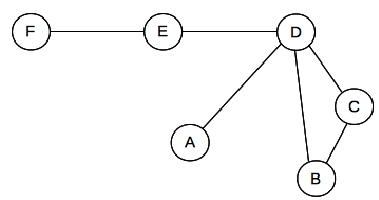
The model allows for detecting friendships that "jump" over multiple rings. For example, a user might share their entire profile with a complete stranger (over a distance in the graph). By analyzing the resulting disclosure matrix, the author shows how a friendship graph can be reconstructed to include these hidden, directed relationships.
Critical Analysis: The Privacy Paradox
This paper exposes a fascinating Privacy Paradox. As users become more privacy-conscious and use "fine-tuned" settings to protect their data, they are actually providing OSN operators with more granular data about their social hierarchies. By trying to hide your data from the public, you are highlighting exactly who you trust most to the system administrator.
Limitations and Future Work
While the mathematical framework is robust, it primarily focuses on access rights. The author acknowledges that future iterations should include:
- Communication Frequency: How often do these "hidden friends" actually interact?
- Textual Analysis: Do their posts show common linguistic patterns?
- Scalability: Testing the algorithm on massive datasets like modern Facebook or X (Twitter) structures.
Conclusion
This work shifts the paradigm of social discovery from "what links exist" to "what trust is shown." For law enforcement and intelligence, it provides a mathematical scalpel to dissect obscured networks. For the average user, it serves as a reminder that in digital spaces, even our "private" settings are a form of public disclosure.