
The Ghost in the Machine: Catching "In Situ" Identity Fraud through Browsing Behavior
12435_Detecting In Situ Identity Fraud on Social Network Services A Case Study With Facebook.
The paper proposes a novel continuous authentication scheme to detect "In Situ Identity Fraud" on Social Network Services (SNS), focusing on Facebook as a case study. The method leverages "role-driven behavioral diversity" and employs a Smooth Support Vector Machine (SSVM) to distinguish account owners from stalkers (acquaintances or strangers) based on browsing patterns.
TL;DR
Researchers have developed a way to catch "peekers"—acquaintances or strangers who sneak into your social media account on your own phone or laptop. By analyzing subtle patterns in how you browse Facebook (what you click, how fast you scroll, and whose profiles you stalk), a universal machine learning model can flag an unauthorized user with over 80% accuracy in just 120 seconds.
The "Invisible" Threat: In Situ Identity Fraud
While Silicon Valley spends billions on preventing hackers from China or Russia, a much more intimate threat often goes unnoticed: In Situ Identity Fraud. This happens when someone you know—a suspicious spouse, an overbearing parent, or a nosy colleague—uses your already-logged-in device to snoop.
Since these attackers use the correct device, the correct IP address, and the correct credentials (often saved cookies), traditional defenses like Two-Factor Authentication (2FA) never trigger. The "attacker" isn't a hacker; they are a guest in your home or office.
The Insight: "Role-Driven Behavioral Diversity"
The core philosophy of this paper is that what you do when you think you are someone else is different from what you do when you are yourself.
The authors identified three distinct roles:
- The Owner: Focuses on recent updates, interacts often (Likes/Comments), and spends time on the Newsfeed.
- The Acquaintance (Stalker): Searches for historical data, checks friend lists, and avoids "Likes" to stay stealthy.
- The Stranger: Looks at photos and profile "cards" to figure out who the victim actually is.
Methodology: Turning Clicks into a Digital Fingerprint
The researchers monitored 18 common actions (Likes, View Photos, Expand Comments) and transformed them into 139 features. These features aren't just about "counts"; they capture the tempo and intent of the session.
The Model Architecture
To make this scalable for a site like Facebook with billions of users, they didn't build a model for every person. Instead, they built a Universal Model using a Smooth Support Vector Machine (SSVM).
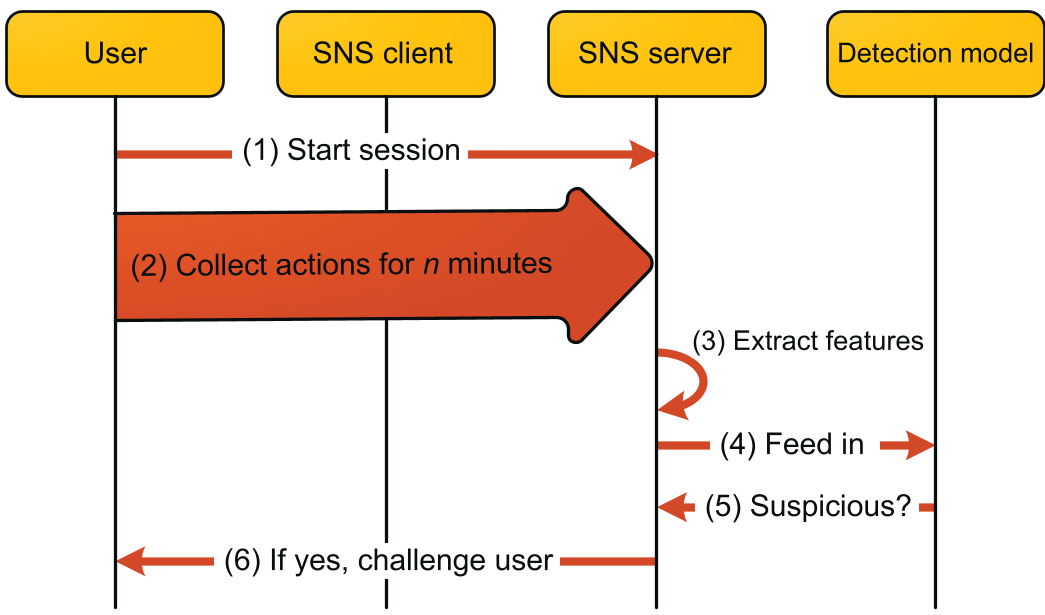 Figure 1: The real-time detection workflow from login to challenge.
The process follows a rigorous pipeline:
- Data Collection: Capturing HTTP/HTTPS requests via proxy.
- Feature Selection: Using 1-norm SVM to prune noisy data, reducing the set to the 60 most "telling" behaviors.
- Classification: Running the session through an SSVM to decide if the user is a "Stalker."
Experimental Battle-Card
Does it actually work in the wild? The researchers conducted a study with 112 participants (56 pairs of acquaintances) and logged over 27,000 actions.
Performance over Time
The most impressive find is the speed of detection. Security systems are useless if they take an hour to trigger—by then, the private messages are already read.
- 2 Minutes: ~82% Accuracy.
- 7 Minutes: >90% Accuracy.
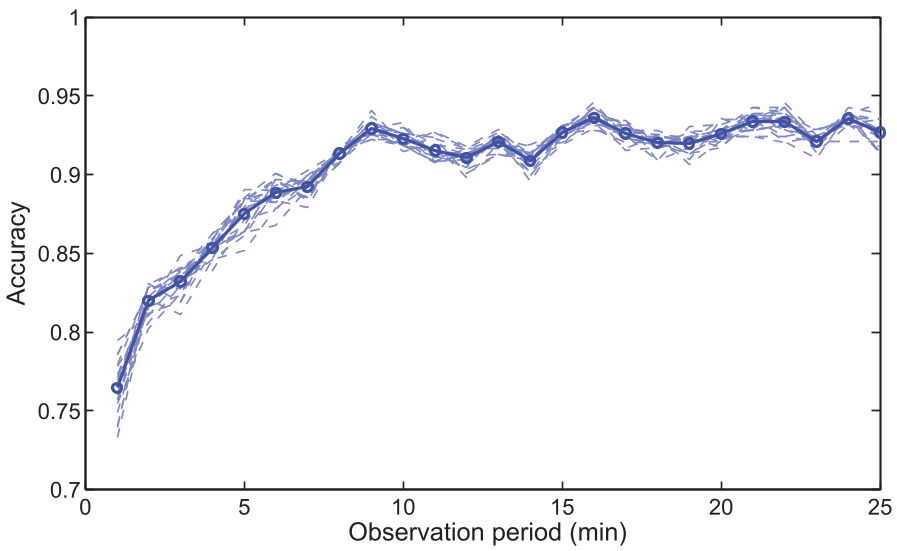 Figure 2: The model gains confidence rapidly as user behavior deviates from the owner's baseline.
What gives a stalker away?
According to the weights in the model (as seen in the paper's feature importance analysis), stalkers are betrayed by:
- Lower interaction rates: They don't want to leave a "Like" notification that tips off the owner.
- Higher "Expand Page" rates: They are digging through the past, not just looking at the top of the feed.
- Profile Card Prying: Seeking context on the victim's social circle.
Critical Insight & Future Outlook
This paper shifts the paradigm of "Continuous Authentication" from physical biometrics (like how you hold your phone) to Social Biometrics (how you traverse a social graph).
Limitations: The study was conducted in a controlled environment. In a real-world scenario, a very sophisticated attacker who knows about this system could theoretically "act" like the owner—liking a few recent posts to throw the algorithm off.
The Takeaway: Identity is no longer just a password; it's a sequence of intentions. As social networks become the primary repositories of our digital lives, "silent" security layers like this will become the standard, challenging us only when our behavior stops looking like "us."