
Decoding the Digital Oil Well: Influence and Power on Twitter during Brazil’s 2019 Mega Auction
Detecting Influential Communities in Twitter during Brazil Oil Field Auction in 2019
The paper presents a framework for detecting influential communities and users on Twitter during the 2019 Brazil mega oil field auction. By combining the Louvain method for community detection and the Herfindahl-Hirschman Index (HHI) for influence concentration analysis, the study identifies key protagonists and the polarization of public opinion.
Executive Summary
TL;DR: This study analyzes the social media dynamics surrounding one of the world's largest oil auctions. Using complex network analysis (Louvain Method) and economic concentration metrics (HHI), researchers mapped out how government bodies, private oil giants, and political activists clashed or collaborated in the digital sphere.
Positioning: This work bridges the gap between Computational Social Science and Economic Theory, applying market concentration indices to social media influence to identify "opinion monopolies."
The Core Friction: Transparency vs. Strategy
The Oil & Gas (O&G) sector is notoriously tight-lipped. However, social media has forced these legacy entities into a two-way conversation with environmental activists and legal regulators. The 2019 "Transfer of Rights" auction in Brazil served as a perfect laboratory to observe this friction. The authors noted a critical gap: while some players use Twitter for legitimacy, others—most notably Chinese state-owned enterprises—remain strategically invisible, creating a "black hole" in the social network graph.
Methodology: From Modularity to Monopoly
The researchers didn't just look at who has the most followers; they looked at the structure of influence.
- Community Detection (Louvain): They partitioned the network of mentions into 7 distinct clusters based on modularity.
- Concentration Analysis (HHI): Borrowed from antitrust economics, the Herfindahl-Hirschman Index was used to see if a community's voice was dominated by one "monopolist" or spread across many users.
- Visual Dynamics: Using Force-Directed Layouts, they mapped users as charged particles to see which accounts act as "bridges" between opposing political camps.
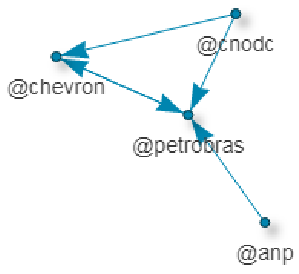 The multi-step pipeline: From raw Twitter scraping to Influence Share calculation.
Key Insights from the Network
1. The "Government Galaxy" (Community C1)
As the most influential community, C1 was dominated by Petrobras and Brazilian regulatory agencies (ANP). Interestingly, it had a low HHI (0.26), meaning influence was widely distributed among different government nodes rather than being a single-person megaphone.
2. The Silent Winners
A striking finding was the complete absence of Chinese companies (CNOOC, CNODC) on Twitter. Despite being the only foreign winners of the auction, they maintained a "party-state" policy of digital silence, contrasting sharply with the active PR of Shell and Chevron.
3. The Hashtag Battleground
The hashtag network revealed a highly polarized environment. Central nodes like #presal and #petroleo served as the common ground, but were surrounded by divergent clusters like:
- The Opposition:
#leilaodopresaleroubo(Auction is a robbery). - The Environmentalists:
#leilaofossilnao(No fossil auction). - The Unexpected: A significant tie-in with the crypto-market (
#bitcoin,#blockchain), suggesting a niche but vocal community linking energy resources to digital assets.
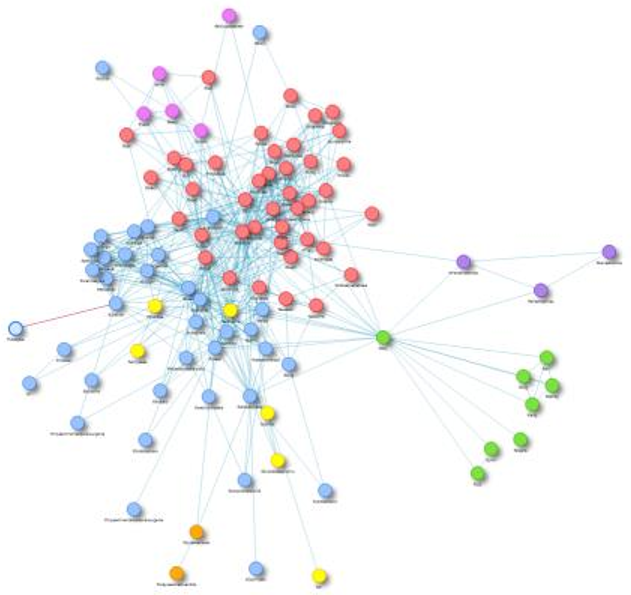 The Hashtag Network visualizing the ideological split between energy development and environmental/political opposition.
Critical Analysis & Conclusion
While the study successfully identifies the "Who" and the "How," it highlights a fundamental limitation of social media analysis: Invisible Influence. The fact that Chinese NOCs won the auction without a single tweet suggests that in highly regulated industries, the most influential players may not be in the graph at all.
Future Outlook: The authors suggest moving toward the Leiden Algorithm to solve Louvain's tendency to create poorly connected communities. For industry analysts, the takeaway is clear: digital sentiment in the energy sector is a proxy for public trust, and those who remain silent may be leaving their narrative to be shaped by the opposition.
Keywords: Twitter Analysis, Louvain Method, HHI, Brazil Oil Auction, Complex Networks.