
Beyond Static Centrality: Evolution and Incremental Detection of Influential Nodes in OSNs
Detecting Influential Nodes Incrementally and Evolutionarily in Online Social Networks
This paper introduces the Incremental Influential Nodes Detection (IIND) algorithm to identify local and global influential nodes in Online Social Networks (OSNs). By leveraging three distinct time-window partition methods and a behavior-based influential degree model, the study achieves superior performance in influence spread compared to traditional static metrics like Maximum Degree Heuristic (MDH).
TL;DR
Static analysis is no longer enough to understand information viralization. This paper proposes the IIND (Incremental Influential Nodes Detection) algorithm, which treats influence as a dynamic variable. By segmenting the life cycle of a "tweet" or "post" into windows, the authors track how influence shifts from elite media hubs to local actors, providing a roadmap for more effective influence maximization.
The Problem: The Static Trap
In the early days of social network analysis, we relied on Degree Centrality or K-shell decomposition. The logic was simple: the more connections you have, the more influential you are. However, in the fast-paced world of Sina Weibo or Twitter, many "high-degree" nodes are dormant, while "low-degree" nodes might trigger massive cascades due to the timing and context of their engagement.
The authors identify two gaps:
- Measurement Gap: We lack a behavior-driven metric for "influential degree."
- Evolution Gap: We don't know how influencers emerge and fade as a topic matures.
Methodology: The IIND Framework
The core innovation lies in the Incremental Influential Degree (). Unlike static counts, it calculates a node's specific contribution within a discrete time window, factoring in:
- Behavioral Ratios: Retweets, Comments, and Likes relative to the total window volume.
- Authority Scaling: A weighted factor for verified (certified) accounts and the certification status of their followers.
Window Partitioning Strategies
To capture the evolution pattern, the authors tested three ways to slice the data:
- Uniform Time Window: Fixed intervals (e.g., 1 hour).
- Non-Uniform Window: Adjusted for the "decay" of information (smaller windows at the start, larger at the end).
- Uniform Retweet Window: Windows defined by activity volume rather than clock time.
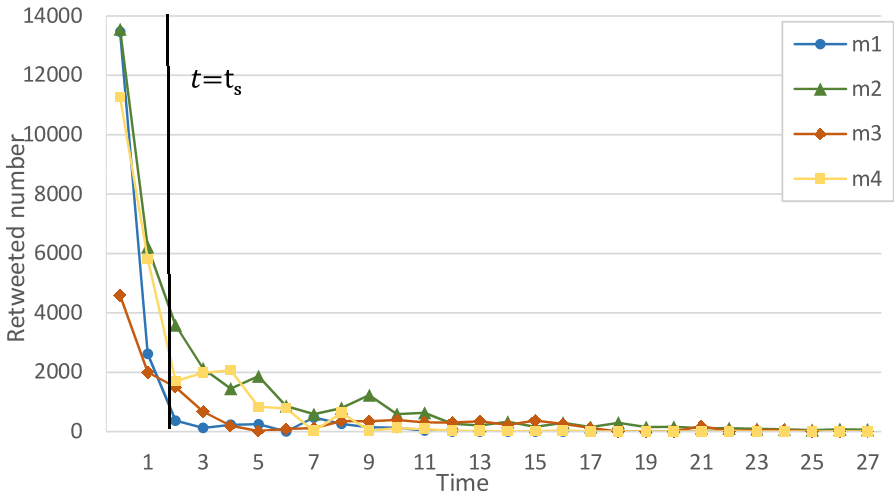 Figure 1: The IIND process transforms a static propagation tree into a sequence of temporal snapshots.
Experiments and Discoveries
Using real-world datasets from Sina Weibo (covering major news events), the researchers uncovered fascinating Evolution Patterns:
- The Power Law of Influence: Local influence follows a heavy-tailed distribution, mirroring the overall decay of interest in a topic.
- Geographic Diffusion: Information typically flows from economic hubs (Beijing, Shanghai) to the countryside.
- Identity Shift: Influence starts with News Media, moves to Famous Bloggers, and eventually settles with Official Organizations.
- Certification Decay: As time passes, the percentage of "certified" influencers involved in a cascade drops, showing how "ordinary" users take over the conversation in its later stages.
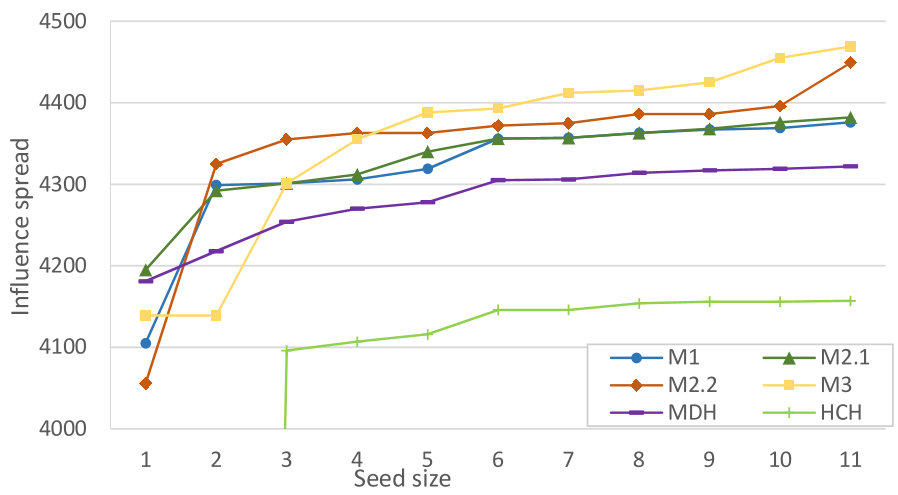 Figure 2: Performance comparison showing that IIND-selected seeds (especially using Method 3) achieve a wider influence spread than traditional heuristics (MDH, HCH).
Critical Analysis & Conclusion
The IIND algorithm's beauty is its computational efficiency. By focusing on incremental changes within windows, it avoids the complexity common in greedy influence maximization algorithms, making it viable for large-scale OSNs.
Limitations: The model relies heavily on "certification" as a proxy for authority. In modern decentralized platforms (like Mastodon or newer Twitter iterations), the value of a "checkmark" is decreasing, which might require a more nuanced "trust" metric in future iterations.
Takeaway for Practitioners: If you are launching a campaign, target the Global Influencers (media) for the initial burst, but identify Local Influencers in the second and third windows to sustain the momentum as the topic diffuses into specific demographics and regions.