
Beyond Friend Counts: Measuring "True" Influence via Interaction Dynamics
Towards Detecting Influential Users in Social Networks
This paper introduces an interaction-based model to identify influential users in online social networks (OSNs) by analyzing the frequency and direction of user communications. Unlike connection-based approaches, it effectively filters out spammers and inactive users, achieving higher accuracy in detecting real influence within dynamic digital environments.
TL;DR
In the world of social media marketing, a million followers can be meaningless if they don't talk to you. This paper argues that interaction frequency, not just connection counts, is the secret to identifying true "Influencers." By modeling social networks as directed graphs of messages, the researchers provide a robust framework that ignores spammers and inactive users who often trick traditional algorithms.
Background: The Illusion of Popularity
In the early days of Social Network Analysis (SNA), "Indegree Centrality" (how many people follow you) was the gold standard. However, in the era of Web 2.0, this metric is easily gamed. Spammers can follow thousands of people to boost their visibility, and many "friendships" are essentially dead—connecting two accounts that never actually exchange a single word.
The authors' core insight is simple: If there is no communication, there is no influence.
The "Interaction-Based" Methodology
The authors shift the perspective from a static map of "Who knows whom" to a dynamic map of "Who talks to whom."
1. The Directed Interaction Graph
Unlike offline friendships which are usually mutual, online interactions are often one-sided. The authors build a directed graph where an edge exists only if a message or content piece is transferred.
2. The Core Metrics
The paper defines several sophisticated metrics to weight the influence:
- Link Strength (): The ratio of two-way interactions between two users compared to their total output. Stronger bonds mean influence travels more easily.
- Clustering Values (): This measures how close a user is to highly interconnected "clusters." If you sit at the gates of a dense community, your voice propagates further.
- The Zeroing Mechanism: To handle the "noise," the authors use a hyperbolic tangent function () on outdegree. If a user doesn't generate content (), their total influence score is mathematically forced to zero, regardless of how many followers they have.
 The Influence Equation: Combining activity volume, cluster proximity, and bond strength.
Experimental Results: Filtering the Noise
Using a simulated network of 150 nodes created with the Java Universal Network/Graph (JUNG) framework, the authors compared their model against standard connection-based sociometrics.
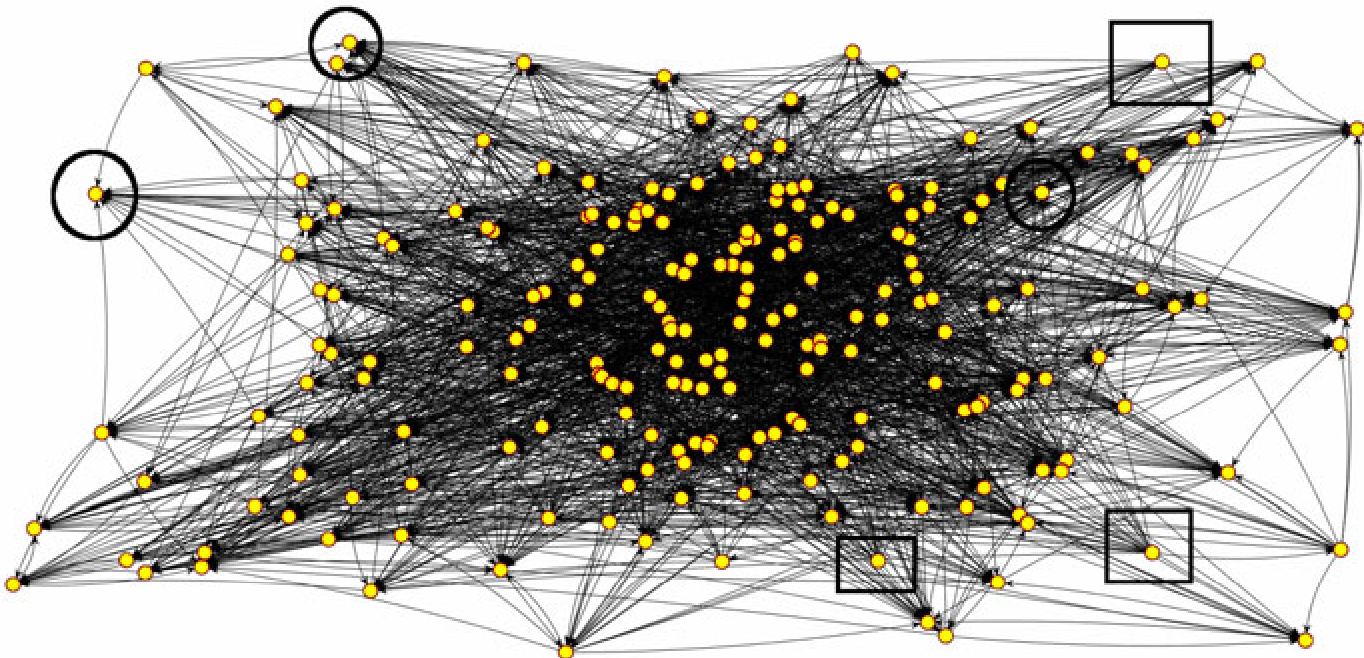 Figure 1: Simulated social graph highlighting Spammers (rectangles) and Inactive users (circles).
Key Findings:
- Spammer Detection: Spammers often have high outdegree but zero indegree (people don't talk back to bots). The model successfully assigned them an influencer value of ~0.
- Inactive User Detection: "Lurkers" might have high indegree (popular people who stopped using the app), but they don't influence others. The model filtered them out by requiring active content generation.
- Sensitivity: The most influential person in the interaction model only ranked 3rd in the traditional model, proving that the quality and frequency of talk are better indicators than the quantity of friends.
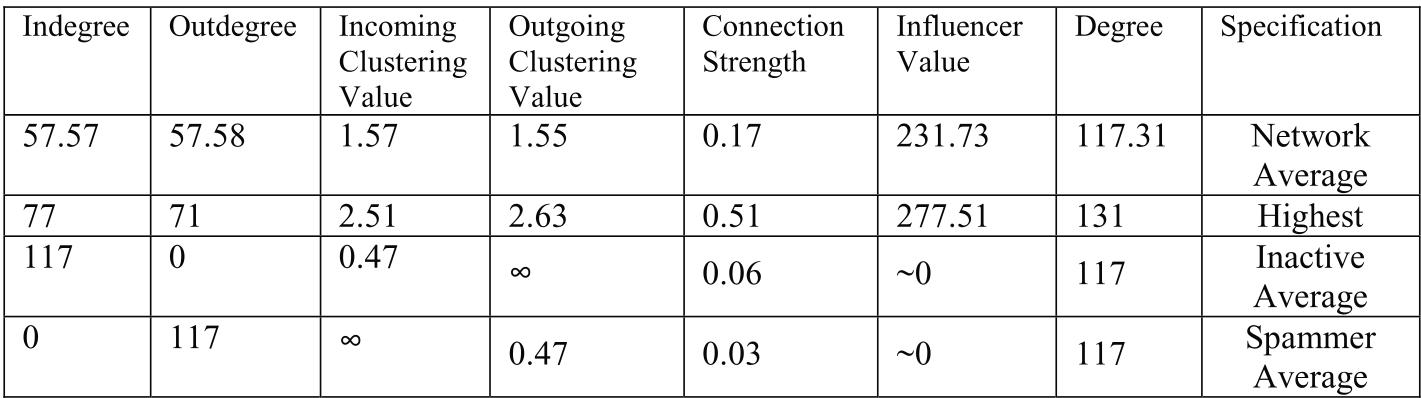 Performance Comparison: Note how Spammer and Inactive Influencer values drop to near zero compared to traditional Degree metrics.
Critical Insight & Future Outlook
The primary takeaway for businesses is that Viral Advertising should target "hubs of conversation" rather than just "hubs of followers."
Limitations: Currently, the model treats every interaction as equal. It doesn't differentiate between a "Like" and a long, thoughtful comment. Furthermore, it is "scent-blind"—it identifies influential people even if their influence is negative (e.g., someone discouraging people from buying a product).
Next Steps: The future of this research lies in Content Analysis. By integrating Natural Language Processing (NLP) to understand the sentiment of those interactions, we could predict not just who is talking, but whether they are building or burning a brand's reputation.
Conclusion
This paper serves as a vital correction to the "more is better" philosophy of social media metrics. By grounding influence in the physics of interaction, Rad and Benyoucef provide a blueprint for a more honest and effective approach to social commerce.