
Beyond the Retweet: Normalizing User Influence to Find Informative Tweets
Detecting Informative Messages Based on User History in Twitter
The paper introduces a method for detecting "informative" messages on Twitter by leveraging a novel "User History" feature set. By modeling individual user behavior using Gaussian distributions, the authors achieve SOTA-level performance in distinguishing valuable content from mundane chatter, regardless of a user's total follower count.
TL;DR
Twitter is a sea of noise where meaningful news and technical insights are often buried under "daily chattering." This paper addresses the "Popularity Bias"—the phenomenon where high-quality tweets from regular users are overlooked while mundane tweets from celebrities go viral. The authors introduce a User History framework that normalizes engagement metrics, allowing "informative" content to be detected by how much it deviates from a user's own standard behavior.
The "Celebrity" Problem in Social Media
In the Twitter ecosystem, the "Retweet count" is the gold standard for importance. However, this metric is fundamentally flawed. If a celebrity tweets "Good morning," it may get thousands of retweets. If a local scientist tweets a breakthrough discovery, it might get ten.
Conventional classifiers fail here because they treat these counts as absolute values. The authors identify three types of prior features:
- Propagation: Raw RT and Reply counts.
- Message: Text length, URLs, hashtags.
- User Metadata: Follower/following counts.
None of these account for the context of the speaker. The authors' insight is simple yet powerful: To know if a tweet is special, you must first know what "normal" looks like for that specific user.
Methodology: The User History Engine
The core innovation is the User History Class, divided into two categories:
1. Distinctiveness of Tweets (The Normalization)
The authors assume that a user's engagement metrics (Retweets, Replies, Repliers, and Text Length) follow a Normal Distribution. By analyzing four months of a user's past data, they calculate a personal Mean () and Variance () for that user.
When a new tweet arrives, the system calculates a Z-value: This standardized score tells us how many standard deviations the new tweet is away from the user's average. A high Z-value signifies that even if the absolute RT count is low, the tweet is "informative" relative to that user's usual reach.
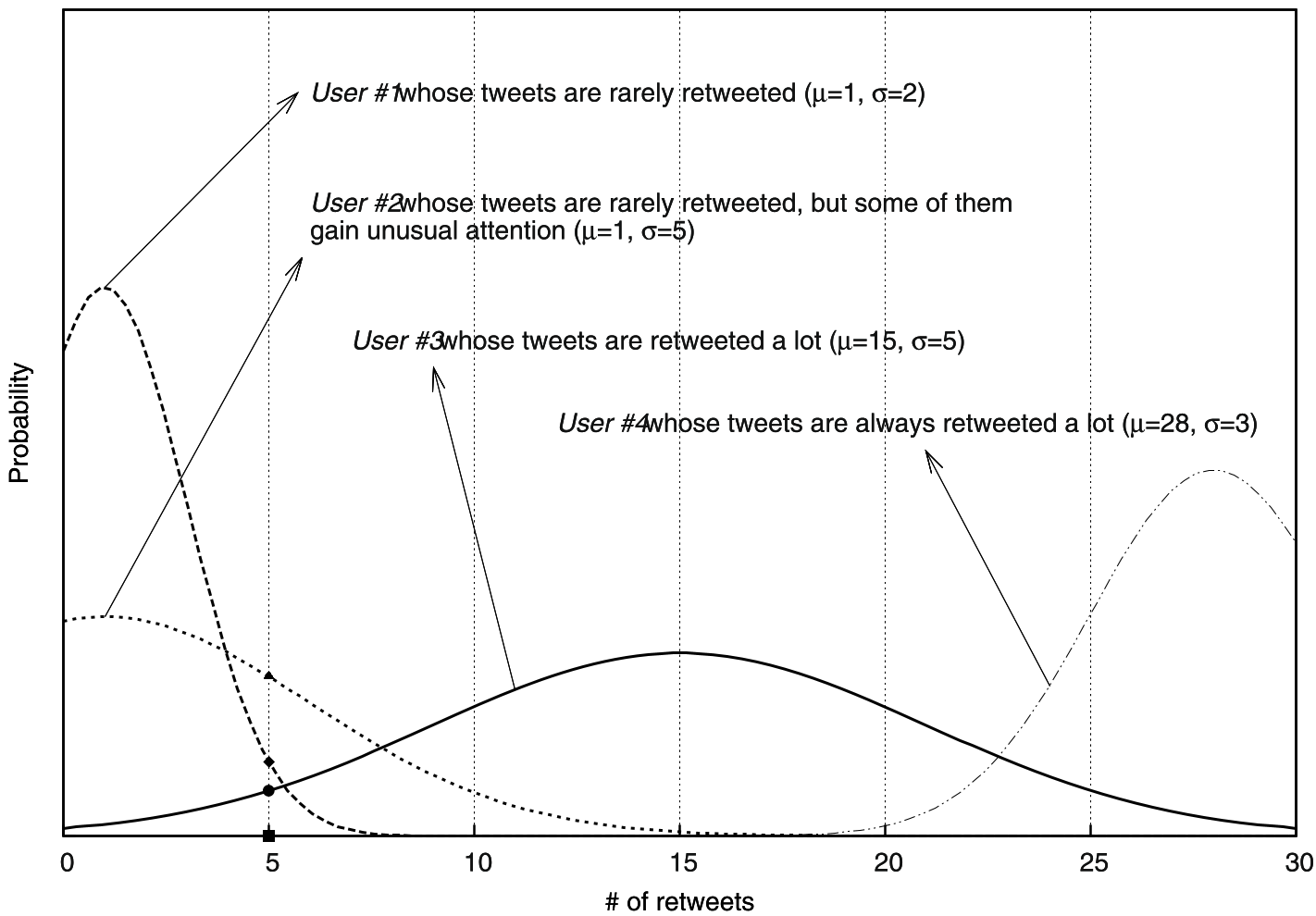 In Figure 1, the authors illustrate how Gaussian functions model influence. Even with the same number of RTs, a tweet from a "low-influence" user represents a much higher probability of being informative than one from a "high-influence" user.
2. User Tendency
The model also tracks behavioral patterns. Does this user primarily post news (Normal tweets), or are they a "Social Hub" that mostly propagates others' content (Retweets)? This helps the classifier identify accounts like mass media or bots.
Experimental Battlefront
The researchers tested their approach on a massive Korean Twitter dataset (337 million tweets). Because informative tweets are rare (0.5%), they used a priority-based sampling method to create a balanced training set.
Performance Gains
Using a Maximum Entropy classifier, the results were stark:
| Feature Class | Accuracy | Precision | Recall | F1 |
|---|---|---|---|---|
| Baseline (P+M+U) | 0.800 | 0.725 | 0.500 | 0.591 |
| Proposed (B+History) | 0.860 | 0.778 | 0.724 | 0.750 |
The most significant leap was in Recall (+45%). This proves that User History is the key to finding those "hidden gems"—informative tweets that would otherwise be missed by propagation-only models.
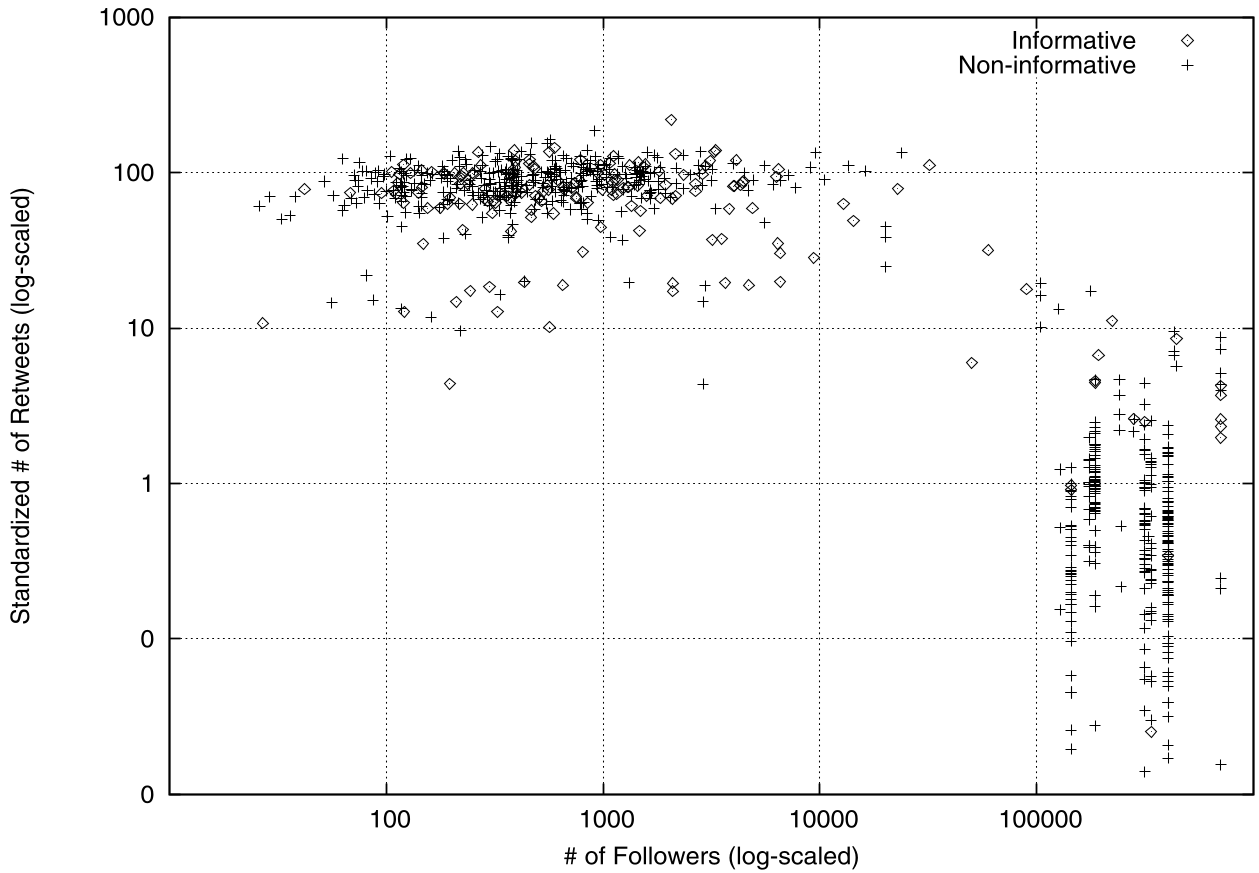 Visual proof of the normalization effect: Standardizing RT counts (right) levels the playing field, making informative content detectable across users with wildly different follower counts.
Critical Insight & Conclusion
This paper shifts the paradigm from Global Ranking to Local Normalization. By viewing setiap (every) tweet through the lens of its author's history, the system filters out the "celebrity noise" and highlights true informational value.
Limitations: The model currently struggles with new users (the "Cold Start" problem) where no history exists. The authors suggest using Poisson or Beta distributions in the future for more robust estimations at the tail end of the distribution.
Takeaway: For developers building recommendation engines or content curators, the lesson is clear: A tweet's value is not just in who says it or how many people hear it, but in how much it breaks the pattern of the person who said it.