
SansNet: Predicting Social Media Virality Without the Network Map
Detecting Large Reshare Cascades in Social Networks
The paper introduces SansNet, a network-agnostic supervised classification framework for detecting large reshare cascades in social networks. By leveraging Survival Analysis, it predicts whether a cascade will cross a specific virality threshold using only time-series reshare counts, achieving SOTA performance without requiring underlying network topology.
TL;DR
Predicting which post will "go viral" usually requires a deep dive into social graphs—who follows whom, and how influential they are. SansNet flips the script by proving you don't need the network at all. By applying Survival Analysis to simple reshare time-series, this approach detects viral outbreaks earlier and more accurately than complex, network-aware SOTA models, all while being significantly faster to compute.
The "Missing Map" Problem
Why is viral prediction so hard? Most current research assumes we have a perfect map of the social network. In reality:
- Data Scarcity: APIs for Twitter or Facebook rarely grant full access to the trillion-edge social graph.
- Hidden Links: Many interactions happen through "dark social" or inferred networks that don't appear in official logs.
- Computation: Tracking billions of nodes in real-time is a scaling nightmare.
Earlier attempts used Autoregressive (AR) models, but social media resharing is bursty, not seasonal. If you treat a cascade like a standard time series, you miss the "epidemic" logic of viral spread.
Methodology: Survival of the Viral
The core insight of SansNet is treating virality as a "death event" in medical statistics. In a hospital, doctors track how long a patient survives under certain conditions. In SansNet, the researchers track how long a cascade "survives" without crossing a virality threshold ().
1. The Cox-Extended Model
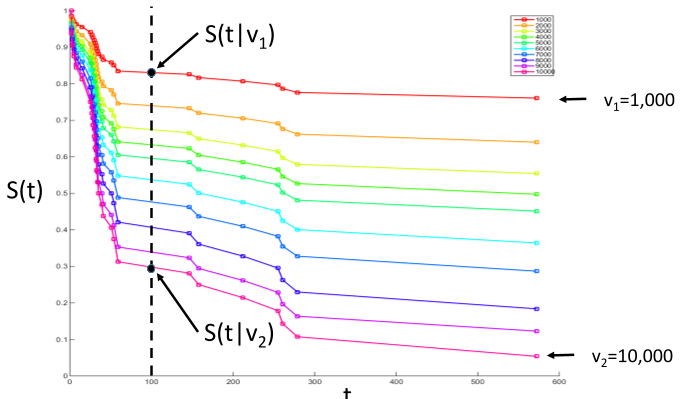
The authors use the Cox-extended model to calculate a survival probability .
- Physical Intuition: As the size of a cascade () increases, the probability of it "surviving" (staying non-viral) drops.
- Handling Rarity: Because 99.9% of posts never go viral, they are treated as right-censored data—meaning they survived the observation period, providing valuable negative samples without needing to undersample the data.
2. The Survival Boundary
SansNet doesn't just look at a single probability. It learns an optimal decision boundary across time. If a cascade's survival probability falls below this boundary at any time , it is flagged as content that will eventually go viral.
Experimental Showdown
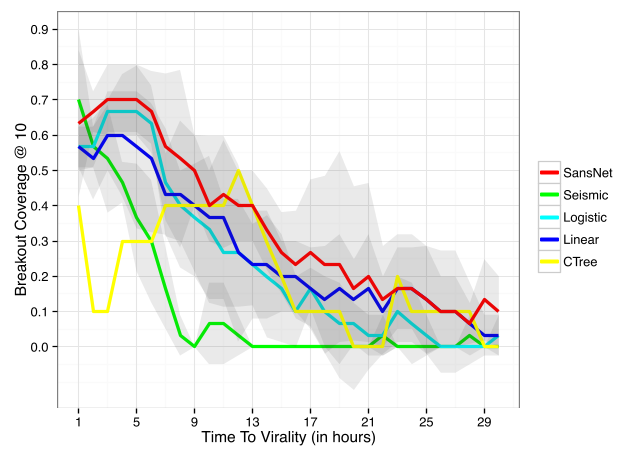
The researchers tested SansNet against Seismic (a self-exciting point process model) and standard Logistic/Linear models across Facebook and Twitter data.
Performance & Early Detection
SansNet dominated in Recall and F-measure. More importantly, it showed a massive Early Prediction Advantage (EPA). While most models can tell you a post is viral 1 hour before it peaks, SansNet can often flag it 24 hours in advance with high confidence.
Scalability
Because SansNet avoids the matrix math of large graphs, it is incredibly lean:
- SansNet: ~125 seconds to train.
- Seismic (Network-Aware): ~1832 seconds to train.
Critical Analysis & Future Outlook
Contribution: The primary value of SansNet is its Inductive Bias. By assuming that the "hazard rate" of a cascade implicitly captures the underlying network structure (e.g., a clique vs. a chain will have different survival slopes), it achieves better generalization than models that try to measure the network explicitly but fail due to noise.
Limitations: The model is currently focused on the quantity of reshares. It does not account for the content (sentiment, image quality) or the source (celebrity vs. bot).
Moving Forward: The next frontier is Multimodal Survival Analysis—combining these robust temporal hazard rates with Computer Vision features to predict if a video will go viral before it even receives its first reshare.