
Trust Flows Backward: A Structural Approach to Social Media Malice
Detecting Malicious Activities Using Backward Propagation of Trustworthiness over Heterogeneous Social Graph
The paper proposes an extended trust model for detecting malicious activities in Online Social Networks (OSNs) by performing iterative "Backward Propagation of Trustworthiness" over a heterogeneous social graph. Using a real-world Twitter dataset of 5.5 million users, the method achieves robust detection of spammers and malicious accounts through structural graph analysis.
TL;DR
Social media platforms are battling an endless wave of spammers and malicious bots. While most defenses look at what a user says, this paper focuses on how trust moves through the social network. By treating Twitter as a Heterogeneous Social Graph and using a Backward Propagation algorithm, the authors can calculate a "Trustworthiness Score" for every user, tweet, and topic, effectively filtering out malicious actors with high precision.
Background: The Failure of Content-Only Detection
The industry standard for fighting spam has long been a mix of manual expert review—which is painfully slow—and standard Machine Learning classifiers. However, attackers are smart; they can easily tweak their text to bypass filters.
The authors' core insight is that trust is a structural property. A malicious user might write a normal-looking tweet, but their relationship patterns (who they follow, what they retweet, and how they mention others) form a specific topological signature. To capture this, we need a model that doesn't just treat everyone as a "node," but understands the different meanings of their interactions.
Methodology: The Heterogeneous Social Graph
The researchers mapped Twitter's complexity into a unified graph involving three entities and five distinct activities.
The Unified Representation
Unlike a simple "friendship" graph, this model uses:
- Vertices: Users, Tweets, and Trending Topics.
- Edges:
- Following: User User.
- Posting: User Tweet.
- Covering: Tweet Topic.
- Retweeting: Tweet Tweet.
- Mentioning: Tweet User.
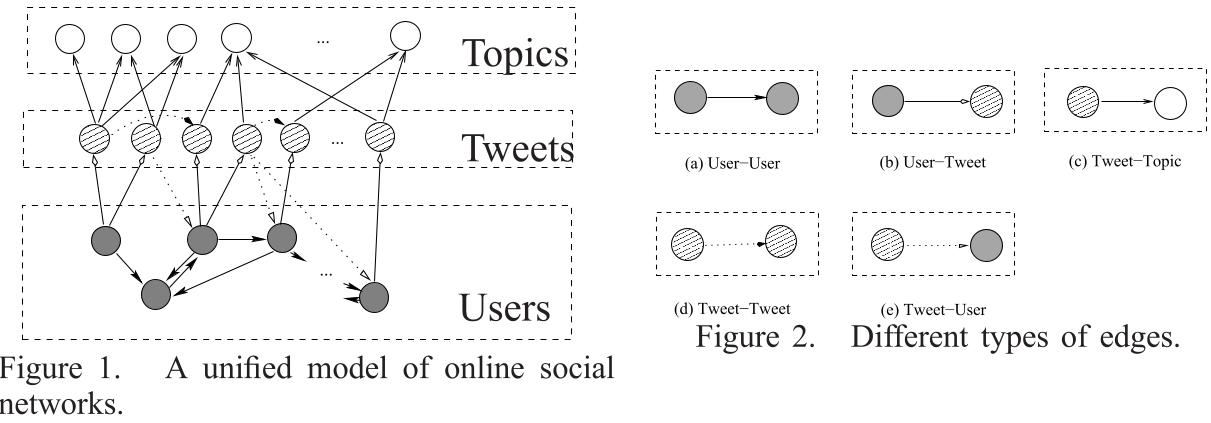 Figure 1: The heterogeneous social graph showing the flow of interactions between users, tweets, and topics.
The Logic of Backward Propagation
Why "Backward"? In a standard PageRank, authority flows forward (if an expert points to you, you become an expert). In trustworthiness, the logic is: if you engage with a malicious entity, your own trust score should decrease.
If User A follows User B, and User B is verified as a bot, the "untrustworthiness" propagates backward to User A. The system iterates until every node reaches a stable score between 0 (Malicious) and 1 (Legitimate).
Experiments & Results: Real-World Twitter Data
The authors tested their model on a massive scale: 5.5 million users and 12 million tweets. They compared two strategies:
- Normal Trustworthiness: All nodes start with a neutral score of 0.5.
- Biased Trustworthiness: Nodes with known labels (provided by 12 human volunteers) are initialized with fixed high or low values.
The performance was measured using the F-1 score across varying thresholds ().
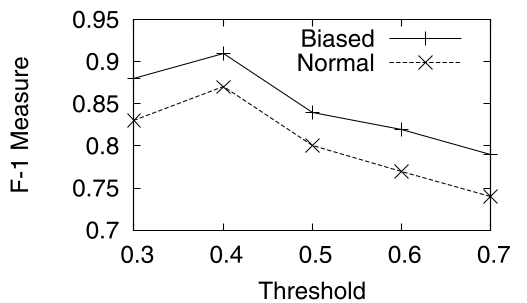 Figure 3: Efficiency of the Biased vs. Normal trustworthiness measures.
Key Findings:
- The Biased Trustworthiness Score consistently outperformed the normal version, showing that even a small amount of "ground truth" labels can significantly boost the propagation accuracy across the entire graph.
- The optimal threshold for detection was found to be 0.4, providing the best balance between precision and recall.
Insight and Conclusion
This work demonstrates that maliciousness in social networks is not an isolated event but a cluster-based phenomenon. By moving away from local feature detection (e.g., "does this tweet contain a link?") toward global structural analysis, the model becomes much harder for spammers to "game."
Future Outlook
While the current model uses a mathematical iterative approach similar to PageRank, the next logical step—as discussed in the modern context of 2024-2026—would be to replace the static propagation rules with Graph Neural Networks (GNNs). This would allow the model to learn the "weight" of different edges (e.g., is a 'retweet' a stronger signal of trust than a 'follow'?) automatically from the data.
In conclusion, the backward propagation of trust provides a robust, scalable framework for cleaning up the digital town square.