
Striking at the Source: Detecting Crowdturfing Campaigns in Crowdsourcing Platforms
Detecting malicious campaigns in crowdsourcing platforms
This paper presents a robust machine learning-based framework to detect "crowdturfing" or malicious campaigns within crowdsourcing platforms like MTurk and Microworkers. By using an SVM-based classifier on features like hourly wages and task descriptions, the authors achieve a SOTA detection accuracy of 99.2% as a first-line defense before malicious activities reach target sites.
TL;DR
Crowdsourcing platforms have become a breeding ground for "crowdturfing"—malicious campaigns designed to manipulate social media and search engines. This paper introduces an automated detection system that identifies these campaigns directly at the source with 99.2% accuracy, utilizing economic and linguistic features to stop manipulation before it ever reaches its target.
Context: The Vulnerability of Digital Trust
While crowdsourcing is a tool for innovation, it has been hijacked by malicious actors to scale deception. Whether it's fake Amazon reviews or artificial Facebook "Likes," the current state of defense is reactive and failing. The authors found that a staggering 87% of fake likes generated via these platforms successfully bypassed Facebook's security filters. This research shifts the focus from the target (where the damage is done) to the origin (the crowdsourcing platforms).
The Economic Incentive of Dishonesty
Why do workers participate in these campaigns? The researchers conducted a deep dive into the demographics and economics of the market. They found a striking "malice premium":
- Median Hourly Wage (Legitimate): $1.88
- Median Hourly Wage (Malicious): $2.48
This higher pay functions as a bribe to encourage workers to participate in tasks that might otherwise trigger ethical hesitation.
Methodology: Building the First Line of Defense
The authors crawled four major platforms—MTurk, Microworkers, Rapidworkers, and Shorttask—collecting over 23,000 campaigns. They developed a feature set that remains agnostic to the specific platform, focusing on:
- Financial Metrics: Reward per task, Estimated Time to Complete (ETC), and Hourly Wage.
- Content Complexity: Number of URLs in instructions and word counts of titles.
- Textual Fingerprints: Unigrams, Bigrams, and Trigrams to identify common malicious phrasing (e.g., "Google Search," "Facebook Like").
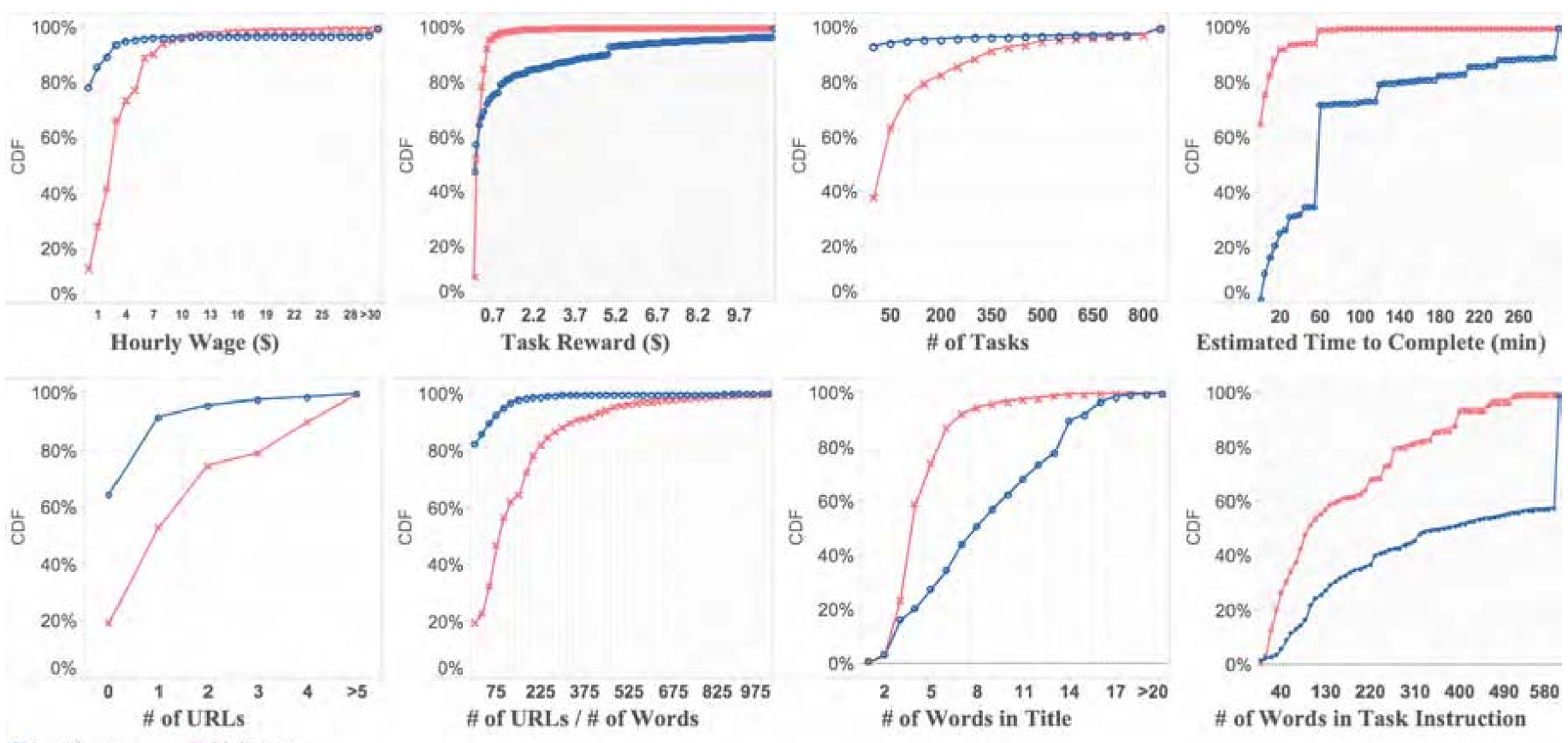 Figure 1: Cumulative Distribution Functions (CDFs) show clear separations between legitimate (white triangles) and malicious (black squares) campaigns across metrics like hourly wage and task length.
Experimental Performance
The researchers tested several models, including Naive Bayes and J48 Decision Trees, but Support Vector Machines (SVM) emerged as the clear winner.
| Approach | Accuracy | False Positive Rate (FPR) | False Negative Rate (FNR) |
|---|---|---|---|
| SVM (Proposed) | 99.2% | 0.019 | 0.055 |
| PCA Baseline | 85.2% | 0.999 | 0.031 |
| URL Filtering | 72.4% | 0.708 | 0.157 |
One of the most impressive findings is the temporal robustness of the model. By training on just two weeks of data, the system remained highly accurate throughout the remaining months, proving that malicious campaign patterns are remarkably consistent.
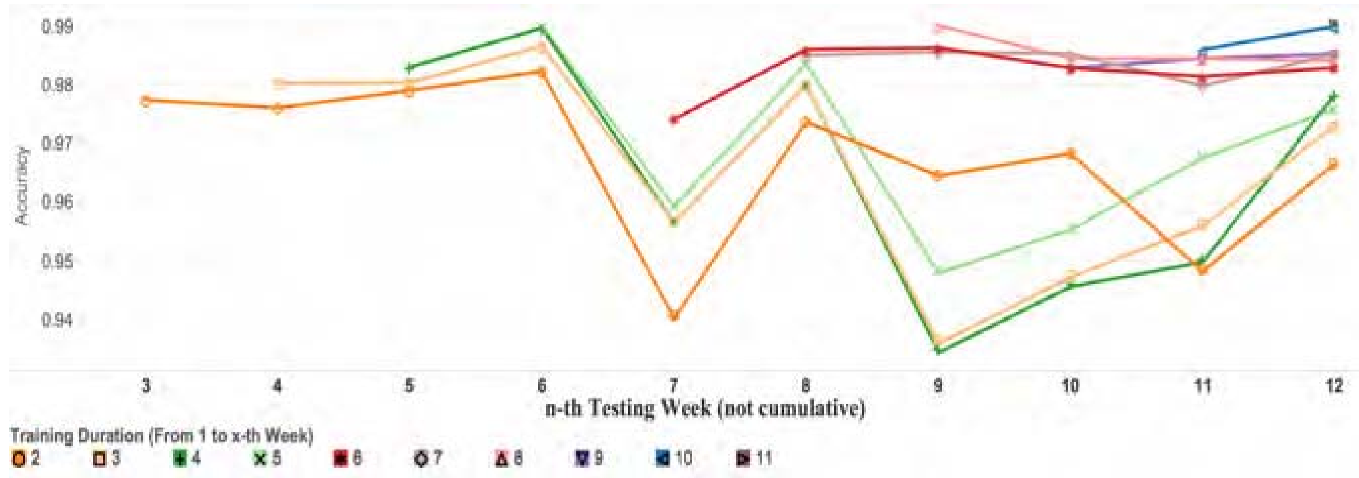 Figure 2: Micro-scale view of classifier accuracy over a 12-week period, demonstrating high stability.
Critical Insight: Why This Matters
The core achievement of this paper is proving that malicious behavior has a distinct "market signature." Malicious tasks are typically shorter, higher-paying, and more link-heavy than legitimate ones. By identifying these patterns at the requester level, platform operators can implement automated bans, effectively "starving" the crowdturfing ecosystem of its human labor.
Conclusion & Limitations
While the study is a breakthrough for platform-side security, it faces a classic "cat-and-mouse" challenge. If malicious requesters become aware of these detection parameters, they may lower wages or add "noise" to their instructions to mimic legitimate tasks. However, as an initial barrier, this machine learning approach provides a much-needed shield for the integrity of our digital world.
Takeaway for Practitioners: To secure platforms against automated and human-driven abuse, monitor the intersection of economic behavior (wages) and linguistic patterns.