
ABCF: Using Collaborative Filtering to Unmask Malicious Social Media Campaigns
Detecting Malicious Users in Social Network via Collaborative Filtering
The paper introduces ABCF (Approach Based on Collaborative Filtering), a novel security framework designed to identify malicious and fake accounts in Online Social Networks (OSNs). By integrating Collaborative Filtering (CF) and K-means clustering, the method distinguishes between legitimate behavior and malicious campaigns by analyzing groups of accounts that exhibit synchronized, anomalous changes in activity.
TL;DR
Researchers have developed ABCF (Approach Based on Collaborative Filtering), a multi-stage detection system that repurposes recommendation algorithms to sniff out malicious social media accounts. By looking beyond simple "spammy" behavior and focusing on how groups of accounts move in unison, ABCF identifies compromised and fake profiles with high precision.
Background Positioning: This work bridges the gap between Recommender Systems and Network Security. It shifts the detection paradigm from individual profile analysis to "campaign-level" detection, which is crucial for identifying sophisticated attackers who use compromised legitimate accounts.
Problem & Motivation: The "Legitimacy" Mask
The core challenge in social network security is no longer just bot detection. While "dumb" bots are easy to spot, attackers now hijack aged, legitimate accounts. A sudden change in a user's behavior—such as posting unusual links—might be a malicious act, or it might just be a user finding a new hobby.
The authors' core insight is that while a single user's behavior change is ambiguous, coordinated changes across multiple accounts are a statistical smoking gun. Malicious campaigns often force hundreds of accounts to perform similar actions (likes, tags, or comments) simultaneously.
Methodology: Repurposing Recommendation Logic
The ABCF system operates through a clever four-step pipeline that transforms raw social interactions into a "Malicious Score."
1. Collaborative Filtering (CF) as a Fingerprint
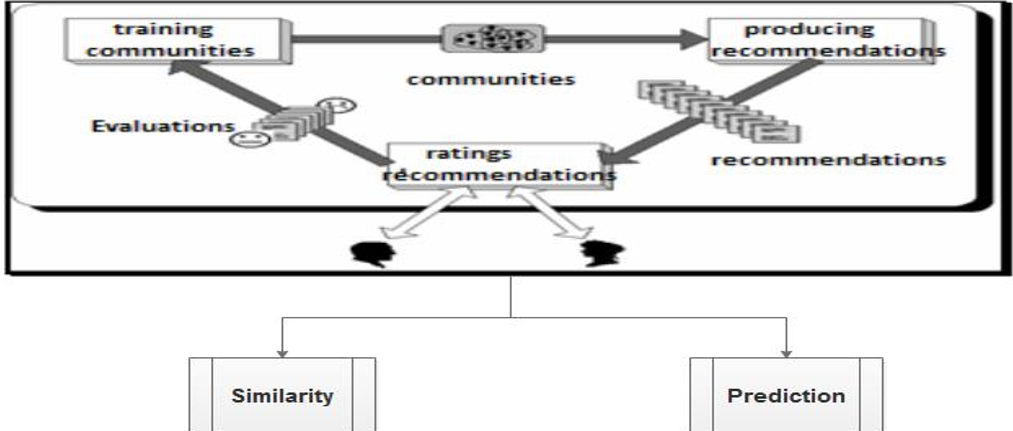
Instead of using CF to recommend movies, the authors use it to calculate Similarity () and Prediction ().
- Similarity: Identifies groups of users who have identical "tastes" or interaction patterns.
- Prediction: Helps flag accounts that deviate wildly from the expected behavior of their community.
2. Clustering via K-means
The output from the CF stage serves as input for a K-means clustering algorithm. By setting for both similarity and prediction, the system separates users into four distinct quadrants: similar vs. dissimilar, and consistent vs. inconsistent predictions. Malicious users typically cluster in the "dispersed" or "highly synchronized but anomalous" groups.
3. Feature Extraction (The Profile Converter)
The system then extracts three high-value behavioral features to create a digital vector for each account:
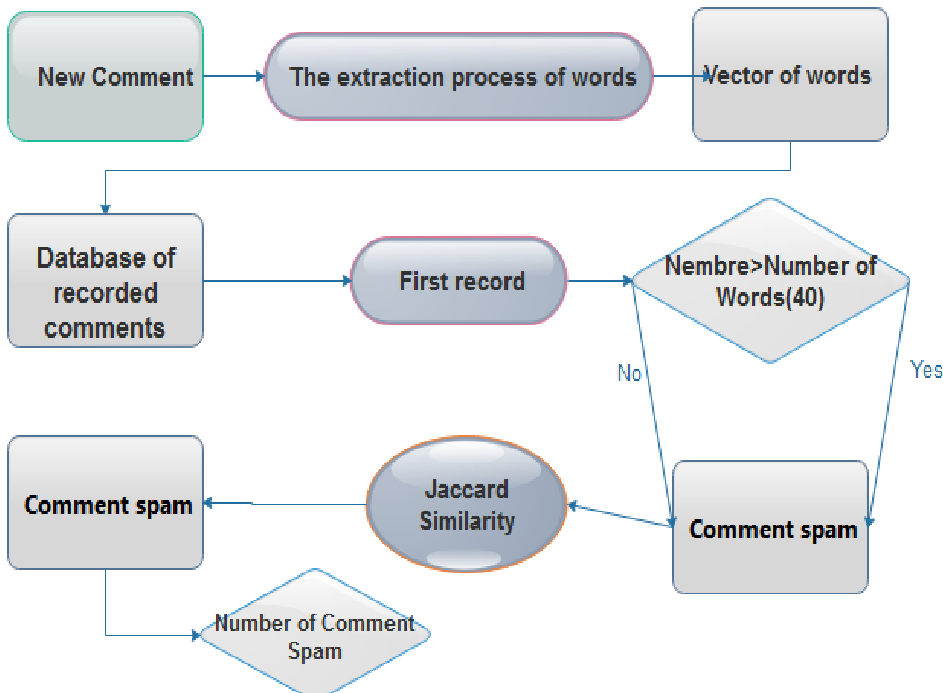
- Criterion 1 (Comments): Uses a similarity function to find "Duplicate Comments." Malicious accounts often spam the same text to maximize reach.
- Criterion 2 (Account Creation): Uses a Standard Deviation formula to see if a batch of accounts were created in a suspiciously short window.
- Criterion 3 (Explicit Vote Score): Analyzes "Likes" and "Tags" (SV score) to find users whose interaction frequency exceeds normal human thresholds.
Experiments & Results
The paper establishes a threshold-based scoring system. If an account's cumulative score across these criteria exceeds 50%, it is flagged as malicious.
The mathematical strength of the approach lies in Criterion 2, which uses the following normalization to catch "registration bursts": This formula effectively penalizes accounts that belong to a group with an unnaturally low variance in their joining dates.
Critical Analysis & Conclusion
Takeaway
The genius of ABCF is its application of the Collaborative Filtering principle—the idea that "if you liked what they liked, you are like them"—to the domain of digital forensics. Specifically, if you behave exactly like a known malicious cluster, you are likely malicious yourself.
Limitations
- Evolving Tactics: Sophisticated attackers may introduce "jitter" or delays in their automated actions to bypass the standard deviation benchmarks for account creation and comment timing.
- Data Scale: K-means is efficient, but the initial calculation of the User-Item similarity matrix can be computationally expensive as the social network grows to millions of users.
Future Work
The authors aim to deploy the ABCF tool on Twitter (X) using the WEKA machine learning suite to validate the model's performance against real-world spam campaigns. Integrating more nuanced behavioral indices (like "standard deviation of activity time") could further harden the system against mimicry attacks.