
Detecting Memory Obstacles: How Your Click Patterns Reveal Your Cognitive Load
Detecting Memory-Based Interaction Obstacles with a Recurrent Neural Model of User Behavior
This paper introduces a method for detecting memory-based interaction obstacles (such as secondary task distractions) using a Long Short-Term Memory (LSTM) network. By analyzing raw temporal sequences of user interaction behavior in a "matching pairs" game, the authors achieve a 66.1% accuracy, significantly outperforming traditional non-sequential baselines.
TL;DR
Researchers from the University of Bremen have developed a way to "read" your cognitive state—specifically whether your memory is being taxed by a secondary task—simply by looking at how you interact with a computer. By using LSTM (Long Short-Term Memory) networks and a cognitive simulator (CMM) to augment data, they successfully detected interaction obstacles from raw behavior logs, outperforming traditional statistical methods by up to 42%.
The "Invisible" Obstacle: Why Sensors Aren't Always the Answer
In Human-Computer Interaction (HCI), "interaction obstacles" are anything that prevents a user from completing a task efficiently. Memory load is a primary culprit. When you're distracted or overwhelmed, your working memory suffers.
While researchers have historically used EEG (brainwave) or pupillometry (eye-tracking) to detect this load, these are high-friction solutions. They require expensive hardware and are often invasive. The authors of this paper ask: Can we detect these memory obstacles purely through the "digital breadcrumbs" of user behavior?
Methodology: LSTMs and Cognitive Simulations
The study centers on a game of matching pairs (Memory), where users must find pairs of cards on a tablet. To create an "obstacle," some users were given a secondary task: calculating a cumulative sum of numbers spoken to them while playing.
1. The Neural Architecture
Because human interaction is a process, not a single event, the authors chose LSTMs. Unlike standard neural networks, LSTMs have "memory cells" that can retain information over time, making them ideal for identifying patterns in the order and timing of card selections.
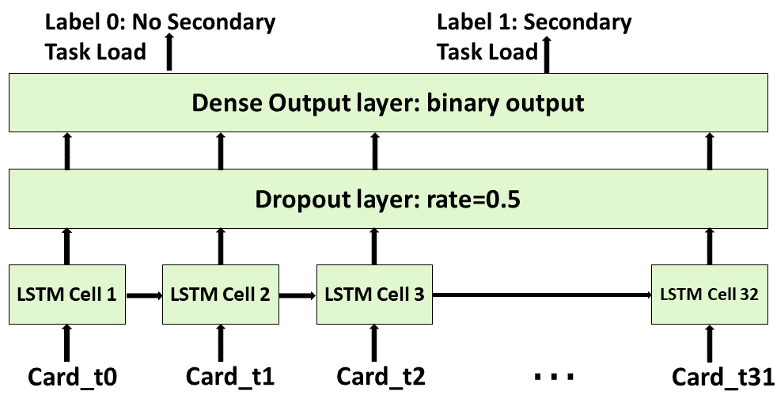 The bottom-up topology involves an LSTM layer followed by Dropout for regularization and a Dense layer for binary classification (Distracted vs. Focused).
2. Solving the Data Scarcity Problem
Deep learning requires thousands of examples, but the researchers only had data from 31 participants. To bridge this gap, they used a Cognitive Memory Model (CMM) based on ACT-R theory.
- The Insight: Instead of just "flipping" data points, they used a model of how human memory actually decays to simulate 15,000 game sessions. These "synthetic humans" played the game with varying levels of memory efficiency, providing a rich dataset for the LSTM to learn from.
Experimental Results: Temporal Context Matters
The researchers compared their LSTM to a Linear Discriminant Analysis (LDA) baseline. The LDA used "hand-crafted" features (like total turns or cards remaining), whereas the LSTM looked at the raw sequence of moves.
| Sequence Length | LSTM (Real Data) | LDA (Real Data) | Improvement (Rel.) |
|---|---|---|---|
| 7 Turns | 62.6% | 43.9% | +42.5% |
| 15 Turns | 65.1% | 57.9% | +12.4% |
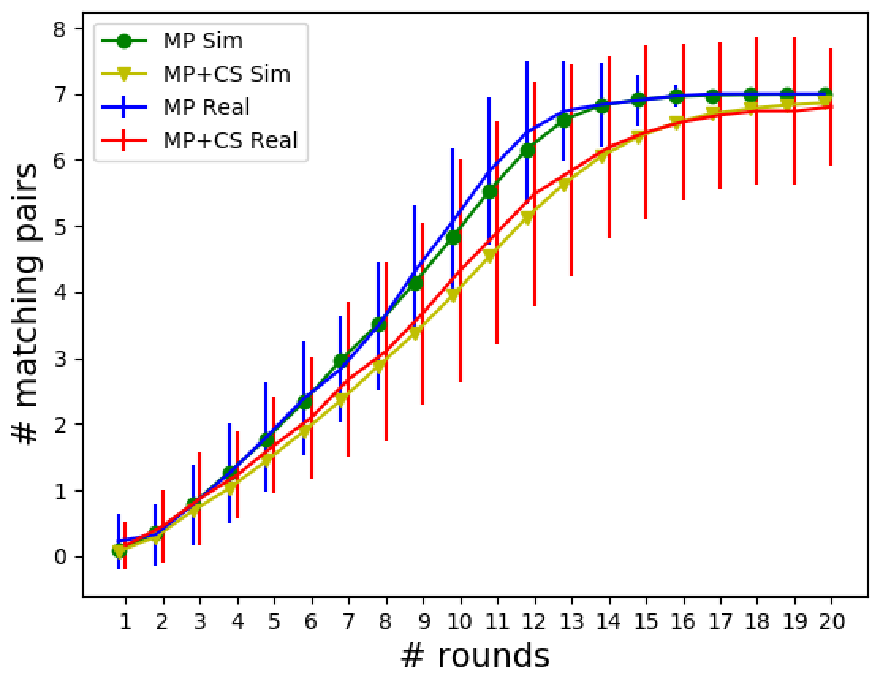 Figure: The "Matching-Pairs" statistic shows a clear divergence in performance between the distracted (MP+CS) and focused (MP) groups as the game progresses.
Key Findings:
- Short Sequence Superiority: The LSTM was significantly better at detecting distractions early in the game (after only 7 turns).
- Validation of Synthetic Data: The LSTM trained on simulated data transferred well to real human data, proving that cognitively-grounded simulation is a viable path for training HCI models.
Critical Insight: The Future of Adaptive Systems
This paper represents a shift from Biometric Sensing to Behavioral Inference. If a system can detect that you are struggling or distracted just by monitoring your input patterns, it can proactively adapt—for example, by simplifying the interface or providing "memory cues" to help you get back on track.
Limitations: While the approach is promising, 66% accuracy is not yet high enough for a production system to make autonomous drastic changes. Future work will likely involve merging these behavioral sequences with lightweight sensors (like mouse-tracking or typing rhythm) to improve reliability.
Conclusion
By moving away from static features and toward temporal, recurrent modeling, Putze et al. have shown that our behavior is a mirror of our cognitive state. The integration of cognitive psychology (ACT-R) with deep learning (LSTM) provides a robust framework for building the next generation of empathetic, adaptive software.