
Tracing the Truth: Using Provenance Data to Combat Social Media Misinformation
Detecting misinformation in social networks using provenance data
This paper introduces a misinformation detection algorithm that utilizes provenance data (history of information creation and modification) to assess the credibility of social media content. By modeling user interactions as social provenance workflows, the authors identify fake or malicious information based on the "distance from positivity" and "collaborative wisdom" of the network in English.
TL;DR
As misinformation spreads faster than truth, manual fact-checking has become a bottleneck. This paper proposes a novel approach: don't just look at what is being said; look at who touched it and how the community reacted over time. By leveraging Provenance Data (the history of data origins and modifications) and a new "Distance from Positivity" metric, the authors provide a scalable way to flag "polluted" information using collective wisdom.
Problem & Motivation: The Context Vacuum
In the event of crises—like earthquakes or political upheavals—social media is a double-edged sword. While it provides rapid information, it lacks a "Paper Trail." Current detection methods often suffer from:
- Scale hurdles: Manual labeling cannot keep up with millions of tweets.
- Context loss: Semantic analysis (NLP) often misses the intent behind information propagation.
- Systemic gaps: Current APIs don't track the provenance—the genealogy of a post as it is modified and reshared.
The authors' insight is grounded in Cunningham’s Law: "The best way to get the right answer on the internet is to post the wrong answer." They argue that the collective reaction (or lack of positive feedback) from a community serves as a natural filter for the credibility of information.
Methodology: The Provenance-Based Detection Algorithm
The core methodology treats social interactions as a Directed Acyclic Graph (DAG). Instead of just analyzing text, the system looks at the relationship between the Artifact (the tweet) and the Actor (the user).
Key Assumptions & Metrics
The algorithm operates on four critical assumptions:
- Like = Positive: Direct positive signal.
- Interaction + Like = High Positive: Synergy between engagement and approval.
- No Like = Negative: If a user interacts (replies/retweets) but doesn't "like," it is a signal of skepticism.
- State Evolution: Truthfulness isn't static; the state of a post's credibility changes over time as more provenance data is collected.
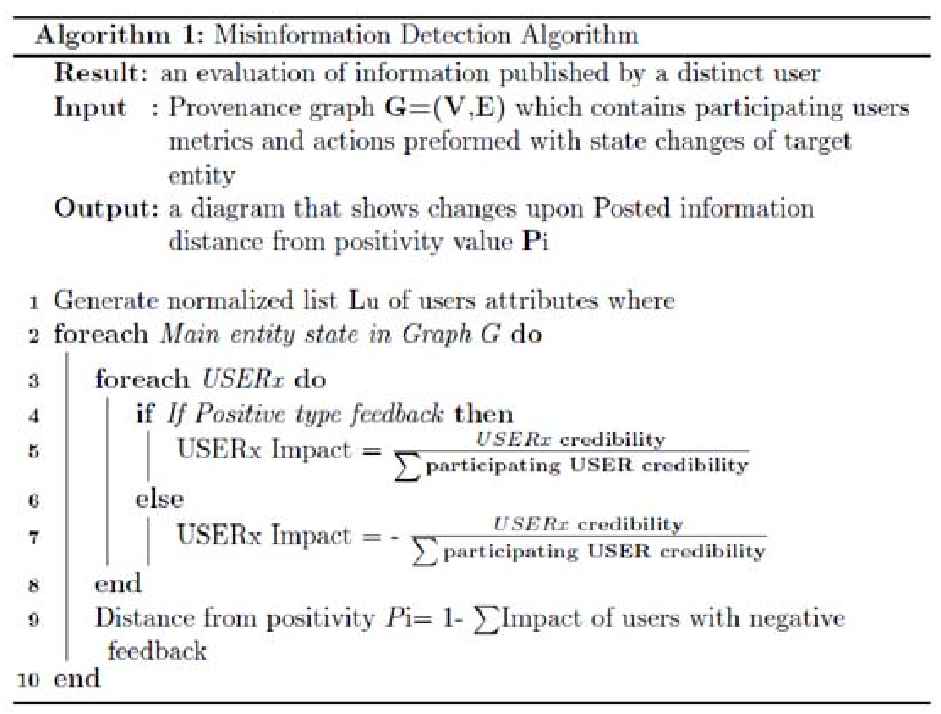
The Distance from Positivity metric is calculated by aggregating these interactions weighted by the Originator's Credibility (calculated via metrics like Prestige, Social Impact, and Verifiability).
Experimental Results: Validating Collective Wisdom
To test the algorithm, the authors used a framework composed of WorkflowSim and KOMADU (a provenance capture system). They simulated 2,000 social workflows under two scenarios:
- Naive Environment: Users react only to content.
- Metadata-Aware Environment: Users react based on the content and the reputation of the author.
Performance Insights
The experiments revealed that the Distance from Positivity score effectively mirrors the "Information Pollution" level.
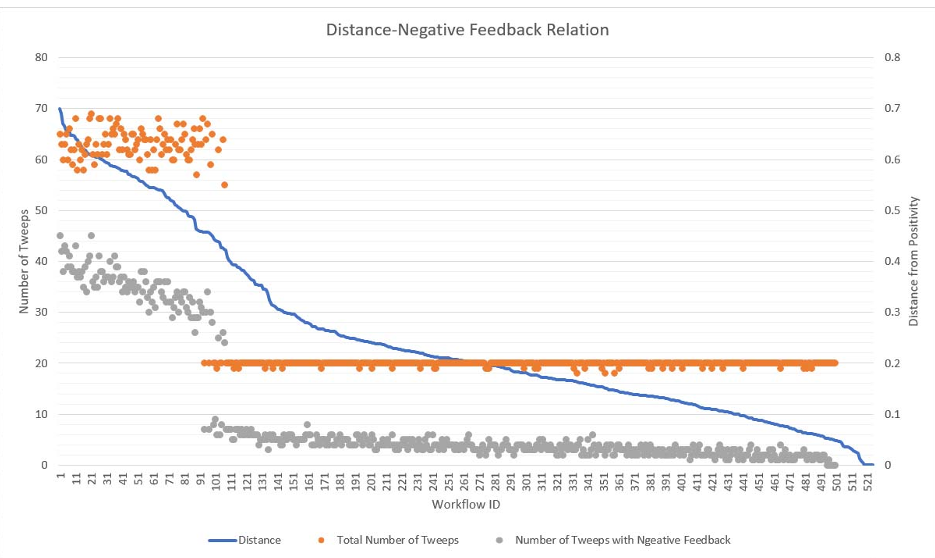 Fig 5: This chart demonstrates the dance between originator credibility and negative feedback. As positive interactions drop, the "distance from positivity" spikes, flagging the content as likely misinformation.
The study confirmed a strong positive correlation: as negative feedback increases, the calculated "Distance from Positivity" metric increases proportionally, proving that user-driven provenance is a reliable proxy for truth.
Critical Analysis & Future Outlook
The beauty of this approach is its scalability. By focusing on the structural "metadata" of interactions rather than the high-compute requirements of LLM-based content analysis, it offers a lightweight path to real-time misinformation monitoring.
Limitations:
- The current evaluation relies on synthetic data. While large-scale, synthetic data may not capture the nuances of "coordinated inauthentic behavior" (bots) that simulate positive feedback.
- It assumes a "good faith" community where the majority eventually gravitates toward the truth.
Future Work: The authors plan to feed these provenance metrics into a Machine Learning classifier trained on actual Twitter data, moving from a rule-based algorithm to a predictive AI model.
Conclusion
This work shifts the battlefield of misinformation detection from Content Analysis to Contextual Genealogy. By proving that "how information travels" is as telling as "what the information says," Baeth and Aktas provide a vital new tool for data scientists fighting the spread of fake news in the age of social workflows.