
Driving Under the Skin: Dynamic Physiological Labelling for Stress Detection
Detecting Negative Emotions During Real-Life Driving via Dynamically Labelled Physiological Data
This paper presents a novel approach for detecting negative emotions like stress and anger during real-life driving by using dynamically labelled physiological data (e.g., Heart Rate, Pulse Transit Time). The study demonstrates that psychophysiological self-labelling achieves a 74% AUC, comparable to traditional subjective self-reports but with significantly higher temporal fidelity.
TL;DR
Researchers have developed a method to detect negative emotions during driving by using a person’s own heart rate and blood pressure signals to "label" their stress levels. By bypassing unreliable self-reports and using machine learning (SVM/LDA), they achieved a 74% detection accuracy, proving that our bodies are often more honest narrators of stress than our conscious minds.
Context: The Hidden Toll of the Commute
For many, driving is a mundane necessity, yet it is a significant source of chronic stress that directly impacts cardiovascular health. The challenge for researchers has always been "Ground Truth". How do we know a driver is actually stressed? Usually, we ask them. But self-reports are biased, annoying to fill out, and can't capture the sudden surge of adrenaline when a car cuts you off. This paper shifts the paradigm from "asking" to "sensing."
The Core Insight: Physiological Self-Labelling
The authors suggest that instead of using a questionnaire to label a 40-minute drive as "stressful," we should use the driver's own physiology to label 30-second windows.
The Methodology
- Data Collection: Sensors captured ECG (heart activity), PPG (blood flow/ear clip), and Accelerometry (speed/driving dynamics).
- The Labelling Switch:
- Standard approach: Pre/Post drive questionnaires (STAXI-2/UMACL).
- Proposed approach: Split Heart Rate (HR) and Pulse Transit Time (PTT) into percentiles. The top 33% of HR signals were automatically labelled "Stressful."
- Feature selection: They used the RELIEF algorithm to prune redundant features, reducing the noise by up to 70%.
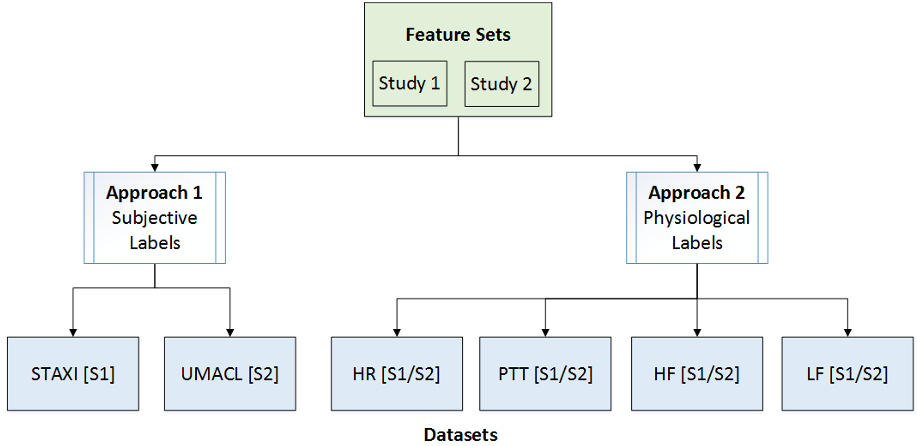 Fig 1: The dual-track process comparing subjective vs. physiological labelling.
Breaking Down the Math: From Acceleration to Velocity
To ensure the "Driving Features" were accurate, the authors didn't just look at raw GPS. They used cumulative trapezoidal numerical integration to convert 3D accelerometer data into velocity () and distance (). This allows the model to "feel" the car's micro-movements—braking, swerving, and idling—more precisely than a standard GPS update at 1Hz.
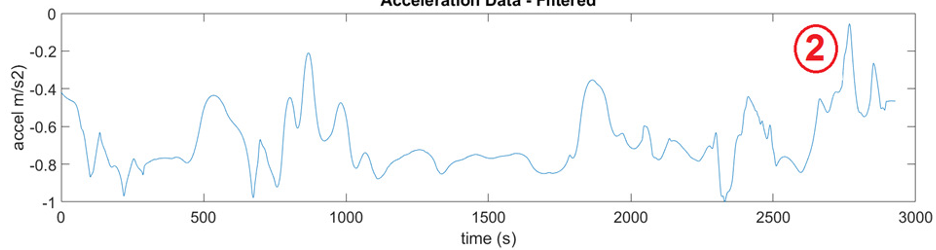 Fig 2: Example of raw vs. filtered accelerometer data used to derive driving context.
Results & SOTA Comparison
The study found that classifiers (SVM and LDA) performed almost identically regardless of whether they used human labels or heart-rate labels.
- Subjective Labels: ~73% AUC.
- Physiological Labels: ~74% AUC.
While the accuracy is similar, the quality of physiological labelling is superior because it is dynamic. It identifies when during the drive the stress happened, not just if it happened.
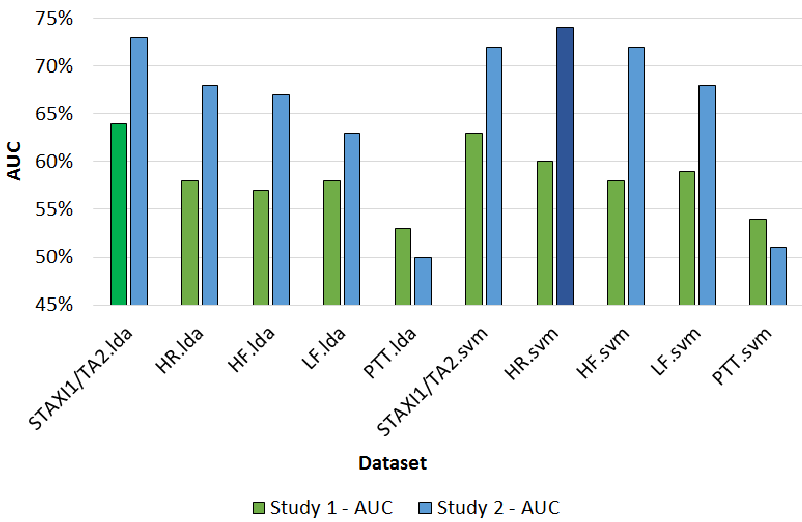 Fig 3: Performance comparison (AUC) across different labelling strategies.
Critical Insight: Why This Matters
The most profound takeaway is the utility of Pulse Transit Time (PTT). PTT acts as a proxy for blood pressure. In the study, PTT-based models had the lowest False Negative Rates. In a clinical or safety-critical setting, a "miss" (failing to detect stress) is more dangerous than a "false alarm." For monitoring at-risk patients with CVD, PTT-driven models are the clear winners.
Conclusion & Future Outlook
This research moves us closer to the "Invisibly Integrated" health monitor. By using physiology to train models on environmental data (speed, traffic), we can eventually predict stress using only the car's data, without even needing the driver to wear a sensor.
Limitations: The study was conducted on a small sample size (21 total). Future work must validate these physiological thresholds across a more diverse population to ensure the "33% percentile" rule holds across different ages and fitness levels.