
MHCC: Accelerating Overlapping Community Detection through Multi-level Aggregation
Detecting Overlapping Communities in Social Networks Using A Modified Segmentation by Weighted Aggregation Approach
This paper introduces Multilevel Hierarchical Clustering with Coarsening (MHCC), a novel algorithm for detecting overlapping communities in social networks. By adapting the Segmentation by Weighted Aggregation (SWA) framework from computer vision, MHCC achieves SOTA performance in both accuracy and computational efficiency across synthetic and real-world datasets like Movielens.
Executive Summary
TL;DR: Detecting how users belong to multiple social circles is a complex, NP-hard task. This paper presents MHCC (Multilevel Hierarchical Clustering with Coarsening), a method that borrows "weighted aggregation" techniques from image segmentation to map social structures. It outperforms traditional hierarchical methods by improving accuracy (F-measure) by 40% while being over 20 times faster.
Academic Positioning: This work bridges computer vision and social network analysis, repurposing the Algebraic Multi-Grid (AMG) philosophy to solve the computational scaling issues inherent in community detection.
The Problem: The Complexity of "Overlapping" Identities
In social networks, nodes are rarely isolated into single groups; a person can be a "Teacher," a "Parent," and a "Musician" simultaneously. Existing methods face two main hurdles:
- Computational Cost: Hierarchical clustering usually scales poorly with N.
- Resolution Limits: Modularity-based methods often swallow small, distinct communities into larger ones.
The authors hypothesized that the hierarchical nature of image pixels (which aggregate into textures, then objects) is mathematically analogous to social actors aggregating into sub-communities and eventually full clusters.
Methodology: The V-Cycle Core
The MHCC algorithm operates through a signature V-cycle mechanism, divided into two distinct phases:
Phase 1: Top-Down Coarsening
Starting with individual users, the algorithm recursively groups them into larger "coarse" points. This is governed by a Coupling Matrix () using an exponential function of Euclidean differences.
- Coarsening Procedure: It selects "C-points" (coarse nodes) that strongly influence their neighbors, ensuring the set of coarse nodes is a maximal independent subset.
Phase 2: Bottom-Up Sharpening
Once a root node is reached, the algorithm travels back up. It uses a Scale-Invariant Saliency Measure to determine if a node represents a significant community or just noise.
- Interpolation (): A matrix that defines how much a fine-level node belongs to a coarse-level cluster, enabling the "overlapping" property.
 Above: The hierarchical structure where nodes aggregate into higher-level clusters while maintaining overlapping memberships.
Mathematical Intuition
The core of the speedup lies in Galerkin Coarsening: This equation shows that the weights of the next (coarser) level are calculated through an averaging process. Instead of re-calculating the entire graph, it builds a succinct representation of the level below, drastically reducing the search space for communities.
Experimental Results and Performance
The authors tested MHCC against heavyweights like SLINK and Ward Clustering using synthetic and real-world datasets (Movielens).
1. Accuracy (F-measure)
MHCC demonstrated a clear advantage in identifying nested structures. In the "MovielensSmall" dataset, it achieved a 40% improvement in F-measure over traditional hierarchical methods.
2. Efficiency (Speedup)
The most striking result is the computational efficiency. On the "MovielensBig" dataset (27 million ratings), MHCC was 21 times faster than its competitors.
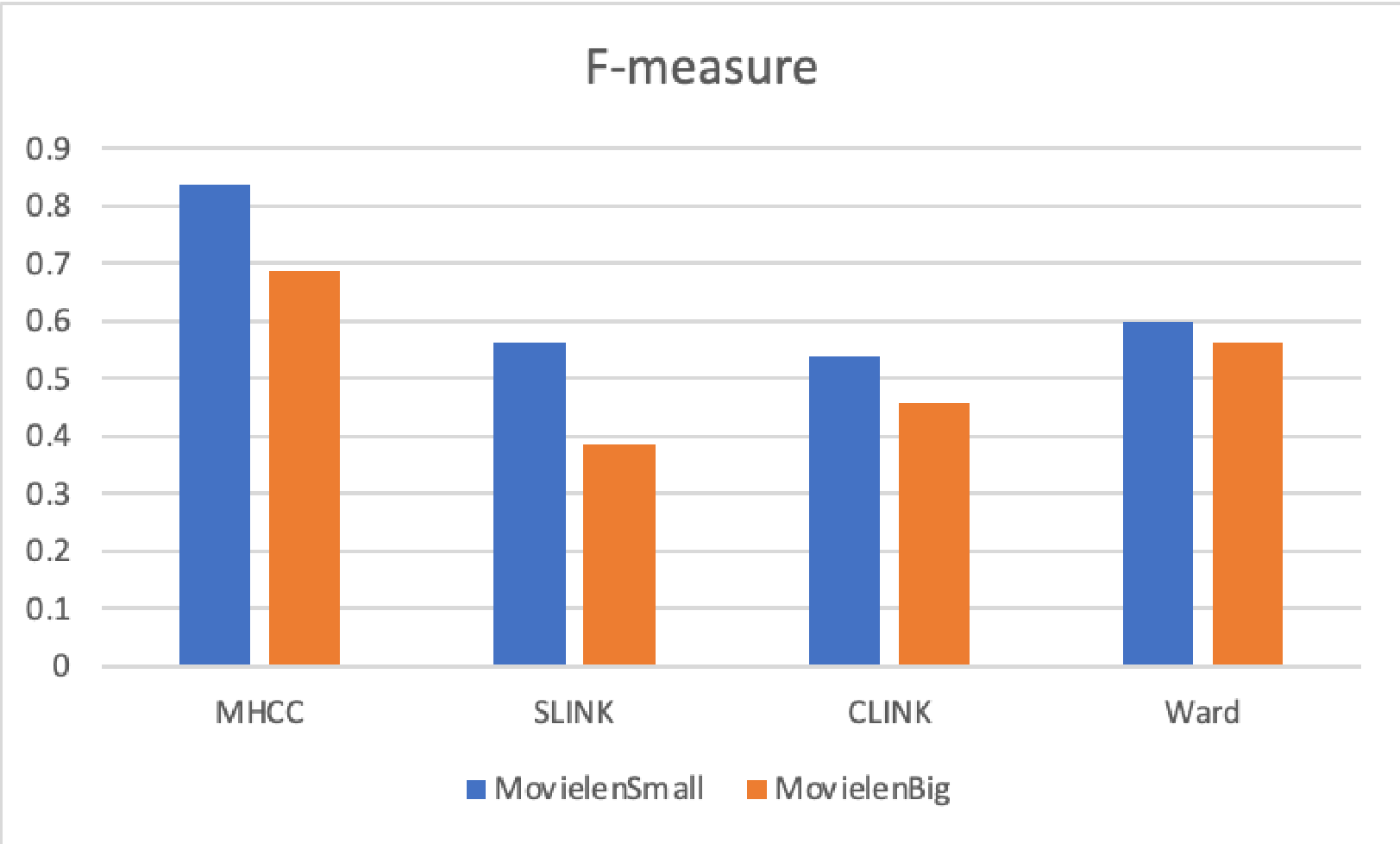 Figure 4: The sharp lead of MHCC in F-measure across different dataset sizes.
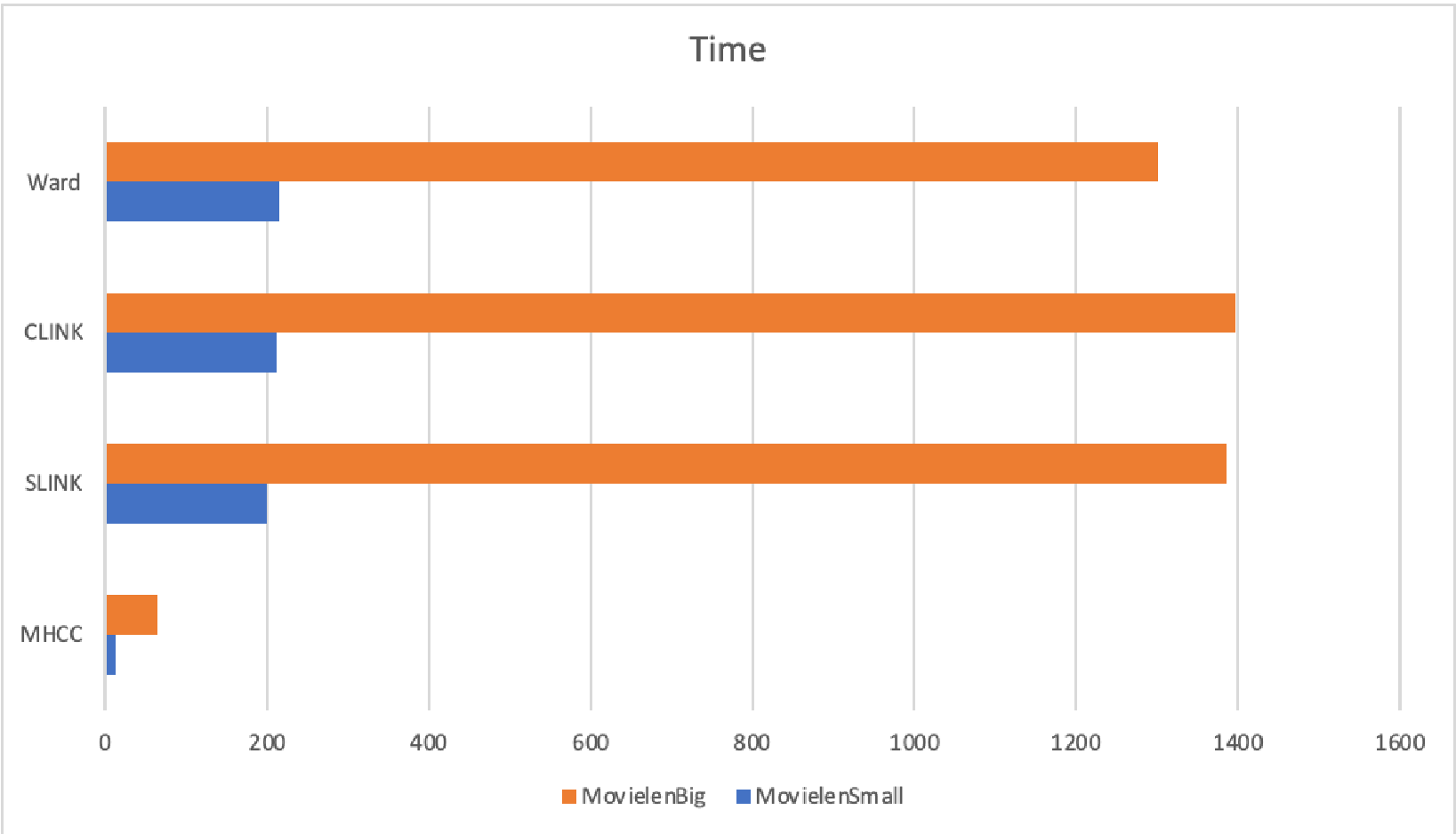 Figure 5: The dramatic reduction in processing time compared to standard hierarchical baselines.
Critical Analysis & Future Outlook
Key Contribution: The genius of MHCC is the use of a Saliency Measure that is scale-invariant. This allows the algorithm to detect a tiny community of "specialist doctors" with the same precision as a massive community of "general users."
Limitations: While MHCC excels against traditional hierarchical methods, its performance against modern Modularity-based or Deep Graph Neural Networks (GNNs) remains a target for future comparison. Additionally, the sensitivity to the user-defined parameter (intensity scaling) requires careful tuning depending on graph density.
Conclusion: MHCC proves that social networks, like images, are multiscale entities. By treating community detection as a multilevel aggregation problem, we can finally achieve the speed required for modern, massive-scale social analytics.