
Voronoi TRSM: Bridging Geometry and Rough Sets for Overlapping Community Detection
Detecting Overlapping Communities in Social Networks with Voronoi and Tolerance Rough Sets
The paper introduces Voronoi TRSM, a novel hybrid approach for detecting overlapping communities in social networks. By combining geometric Voronoi partitioning with Tolerance Rough Set Method (TRSM), it identifies core community members and uncertain overlapping nodes, achieving state-of-the-art results on standard benchmarks like the Karate Club and Dolphin networks.
TL;DR
Social networks are rarely clean-cut; people belong to multiple families, workplaces, and hobby groups. Voronoi TRSM is a new methodology that treats social networks as metric spaces. It uses Voronoi Diagrams to find the heart of a community and Tolerance Rough Sets to capture the "fuzzy" members who sit on the fence between multiple groups.
Background: The Limits of Hard Boundaries
In the study of social structures, most algorithms (like the Louvain method) are "hard" clusterers—they force every node into exactly one bucket. However, real-world networks are messy. The limitation of prior work, including classical Rough Set theory, is the reliance on equivalence relations, which partition space into disjoint sets. To solve this, the authors turned to Tolerance Relations, which are reflexive and symmetric but not transitive, allowing for the mathematical representation of overlap.
Methodology: From Geometry to Soft Computing
The Voronoi TRSM workflow follows a sophisticated three-step logic:
- Metric Space Mapping: The graph is converted into a metric space using the Edge Clustering Coefficient (ECC). The inverse of ECC serves as the distance; the fewer triangles an edge completes, the "further apart" the two nodes are.
- Seeding & Voronoi Partitioning: High-density nodes (those with many internal edges and few external ones) are chosen as "seeds." The space is partitioned into Voronoi cells where each node is assigned to its nearest seed.
- Tolerance Rough Set Softening: This is the "secret sauce." Instead of keeping the Voronoi boundaries crisp, the algorithm calculates a Tolerance Class for each seed. Using the Upper Approximation operator, the method identifies nodes that could belong to a community based on a proximity threshold .
 Figure 1: The logic flow from Graph Inputs to Overlapping Community detection via TRSM.
Experiments: Proving the Soft Touch
The authors tested their method on three classic datasets: Zachary’s Karate Club, the Dolphin Network, and American Political Books.
The performance was measured using Extended Modularity (EQ), which accounts for overlaps, and Average Degree (), which measures how tightly knit the resulting communities are.
| Approach | Network | EQ | |
|---|---|---|---|
| Voronoi TRSM | Karate Club | 0.2864 | 87.00 |
| Fuzzy-Rough | Karate Club | 0.2668 | 75.50 |
| Matrix Factorization | Karate Club | 0.2749 | 89.50 |
The results demonstrate that Voronoi TRSM successfully identifies tricky nodes (like nodes 9 and 10 in the Karate Club) that are often misclassified by standard non-overlapping algorithms.
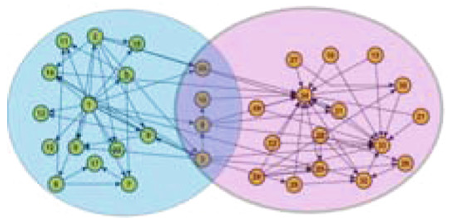 Figure 2: Visual comparison of detected communities. Note how the Voronoi TRSM maintains dense cores while acknowledging shared nodes.
Critical Insight: Why Geometry Works
Why does a geometric Voronoi approach work on a topological graph? The intuition lies in the Inductive Bias of social proximity. By utilizing the Edge Clustering Coefficient as a distance metric, the authors effectively embed the graph's structural hierarchy into a measurable space. The TRSM then acts as a "buffer zone" manager, quantifying the uncertainty of node membership.
Limitations and Future Path
While highly effective on small-to-midscale networks, the current implementation’s reliance on calculating all-pairs shortest paths or extensive ECC values might face scalability challenges in billion-node graphs. The next frontier for this research will likely involve Approximate Voronoi Diagrams to handle web-scale data.
Conclusion
Voronoi TRSM proves that detecting overlapping communities isn't just a grouping problem—it's a spatial problem. By defining the "territory" of a community and allowing for "border crossing" using Rough Set theory, we get a much more realistic picture of social dynamics.