
Beyond Rigid Frontiers: Detecting Overlapping Circles in Complex Networks
Detecting overlapping community structure of complex networks in nature and society
The paper introduces a heuristic method for overlapping community detection in complex networks using PageRank and cluster density. By ranking nodes based on their global importance and iteratively optimizing local connectivity, the algorithm identifies nodes belonging to multiple communities and uncovers hierarchical structures in social and natural networks.
TL;DR
Researchers have developed a heuristic algorithm that leverages PageRank to identify influential seeds and uses a Cluster Density metric to allow nodes to inhabit multiple communities simultaneously. This approach successfully uncovers both overlapping memberships and hierarchical nesting in classic benchmarks like the Karate Club and Dolphin networks.
Problem & Motivation: The "Multi-Role" Dilemma
In traditional network analysis, we often force nodes into a single bucket. However, the "Birds of a feather flock together" adage is oversimplified in the digital age. A single Weibo or X (Twitter) user might belong to a "Tech Enthusiast" circle, a "Local Resident" group, and a "Photography Club" all at once.
Existing SOTA methods often struggle with:
- Overlapping Structure: Failing to recognize nodes that act as bridges between disparate groups.
- Hierarchy: Overlooking the fact that small, tight-knit groups often reside within larger, looser organizations.
The authors' insight is that community detection should start from pivotal nodes (hubs) and expand based on the net gain in internal connectivity.
Methodology: PageRank Meets Cluster Density
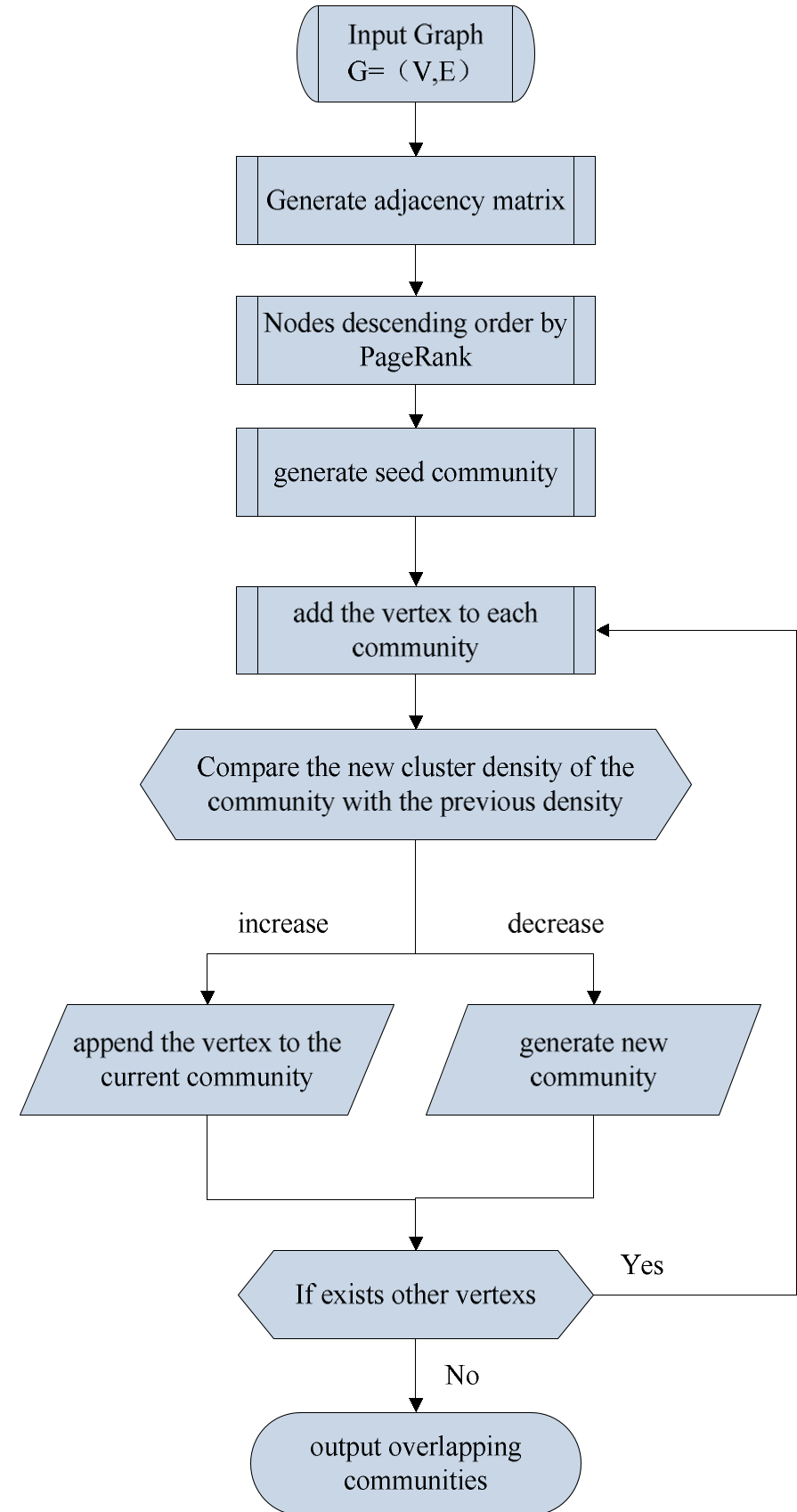
The algorithm follows a two-stage logic: identifying importance and then optimizing local cohesion.
1. Identifying the Seeds (Global Logic)
The paper uses the PageRank algorithm—the same logic Google once used to rank the web—to assign an importance score to every node. This ensures that the expansion starts from the most influential members of the network.
2. Strategic Expansion (Local Logic)
Expansion is governed by Cluster Density , which measures the ratio of internal edges to the total degree of the community: If adding a neighbor increases this density, the neighbor is absorbed. Crucially, a neighbor can increase the density of multiple communities, leading to overlapping results.
Experimental Validation
The authors tested their method on two gold-standard datasets in sociometry:
The Karate Club Split
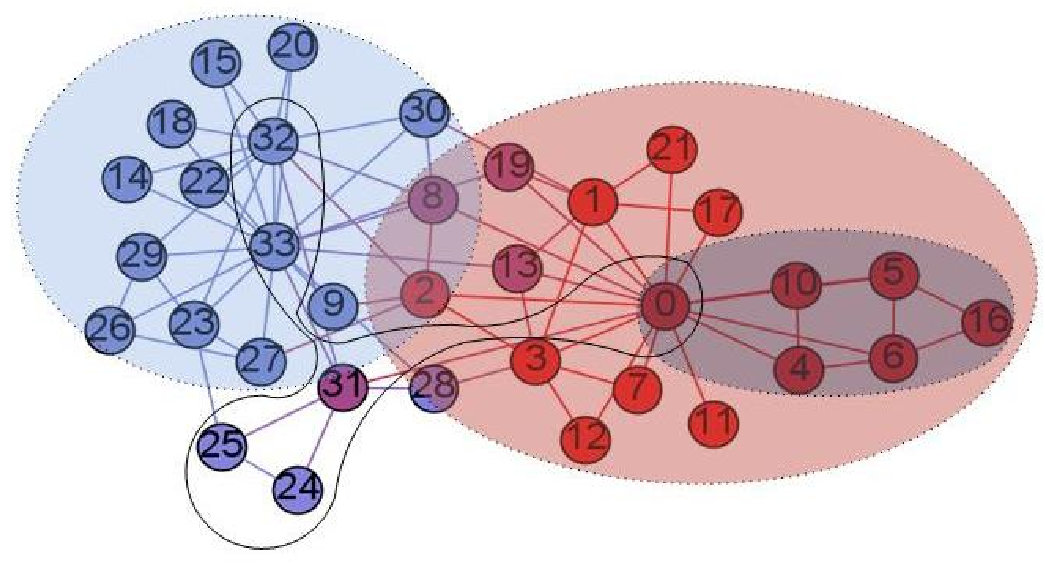
In the Zachary Karate Club network, the algorithm didn't just find the two main factions; it identified four communities. Specifically, it found that nodes 0, 2, 8, 32, and 33 were "bridge" nodes belonging to multiple groups. This provides a much more granular view of the club's social dynamics than a simple binary split.
The Dolphin Network Hierarchy
Applied to a 62-node dolphin social network, the algorithm revealed a hierarchical organization. For instance, Community 2 (a smaller, tighter pod) was found to be entirely embedded within the larger Community 1. Conventional algorithms like Louvain often merge these, losing the "micro-social" details that this new method preserves.
Takeaway and Future Outlook
This work demonstrates that overlapping nodes are not outliers but essential structural components of complex systems. By using PageRank as a guide, the algorithm avoids the "random start" problem of many clustering methods.
Limitations: While effective for medium-sized networks, the iterative density calculation might face scalability challenges on massive social graphs (e.g., millions of nodes) without further optimization or parallelization.
Future Work: The next frontier lies in applying this to Dynamic Networks, where community memberships shift over time, and integrating Node Features (like user bios) alongside edge topology.