
The Robot’s Social "Dance": Detecting Personal Space Violations through Non-Verbal Cues
Detecting Perceived Appropriateness of a Robot’s Social Positioning Behavior from Non-Verbal Cues : ‘A robot study in scarlet’
The paper explores the automatic detection of social feedback cues in human-robot interaction using the "a robot study in scarlet" dataset. It utilizes a Random Forest classifier to infer whether humans perceive a robot's approach distance as appropriate based on non-verbal postural cues, specifically upper body and head tracking.
TL;DR
Even for humans, finding the "social sweet spot" in a conversation is difficult. For robots, it’s an algorithmic nightmare. This paper investigates whether robots can "read the room" by detecting subtle postural cues (like leaning or head tilting) when they get too close to a human. By analyzing a custom "Murder Mystery" dataset, researchers demonstrated that a robot can indeed detect social discomfort with a precision significantly better than chance, focusing on how humans adapt their bodies to the robot's "social mistakes."
The "One-Size-Fits-All" Positioning Trap
Most social robots follow rigid mathematical models based on Hall’s proxemics (e.g., "stay 70cm away"). However, humans are notoriously inconsistent. Factors like the mood of the person, environmental noise, or simply personal quirks mean that 70cm might feel perfectly fine one day and intrusive the next.
The authors argue that we shouldn't just try to predict the "right" distance. Instead, we should enable Responsiveness: the ability of a robot to detect when it has made a mistake and adjust in real-time.
Methodology: The "Murder Mystery" Experiment
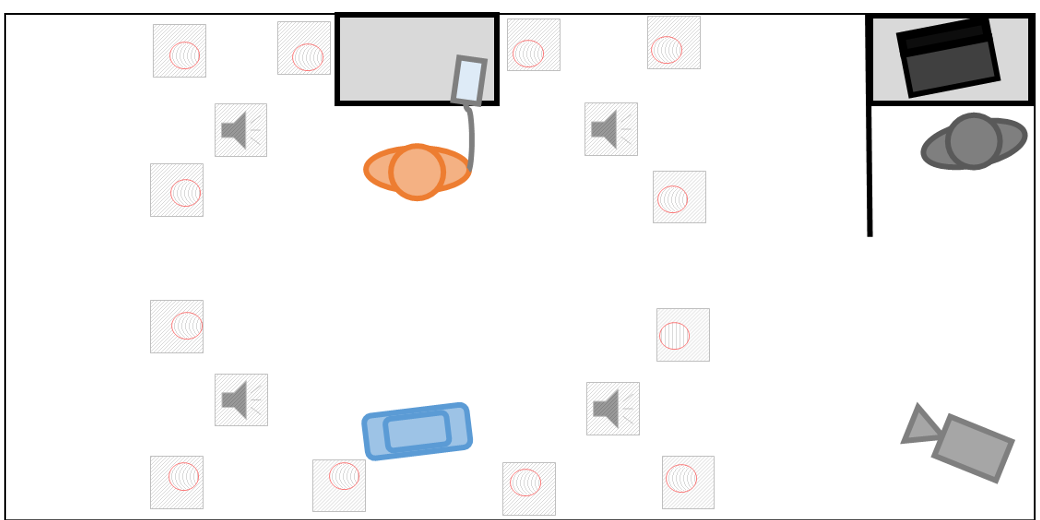
To capture organic social cues, the authors designed a "Study in Scarlet."
- Task: A Giraff robot approaches a participant 8 times to deliver clues for a murder mystery.
- Variables: The robot approached at four different distances (30cm to 150cm) under varying levels of background white noise.
- Tracking: Participants wore OptiTrack markers on their heads and chests, capturing 3D position and orientation.
Architecture of a Social Detector
The researchers generated 4,410 high-dimensional features from just four markers. They looked for "social signals" across different time windows—specifically focusing on the moment just after the robot finished its approach.
Key Results: Can Robots Read Our Discomfort?
The results revealed a fascinating insight: Context doesn't matter as much as behavior. Manually manipulating the noise or the distance didn't consistently change how people "rated" the robot's intelligence or comfort.
Why? Because humans are active participants in the "Proxemic Dance." If a robot got too close, people simply leaned back or stepped away. This compensation masked the discomfort in the questionnaires but was detectable in the tracking data.
Performance Metrics
A Random Forest classifier was used to categorize feedback into "Get Closer," "Don't Change," or "Stay Further Away."
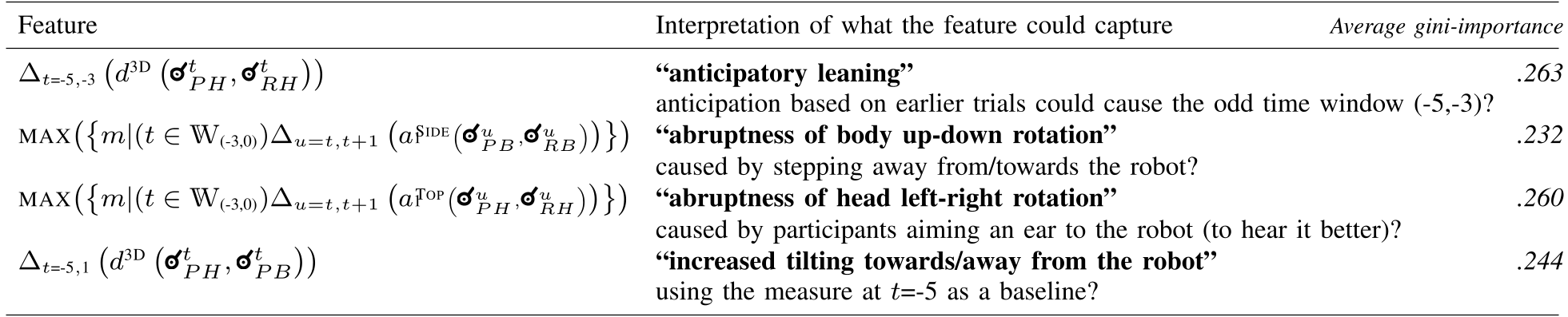
- Strategic Features: The most important cues were "anticipatory leaning" and the "abruptness of head rotation."
- Sensitivity: The model was far better at detecting when the robot was too close (Recall: 0.69) compared to when it was too far. Humans are very vocal (posturally) about their personal space being violated, but less so about distance.
Critical Insight & Future Outlook
This work shifts the paradigm from Model-Based Navigation to Behavior-Driven Responsiveness.
The Takeaway: You don't need a supercomputer or 50 sensors to make a robot "polite." By tracking just the relative distance and orientation of a person's head and chest within one second of an interaction, a robot can determine if it has overstepped its bounds.
Limitations
- Participant Dependence: Currently, the model works best when it has seen a specific person’s behavior before. Generalizing this to a "stranger" remains a challenge.
- Sparse Data: With only 30 participants, the "curse of dimensionality" necessitated heavy feature pruning.
Future research involving facial expressions or more "fine-grained" sensors (like heart rate or skin conductance) could turn this from a "detecting mistakes" tool into a "seamless social partner" system.