
Mining the Social Web for Drug Safety: A Bio-Informed Framework for ADR Detection
Detecting Potential Adverse Drug Reactions from Health-Related Social Networks
The paper introduces a comprehensive framework for detecting potential Adverse Drug Reactions (ADRs) by mining health-related social networks like DailyStrength. It combines Conditional Random Fields (CRF) for named entity recognition with a modified Skip-gram model to identify associated proteins, providing a biological evidence chain for discovered ADRs.
TL;DR
Adverse Drug Reactions (ADRs) are a leading cause of death and economic loss globally. This paper presents an end-to-end framework that crawls patient comments from social networks, extracts mentions of symptoms using Conditional Random Fields (CRF), filters out known information using medical databases, and uses a modified Skip-gram model to provide biological "proof" for new potential side effects.
The Pharmacovigilance Gap
Before a drug hits the market, clinical trials provide a controlled view of its effects. However, once millions of people with diverse genetic backgrounds and lifestyles start using it, unexpected reactions occur. Current systems for monitoring these are often reactive and slow.
The authors identify a massive, untapped goldmine: health-related social networks. In these forums, patients speak candidly about their experiences. The challenge? Deciphering colloquial "internet-speak" from medical terminology and distinguishing between why a patient takes a drug (indication) and what the drug did to them (ADR).
Methodology: From Text to Protein Chains
The framework operates through a sophisticated three-stage pipeline designed to move from raw text to verified biological hypotheses.
1. Named Entity Recognition (NER)
Extraction of disease and ADR mentions is treated as a sequence labeling task. The authors used CRF (Conditional Random Fields). By blending word-level features (Stemming, POS tagging) with dictionary-based features from the SIDER database, the model achieves high precision even in the noisy environment of social media posts.
2. The Knowledge Filter
To find potential (new) ADRs, the system must subtract what we already know.
- Indications: Using DrugBank and SemMedDB, the system filters out symptoms the drug is meant to treat.
- Known ADRs: Using SIDER, it removes side effects already listed on drug labels.
- Residuals: What remains are the "potential ADRs" that warrant investigation.
3. Biological Evidence via Modified Skip-gram
One of the most innovative parts of this paper is the verification step. To help medical experts, the authors find "associated proteins." They modified the Skip-gram model to process MeSH (Medical Subject Headings) terms from MEDLINE citations. By treating a document's MeSH terms as a "bag of words," they learned embeddings for drugs, proteins, and reactions.

The formula above calculates the association strength. If a drug and a reaction both share a high similarity with a specific protein, that protein serves as a latent link—a biological "smoking gun."
Experimental Insights
The authors tested their framework on DailyStrength data (over 600,000 comments).
- Feature Synergy: The inclusion of domain-specific dictionaries improved the F1-score from 80% to 83%, proving that "lexical anchoring" is vital for medical NLP.
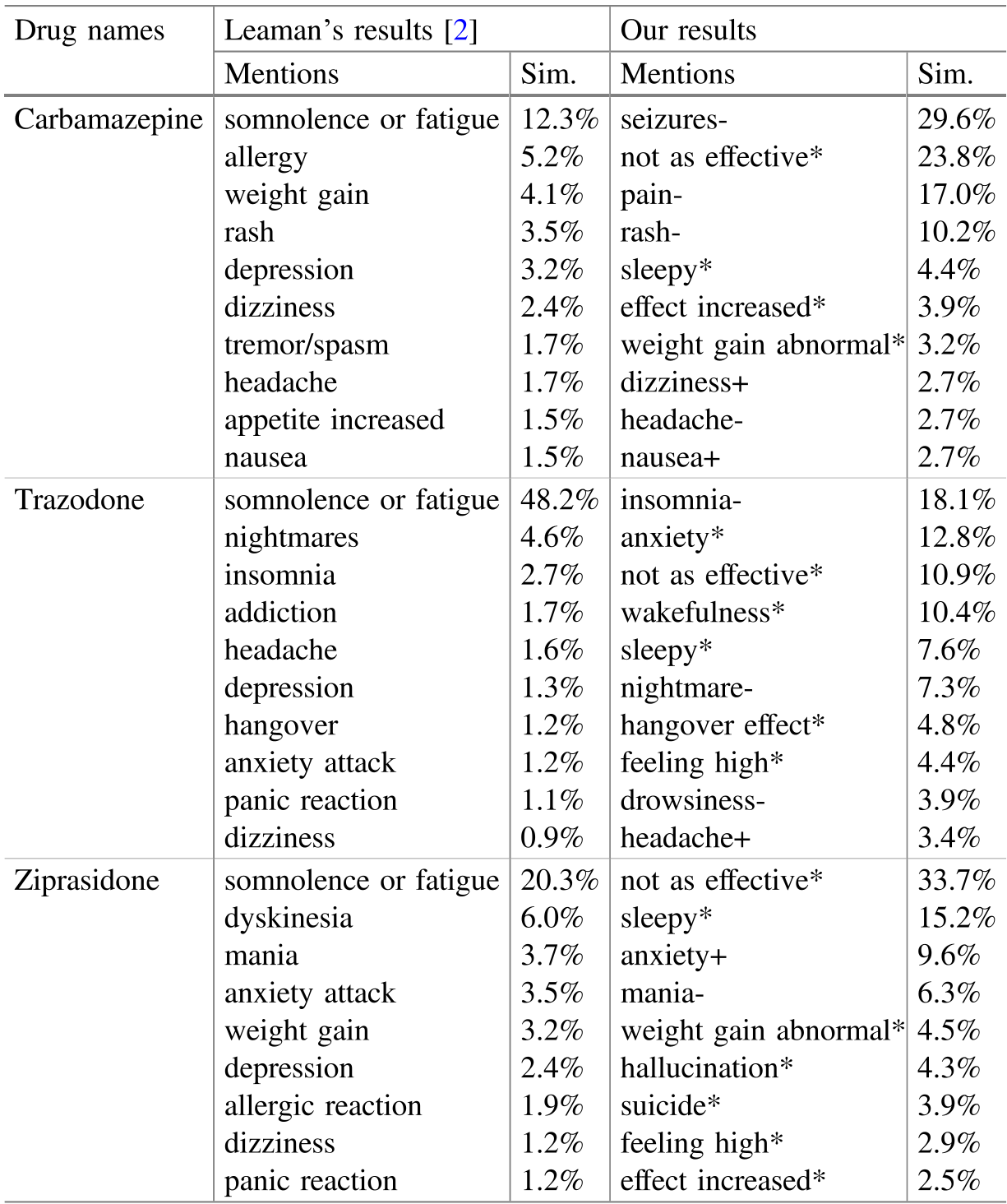
- Comparison with SOTA: When compared to Leaman’s method (a benchmark in the field), the framework showed highly correlated results but provided the added value of biological association.
- Case Study: For the drug Trazodone, the system identified "Anxiety" as a potential ADR. It successfully mapped this back to Serotonin Receptors and Adrenergic Receptors, both of which are corroborated by existing literature as being linked to the drug’s mechanism and the symptom of anxiety.
Critical Perspective
Strengths: The primary contribution is the shift from simple "extraction" to "evidence-based discovery." By linking social media mentions to protein-level data, the authors bridge the gap between patient experience and clinical biology.
Limitations: The reliance on MeSH terms for embeddings limits the resolution of the "associated proteins" to terms already indexed in MEDLINE. Furthermore, the 2016-era CRF model, while robust, lacks the contextual nuances that modern Transformer-based models (like BioBERT) would provide in handling the complex syntax of social media.
Future Outlook
This work paves the way for a real-time drug safety monitoring dashboard. Future iterations could integrate Knowledge Graphs to better model the multi-dimensional relationships between chemical structures, genomic data, and phenotypic results found in patient narratives.