
Decoding the Workplace Social Fabric: Professional vs. Personal Closeness on Enterprise SNS
Detecting professional versus personal closeness using an enterprise social network site
This paper introduces a predictive model to distinguish between "Professional Closeness" and "Personal Closeness" among colleagues using interaction data from "Beehive," an enterprise social network site (SNS). By applying regression analysis to 53 behavioral variables and organizational data, the authors achieve a 71-73% prediction accuracy for relationship strength.
TL;DR
Can your company’s internal social network tell who your actual friends are versus just your project teammates? This study analyzes "Beehive," an IBM-internal social network, to prove that digital footprints—like who you recommend content to or whose profile you comment on—can accurately predict both professional and personal closeness, revealing the "invisible" social structure that organizational charts miss.
The Hidden Dimensions of the Office
In any organization, the official hierarchy is only half the story. While the org chart tells you who reports to whom, it says nothing about Relationship Multiplexity—the idea that a single tie can have multiple facets. A coworker might be a mentor (professional), a gym buddy (personal), or both.
Existing research, such as Gilbert and Karahalios's work on Facebook, successfully predicted tie strength in the "real world." However, the workplace is unique. It operates under Goffman’s "front stage" (professionalism) and "back stage" (socializing) dynamics. The authors set out to determine if these two dimensions could be untangled using data from an Enterprise Social Network Site (SNS).
Methodology: Mapping the Human Connection
To ground their data, the researchers asked 196 active users to rate their colleagues using a "Target" interface. The closer a colleague was placed to the center, the stronger the bond. They asked three distinct questions:
- General Closeness: "How strong is your relationship?"
- Professional Closeness: "How closely are you working together?"
- Personal Closeness: "How likely are you to talk about non-work life?"
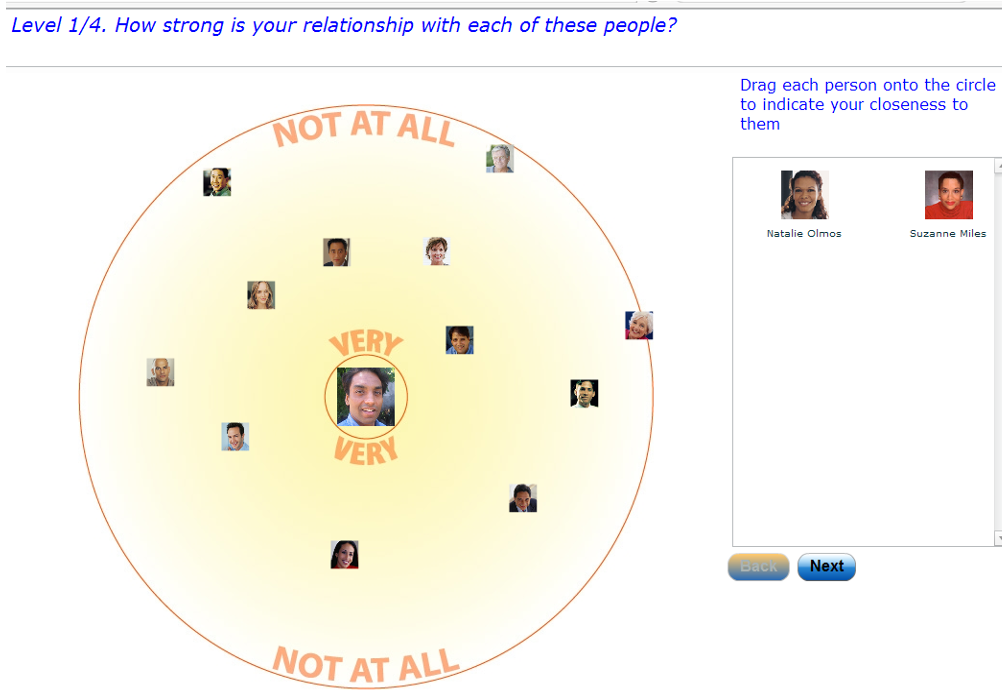
The team then extracted 53 variables from Beehive’s server logs, including photo comments, list creations, and profile views, and distilled them using Principle Component Analysis (PCA).
Key Findings: What Your Clicks Say About You
The study revealed a fascinating split in behavioral predictors:
1. The "Personal" Signal
If you are frequently viewing a colleague's profile or engaging in mutual profile commenting, the model identifies this as a signature of personal closeness. Interestingly, these actions do not strongly predict professional closeness. On Beehive, the profile page acts as a "back stage" for social banter rather than task coordination.
2. The "Professional" Signal
Unsurprisingly, being in the same division or having a direct management relationship were the strongest pillars of professional closeness. These are dictated by the company’s formal structure rather than elective social behavior.
3. The Bridge: Content Recommendations
One of the strongest predictors for both types of closeness was Content Recommendation. Sending a photo or a list to a colleague implies a high-order understanding of their interests—whether those interests are a technical project or a shared hobby.
Scientific Insights & Performance
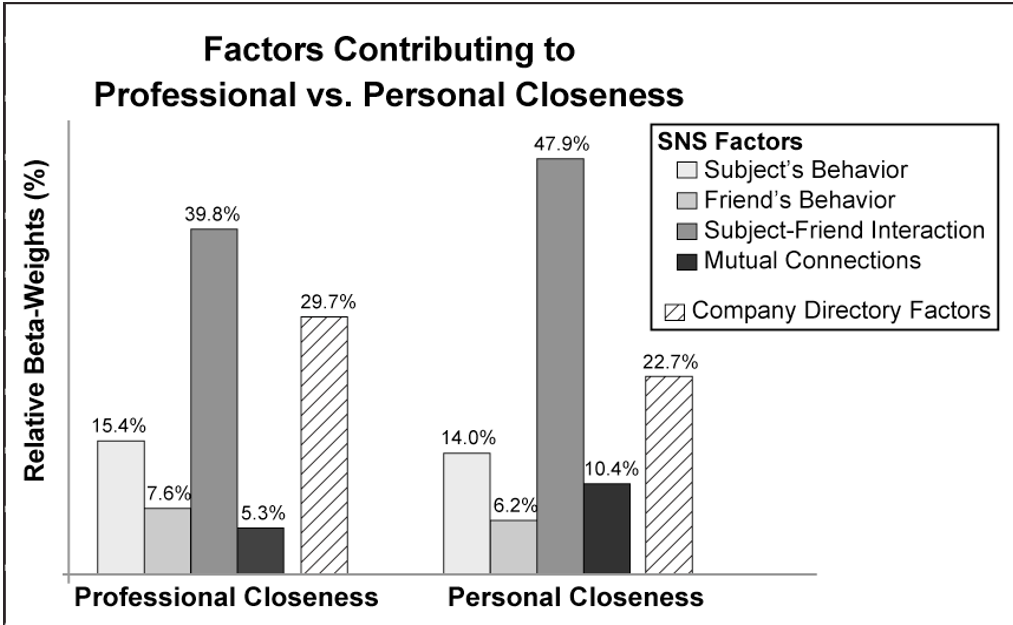
The regression model performed best for "Active Pairs"—colleagues who both interact on the site. For this group, the model achieved a Maximum Absolute Error (MAE) of 0.18 for professional closeness, meaning it could predict relationship strength with high precision.
| Predictor Class | Professional Closeness Impact | Personal Closeness Impact |
|---|---|---|
| SNS Interaction | ~40% | ~50% (Dominant) |
| Org Directory | ~30% | ~23% |
| Mutual Connections | 5.3% | 10.4% |
Critical Analysis: Why This Matters
The value of this research lies in its ability to make the "invisible work" visible. Companies can use these insights for strategic team formation. For example, while friends (personal ties) are great for morale, research suggests they may avoid necessary conflict during projects. Conversely, knowing "weak professional ties" can help identify who is best positioned to spread information across siloed divisions.
Limitations: The study is confined to a single SNS (Beehive) and doesn't account for private emails or IMs. In a modern "Media Multiplexity" environment, the lack of private messaging data likely underestimates the true depth of these ties.
Conclusion
This work proves that professional and personal ties are not just different in "feeling"—they are different in "data." By distinguishing between the two, we can build better tools that respect the boundaries of our professional personas while fostering the personal connections that make work meaningful.
Keywords: Workplace Relationships, Social Media, Multiplexity, Tie Strength, Enterprise SNS, Human Factors.