
Crowd Vigilante: Turning the Crowd Into Forensics Experts to Stop Sabotage
Detecting Sabotage in Crowdsourcing
This paper proposes "Crowd Vigilante," a conceptual framework designed to detect malicious sabotage in crowdsourcing projects. It leverages a "crowdsourcing for forensics" approach, scaling digital forensic techniques to identify unknown saboteurs by utilizing the collective intelligence and data of the crowd itself.
TL;DR
Crowdsourcing is a powerful tool for global collaboration, but it is plagued by "saboteurs"—malicious actors who join projects to intentionally corrupt data. This paper proposes a Crowd Vigilante framework: a vision to scale digital forensics by using the crowd itself to identify, track, and provide evidence against these unknown attackers.
Background: The Trust Deficit in Crowdsourcing
Crowdsourcing relies on the "wisdom of the crowd." However, the same features that make it successful—anonymity, ease of access, and geographical distribution—make it a prime target for sabotage. Whether it’s a competitor hiring hackers to ruin a product launch or politically motivated actors spreading misinformation, the threat is real.
The authors point to a critical gap: Traditional Digital Forensics are designed for scenarios where the "who" is often known or the data is structured. In a crowd of thousands, how do you find one "poisonous" worker before they destroy the motivation of the entire community?
The "Crowd Vigilante" Conceptual Model
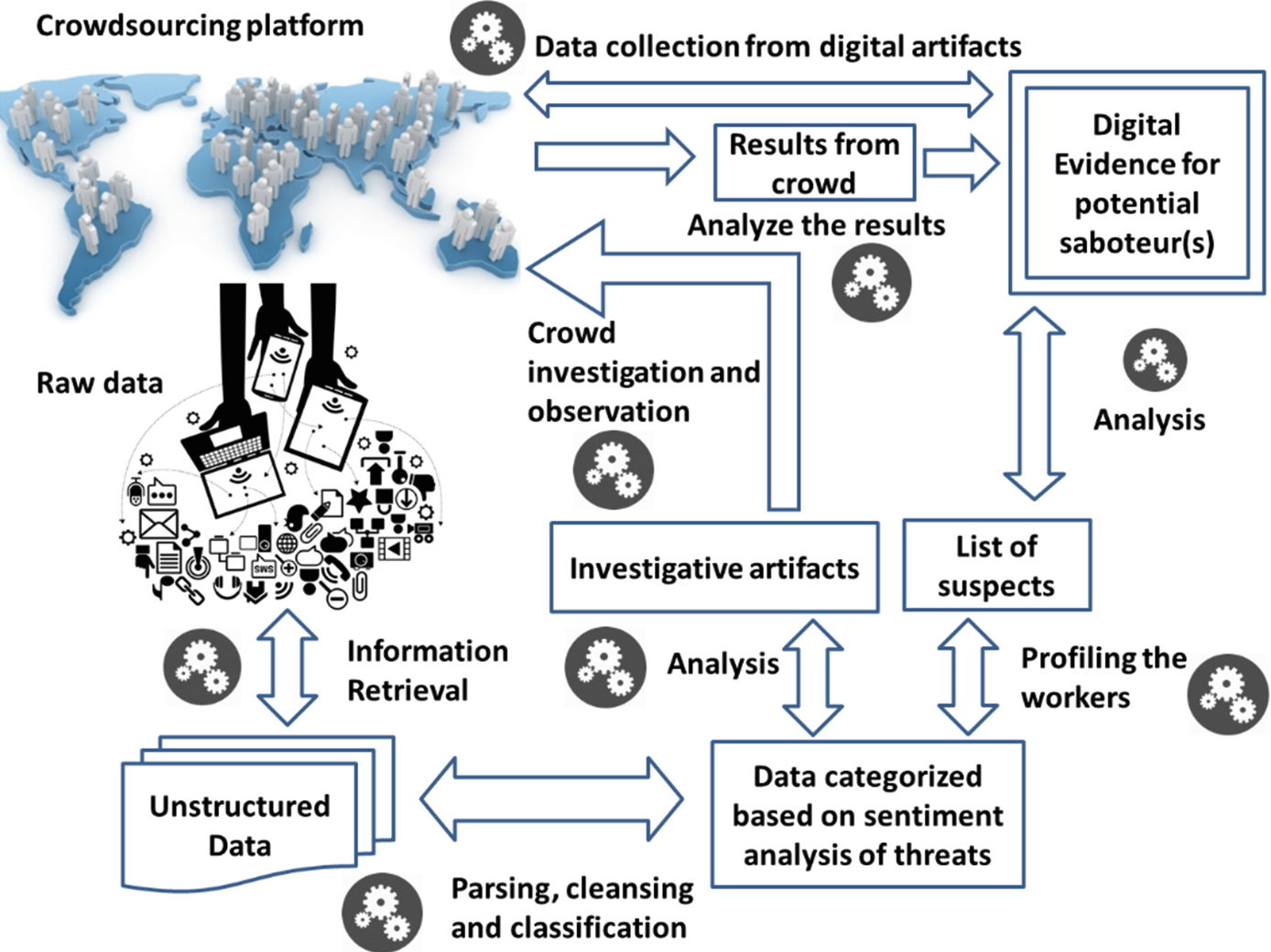
The core philosophy of this work is "built from the crowd and by the crowd." Instead of relying solely on external security audits, the system turns every interaction into a forensic trace.
1. The Trigger Mechanism
The framework identifies "unanticipated delays" as a key indicator. If a project has sufficient resources but is stalling, it likely indicates a sabotage attempt that is nullifying the work of legitimate contributors.
2. Dual-Stream Data Analysis
The model processes two specific types of data to find "suspects":
- Textual Data: Reviews, forum chats, and reports are analyzed using text mining and sentiment analysis to identify linguistic expressions of threat or toxicity.
- Log Data: Mouse clicks, duration timers, and navigation patterns are analyzed via usage mining to find behavioral anomalies that differ from constructive workers.
Requirements Engineering (RE) as a Forensic Tool
The paper introduces a novel intersection between Requirements Engineering and security. The authors argue that finding a saboteur is essentially "eliciting requirements" from the crowd to define what a "malicious actor" looks like in that specific context.
By applying techniques like StakeNet or StakeSource, project managers can identify which workers are considered "untrustworthy" by their peers, effectively crowd-sourcing the "vigilante" work.
Critical Analysis & Open Questions
While the conceptual framework is robust, it raises significant ethical and technical challenges that the authors leave open for future research:
- The Ethics of Observation: How do we monitor a crowd for "sabotage" without creating a surveillance state that kills the motivation of volunteer workers?
- Accuracy: How do we distinguish between a "bad worker" (low skill) and a "saboteur" (malicious intent)?
- Prototyping: The next step for this research is to apply this model to historical case studies, such as the DARPA Shredder Challenge, where a known saboteur successfully hindered a high-stakes crowdsourced task.
Conclusion
The Crowd Vigilante framework is a proactive shift in how we view crowdsourced security. By scaling digital forensics through the very community it protects, the framework offers a path toward a more resilient and trustworthy digital collaboration ecosystem. The future of crowdsourcing might not just be about doing work—it might be about the crowd protecting the work it creates.