
AutoClique: Solving the "Nobody Wants to Make Lists" Problem in Social Privacy
Detecting social cliques for automated privacy control in online social networks
The paper introduces a novel approach for automated privacy control in Online Social Networks (OSNs) by detecting social cliques. It proposes an algorithm that expands a small set of "seed" participants into a full exposure set (friend list) using two new clique expansion schemes, BAND and IN, achieving up to 90% recall in identifying relevant social circles.
TL;DR
Managing who sees what on social media is a chore. This paper presents an automated system that identifies "social cliques" (like your high school friends or local hobby club) starting from just a few tagged people in a photo. Using social graph geometry—specifically common friend counts—the authors developed an algorithm that predicts who should belong to a private "exposure set" with 90% accuracy, potentially ending the era of tedious manual friend-list management.
The "Zuckerberg Paradox" of Privacy
In 2010, Mark Zuckerberg famously noted that while friend lists are the "ideal solution" for sharing, they failed because "nobody wants to make lists." This creates a massive privacy gap: users either overshare with everyone or avoid sharing sensitive content altogether because the friction of manual configuration is too high.
Existing solutions often rely on profile metadata (like "Works at Google"), but many users leave these fields blank. The authors’ core insight is that the structure of the friendship graph itself—who you know and how many friends they have in common—contains all the signal needed to map out these hidden social boundaries.
Methodology: Growing Cliques from Seeds
The proposed algorithm, DetectClique, works on a "local" social graph (the host user and their immediate friends' connections). It starts with a Seed Set (P)—for example, two friends tagged in a family photo—and iteratively adds new candidates from the host's friend list.
The critical innovation lies in the Expansion Schemes:
- K-Band: A relaxation of the mathematical "clique." It requires every member of the group to share at least common friends with every other member. This mirrors how real-world social circles (like a sports team) operate.
- IN Scheme: A dynamic approach that measures "tightness." If the seed group is very exclusive, the algorithm stays strict; if the group is broad, it allows for a looser expansion.
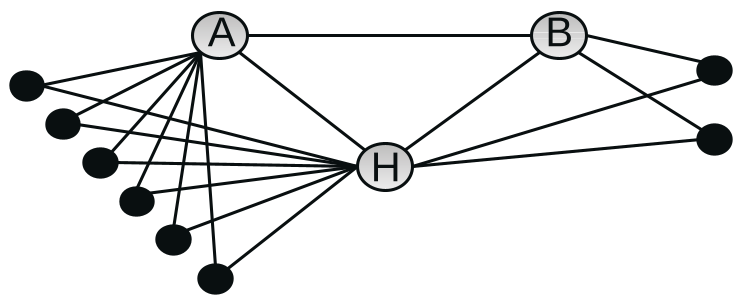 Caption: The algorithm leverages common friends (black nodes) to estimate the strength of the relationship between users (grey nodes).
Experimental Results: Beating the Baselines
The authors built a Facebook app, "AutoClique," and tested it using real-world photo tags as "ground truth." If people appear in the same photo, they likely belong to the same clique.
The project compared their schemes (BAND, IN) against traditional community detection algorithms like CLA (Clauset's greedy algorithm) and CZG.
Key Findings:
- Superior Recall: The BAND2 and IN0.3 schemes achieved ~90% recall. This means if 10 people should have been in the list, the algorithm found 9 of them.
- Precision vs. Coverage: The "Coverage" was around 30%, which is ideal for an average user with 130+ friends; it restricts sharing to a relevant subgroup rather than the whole network.
- Seed Independence: Unlike other algorithms, AutoClique's performance didn't degrade even when provided with only a very small seed (1-2 people).
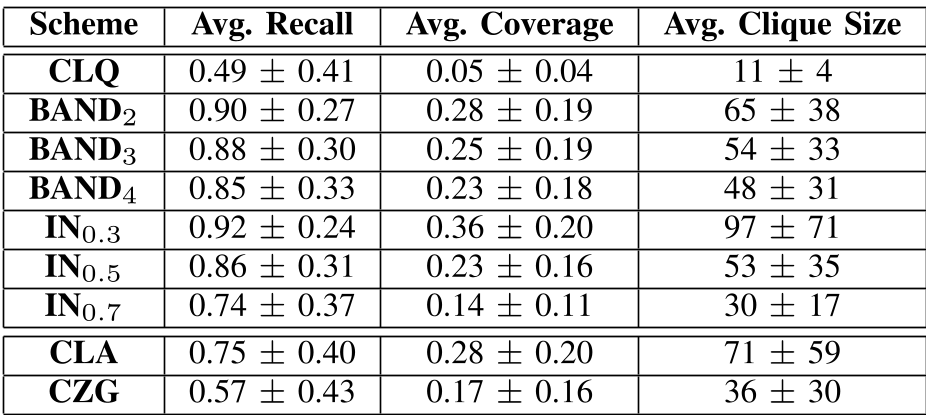 Caption: Comparing different expansion schemes. BAND and IN schemes show a clear advantage in recall over CLA and CZG.
Critical Insight & Future Outlook
The brilliance of this work is its mechanical simplicity. By ignoring complex content analysis and focusing purely on the "Common Friends" heuristic, the authors created a tool that is computationally cheap and metadata-independent.
Limitations: The "Ground Truth" assumption (that everyone in a photo belongs to the same clique) is occasionally flawed (e.g., a photo of a user with two unrelated friends). However, as the authors argue, even an "approximate" list is a massive win for privacy—it's much easier to delete one wrong person from an auto-generated list than to add 50 correct ones from scratch.
Conclusion: This research provides a blueprint for "Privacy Wizards." In an era where social networks are increasingly scrutinized for privacy, integrating structural clique detection could be the key to making granular privacy controls actually usable for the average human being.