
Beyond Proximity: Multi-Modal Sensing for Precision Social Interaction Detection
Detecting Social Interactions in Working Environments Through Sensing Technologies
2016-01-01
Summary
Problem
Method
Results
Takeaways
Abstract
The paper proposes a multi-modal sensing approach to detect social ties and interaction intensities among colleagues in office environments. By integrating Proximity, Speech, Activity, and Location markers, the authors develop a weighted function to distinguish meaningful face-to-face interactions from mere accidental co-location.
## TL;DR
While most Mobile Social Networks (MSN) assume that "being near someone" equals "knowing someone," this paper proves that true social ties require a richer set of behavioral signals. By fusing **Bluetooth, Audio, Accelerometer, and WiFi data**, the authors create a mathematical model ($\gamma$ function) that filters out the noise of accidental proximity to focus on active engagements like walking-and-talking or shared meetings.
## The Fallacy of Co-location
In the world of Computational Social Science, researchers have long relied on "Co-location" as a proxy for social ties. If two smartphones see each other via Bluetooth, they are presumed to belong to the same community. However, this is a weak inductive bias. Two strangers sitting back-to-back in a cafeteria are "co-located," but they are not "interacting."
The authors argue that to truly map a social network, we must look for **sociological markers** that imply intent:
* Are they both moving/sitting at the same time? (Activity Symmetry)
* Is there a conversation happening? (Speech Activity)
* Are they visiting a unique, non-routine location together? (Location Similarity)
## Methodology: The $\gamma$ Function
The researchers define the weight of a social tie ($w$) as a function of four distinct sensors. The logical flow is hierarchical: proximity is the *prerequisite*, while speech and activity act as *amplifiers*.
### The Core Markers
1. **Proximity ($f_P$)**: The "Intimate Zone" (0-10m) detected via Bluetooth scans.
2. **Speech ($f_S$)**: A Boolean indicator derived from Gaussian Mixed Models (GMM) processing 5-second audio clips.
3. **Activity Symmetry ($f_A$)**: Detects if the dyad is "Moving" or "Still" in unison via Google Activity Recognition APIs.
4. **Location Similarity ($f_L$)**: Uses the **Adamic-Adar score** on WiFi BSSIDs. This is clever because it penalizes "popular" locations (like the main entrance) and rewards shared presence in "rare" locations (like a specific meeting room).
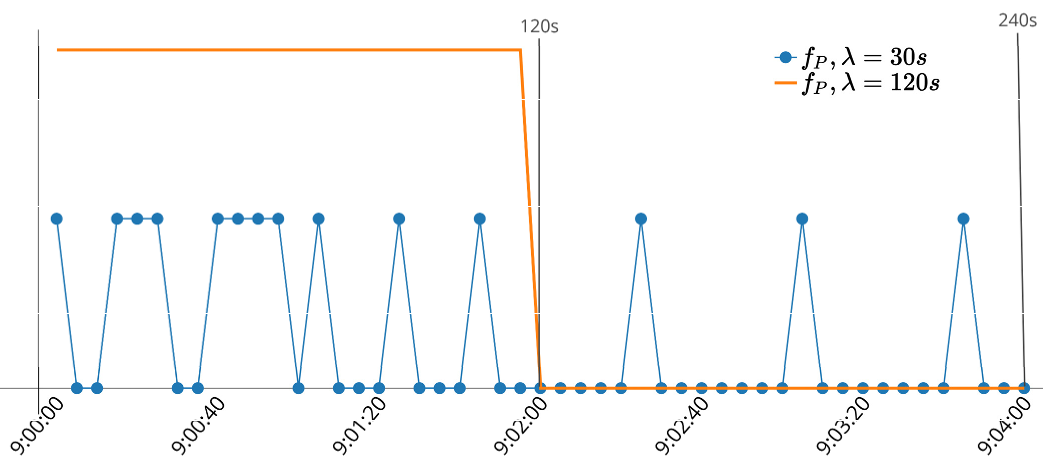
*Fig 1: The data aggregation process, showing how raw sensor samples are normalized into 120-second observation windows.*
The final interaction weight is calculated as:
$$\gamma = f_P \cdot [ f_S \cdot (f_A + \log(f_L)) ]$$
*Crucially, if $f_P$ or $f_S$ is zero, the interaction weight drops to zero, effectively filtering out silent co-location.*
## Experiments: Pisa and Seville
The team deployed the "SmartRelationship" app to 16 volunteers in Italy and Spain. They tracked interaction "Ground Truth" using manual diaries with one-hour granularity to validate the sensor data.
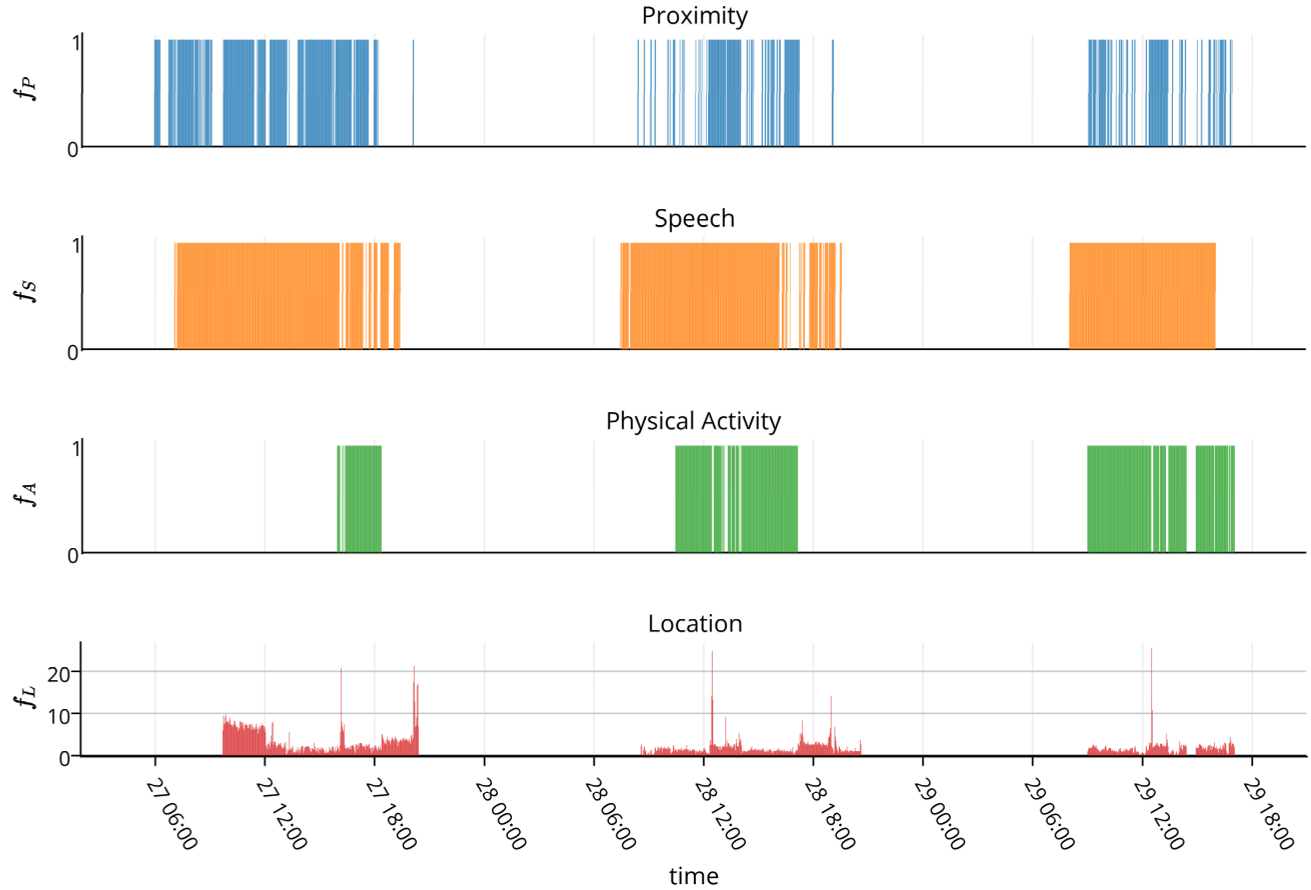
*Fig 2: A 3-day snapshot of sensor markers. Notice how the activity and location spikes often coincide with manual annotations of social interaction.*
### Key Findings:
* **Contextual Amplification**: The $\gamma$ value peaked during lunch meetings where users were in a "new" location (high $f_L$) and actively speaking (high $f_S$).
* **Noise Reduction**: The system successfully ignored periods where participants were in the same office (proximity) but focused on their own work (no speech activity symmetry).
* **Hardware Constraints**: The researchers had to downsample from 30s to 120s intervals because non-flagship smartphones struggled with the continuous sensing load—a reminder of the "Sensing vs. Battery" trade-off.
## Critical Analysis & Takeaways
This work is a strong step toward **Semantic Social Sensing**. By moving away from purely geometric definitions of social ties (distance) toward behavioral ones (speech/activity), it provides a framework for more intelligent MSN protocols.
**Limitations**:
* **Speech Privacy**: While the authors used VAD without recording content, the "Five-second clip" approach remains a privacy concern for many users.
* **Scale**: The study only analyzed 16 participants. Social ties in high-density environments (like a 500-person conference) would require more robust collision handling for Bluetooth and WiFi signals.
**Future Outlook**:
The next frontier for this research is likely **Edge-AI**, where the GMM for voice detection is replaced by on-device neural networks that can distinguish a user's voice from background noise, further refining the $f_S$ marker.