
Beyond Object Recognition: Detecting Social Signals for Friend Recommendation
Detecting Social Signals in User-Shared Images for Connection Discovery Using Deep Learning
This paper introduces a CNN-based analytic framework for connection discovery (follower/followee recommendation) by detecting "social signals" in user-shared images. By utilizing a triplet-based Siamese network optimized with user relationship data rather than standard object labels, the method achieves up to an 89% improvement over conventional object recognition-based approaches.
TL;DR
Researchers have developed a new way to recommend friends on social media by looking at the "social signals" in your photos. Unlike standard AI that just identifies what is in a photo (e.g., "a cat"), this deep learning framework learns who you might be connected to by analyzing visual styles and abstract patterns. The results? An 89% boost in recommendation accuracy over standard object-recognition methods.
The Missing Link: Why Generic AI Fails Social Media
When you follow someone on Flickr or Instagram, it’s not always because you both post pictures of "coffee." It might be a shared aesthetic, a specific photographic lighting, or a niche interest that standard AI doesn't have a label for.
Traditional Convolutional Neural Networks (CNNs) are trained to recognize objects. If User A posts a picture of the Statue of Liberty and User B posts the Empire State Building, a standard AI might link them because both contain "buildings." But if User A and User C are actually friends who share a specific "moody, blue-tinted architectural style," a standard CNN will miss that connection entirely. This gap between semantic content and social intent is what the authors call the "Social Signal" problem.
Methodology: Engineering the Social Intuition
The core innovation is moving away from fixed labels (like "dog" or "car") and moving toward Machine-Generated Labels optimized by social relationships.
1. The Triplet Architecture
The researchers utilized a Siamese Triplet Network. Instead of feeding the AI one image at a time, they fed it three:
- Anchor (x): An image from a specific user.
- Positive (x+): An image from that user's actual follower/friend.
- Negative (x-): An image from a random, unrelated user.
The "training" goal was simple: force the AI to make the distance between the Anchor and the Positive image as small as possible in mathematical space, while pushing the Negative image far away.
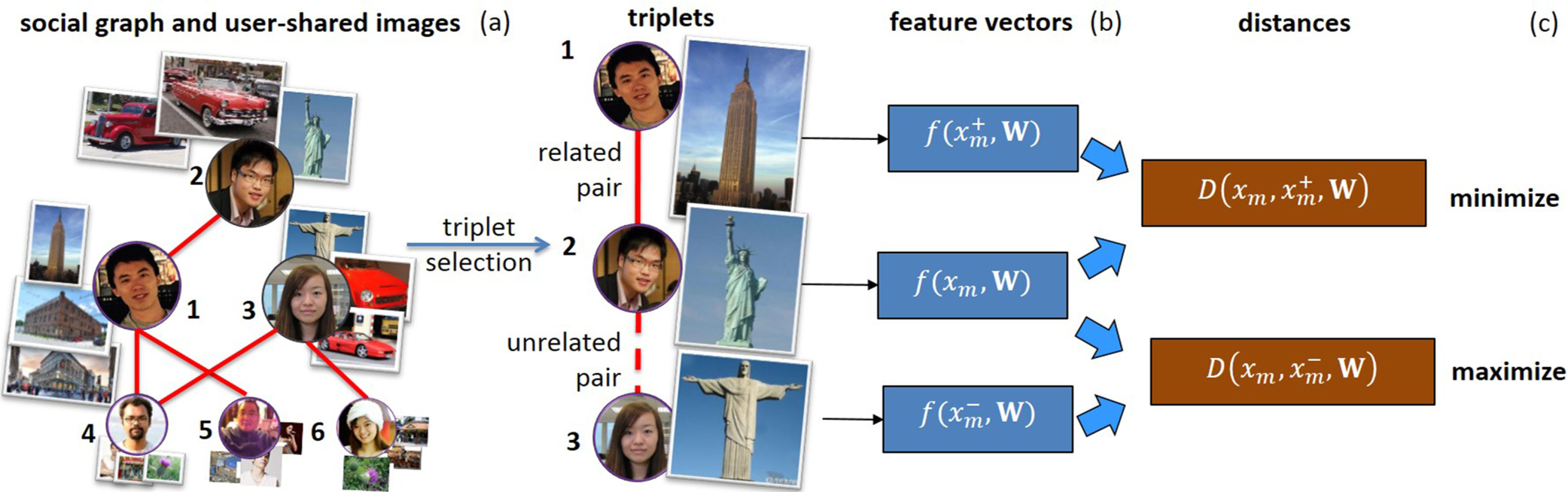 Caption: The Siamese Triplet Network architecture used to align visual features with social connections.
2. From Pixels to Profiles
Once the CNN (ResNet-based) was optimized, every image was converted into a high-dimensional vector. These vectors were clustered using K-means to create a "social vocabulary." A user’s profile is essentially a histogram of how often they "speak" in these visual social signals.
Proof in the Numbers: Skyrock and Flickr
The framework was put to the test against a massive dataset of 1.7 million images.
| Method | Skyrock (Precision AUC) | Flickr (Precision AUC) |
|---|---|---|
| Proposed Framework | High Performance | High Performance |
| Object Recognition (CNNTag) | ~50% lower | 89% lower |
| Hand-crafted (SIFT) | 230% lower | 134% lower |
The study found that images shared by related users had a significantly shorter distance after encoding than those from unrelated users, even if the objects in the photos were completely different.
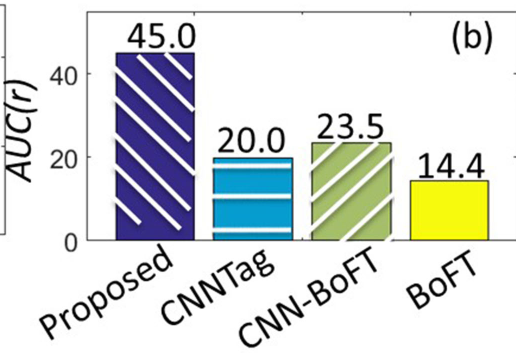 Caption: Performance metrics showing the significant leap in Precision and Recall compared to baselines.
Deep Insight: What are the AI's "Social Signals"?
In a fascinating qualitative analysis (Fig. 15 in the paper), the authors show that when a query image of a man is used, the "Object Recognition" AI looks for other men. However, the "Social Signal" AI might return images of women or landscapes—images that look nothing alike to a human but belong to the same social "cluster" because of how friends interact with them.
This suggests that the AI is picking up on latent visual preferences—the "unspoken" language of a social circle.
Conclusion & Future Look
This paper represents a shift from "AI that sees" to "AI that understands social context."
- Takeaway: If you want to build a better recommendation engine, don't just classify the content—classify the connection.
- Limitations: The system's performance varies across networks (Skyrock's "lifestyle" photos vs. Flickr's "interest" photos), indicating that social signals are platform-dependent.
- Future: Future work could involve "Hard Negative Mining"—finding those tricky images that look similar but belong to strangers—to further sharpen the AI's social intuition.
Generating recommendations based on who we are visually, rather than just what we tag, is the next frontier for privacy-preserving, content-driven social networking.