
Deciphering Social Signals: How Deep Learning Uncovers Hidden Connections in Shared Images
Detecting Social Signals in User-Shared Images for Connection Discovery Using Deep Learning
This paper introduces a CNN-based analytic framework for connection discovery in social networks using user-shared images. By utilizing a triplet siamese network to detect "social signals" rather than just physical objects, it achieves up to an 89% improvement in follower/followee recommendation accuracy over conventional object recognition methods.
TL;DR
Conventional AI "sees" objects (cars, cats, trees), but humans "share" connections. This paper introduces a framework that optimizes CNNs to detect social signals—latent visual patterns that indicate a relationship between two users. By moving beyond simple object recognition, the researchers improved friend recommendation performance by nearly 90% using only raw image data.
Problem: The Limits of Object Recognition
When we look at social media, we often assume that friends share photos of the same things. While true to an extent, relationship dynamics are far subtler. Two professional photographers might be connected by their use of specific lighting or framing (social signals), even if one shoots cities and the other shoots forests (different objects).
Standard Convolutional Neural Networks (CNNs) are trained on datasets like ImageNet to identify categories. If User A shares a photo of a "Bridge" and User B shares a photo of a "Statue," a typical CNN sees no connection. This "content gap" makes conventional image-based recommendation systems unreliable. Furthermore, social graphs (the data of who follows whom) are often private, leaving researchers with nothing but the images themselves to bridge the gap.
Methodology: Mining "Social Signals"
The authors' core insight is that a CNN's weights can be fine-tuned to prioritize social proximity over semantic similarity.
1. The Triplet Architecture
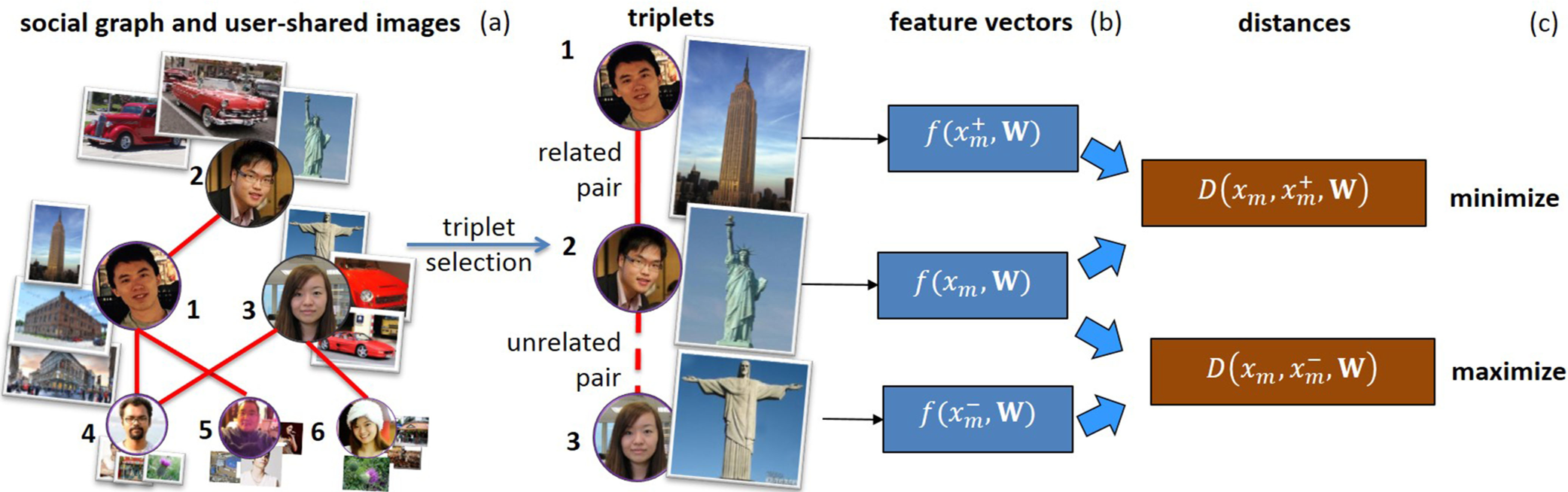
Instead of training the model to label an image, they use a Siamese Triplet Network. The model looks at three images simultaneously:
- Anchor (): An image shared by User A.
- Positive (): An image shared by a friend/follower of User A.
- Negative (): An image shared by a random, unconnected user.
2. Contrastive Loss Function
The goal is to solve an optimization problem where the distance () between the Anchor and the Positive is minimized, while the distance between the Anchor and the Negative is maximized. This forces the network to ignore the "object" if it doesn't help identify the social connection, focusing instead on the "style" or "signal" that links friends together.
Experiments: Skyrock and Flickr
The framework was tested on a massive scale: 1.7 million images from over 2,000 users across two diverse platforms.
Key Results
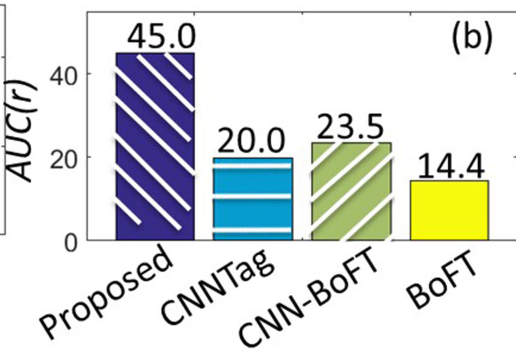
- Massive Accuracy Gains: The proposed method outperformed "CNNTag" (object-based) by 89% on Flickr and 93.7% on Skyrock.
- Beyond Human Intuition: Interestingly, the signals detected by the model were often "ununderstandable by humans." While we might look for common hobbies, the AI found mathematical similarities in feature vectors that predicted friendship with high precision.
Visual Evidence
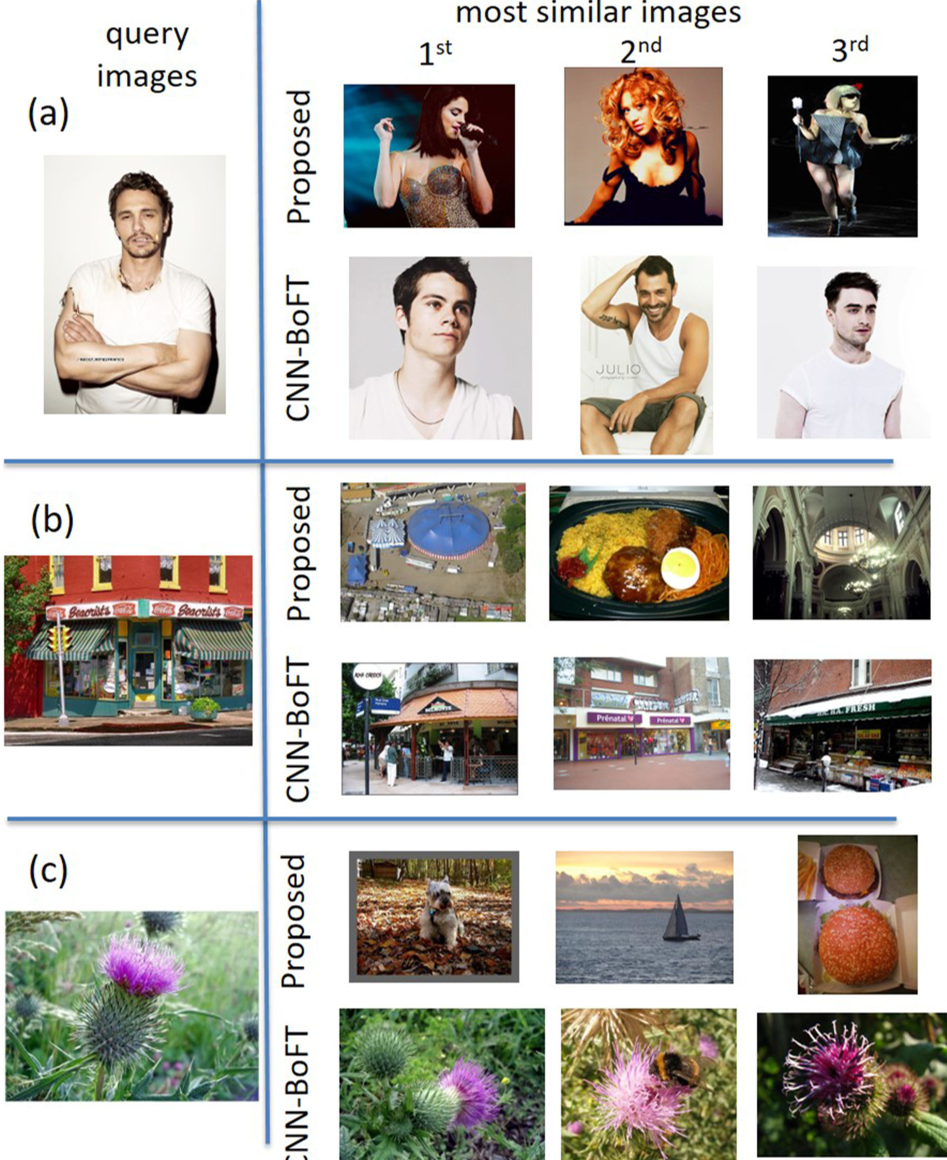
In the comparison below, notice how CNN-BoFT (object-based) retrieves images of the same "thing." In contrast, the Proposed Analytic Framework retrieves images that might have different subjects but share the latent "social signal" characteristic of the user's connection circle.
Deep Insights & Summary
This paper effectively demonstrates that context is king. In a social media environment, a photo is not just a collection of pixels—it is an invitation to interact.
Key Takeaways:
- Social Signals > Object Labels: For recommendation tasks, how an image is taken (style, choice of subject, aesthetic) is often more informative than what is in the image.
- Privacy-Preserving Potential: This method can discover connections without needing access to a user's private contact list or social graph, solely through public shared content.
- Transferability Challenges: The researchers found that "social signals" are platform-specific. A model trained on Skyrock (daily life photos) didn't perform as well on Flickr (high-interest photography), indicating that social signals are deeply tied to the community culture of the platform.
Future Outlook
As we move toward more visual-centric social apps, the ability to understand "Social Signals" will be the differentiator between recommendations that feel "robotic" and those that feel "intuitive."